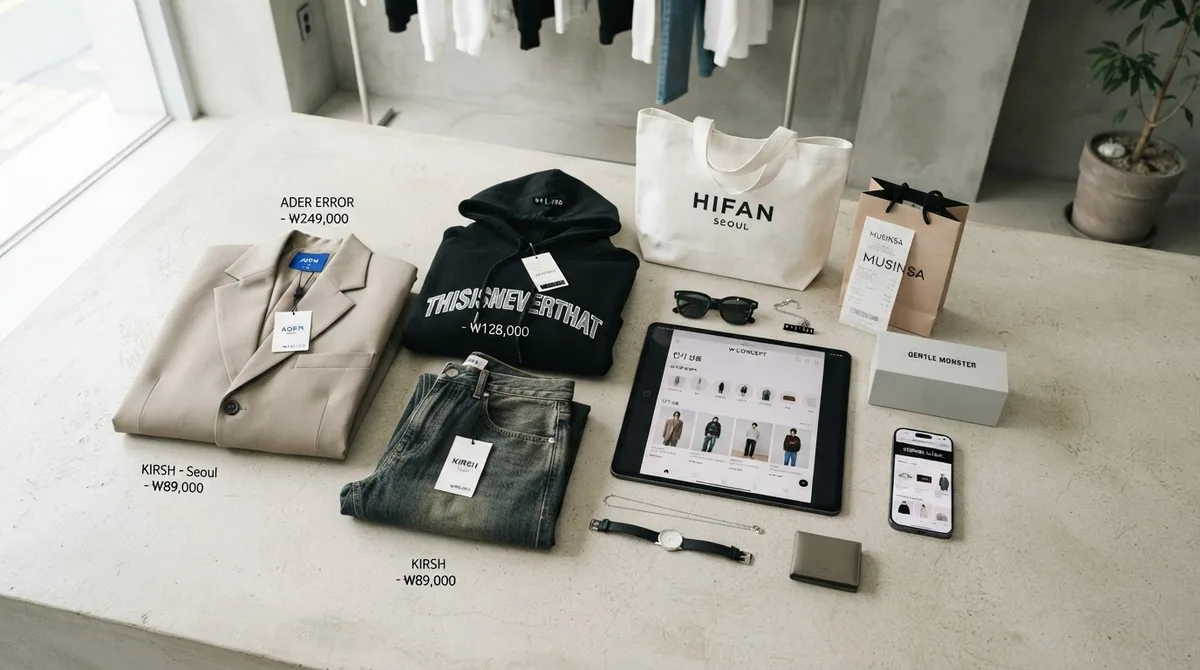
Musinsa started in 2001 as a message board where Korean teenagers traded photographs of imported sneakers. By 2026 it is preparing an IPO with Citi and JP Morgan as global coordinators, targeting a valuation above 10 trillion won. The Global Store has grown at an annual average rate of 260 percent since its launch. Japan is the breakout international market, with transaction volume up 145 percent year-on-year. A Musinsa pop-up in Tokyo in April 2026 pulled 82,000 visitors through the door in 24 days and lifted participating brand sales 3.5 times. This is the context for understanding what Korean fashion brands are in 2026: not a niche import category but a maturing global industry that happens to still be underpriced relative to its quality and influence.
The practical question for anyone outside Korea is which brands are worth the attention and how to actually buy them. The international infrastructure has improved significantly but it is not uniform. This guide covers the eight brands that justify the effort, the three-tier ecosystem they sit within, and the most reliable purchasing routes for each.
Three tiers: how to think about the ecosystem
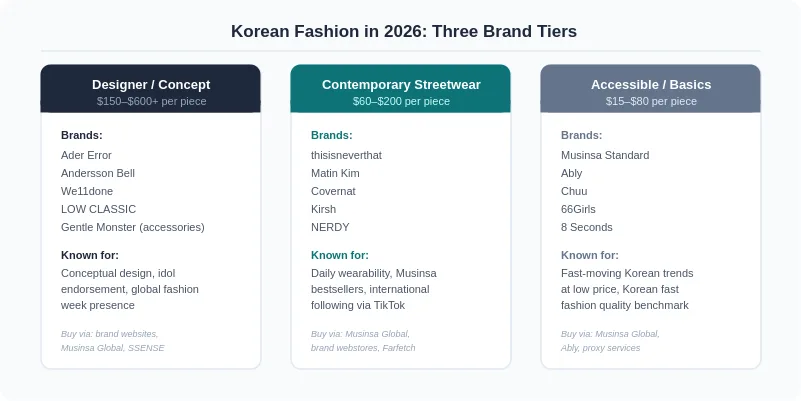
The Korean fashion market organises itself into three roughly distinct tiers, each with different purchasing logistics and different relationships to the idol and street style trends that drive international interest.
The designer and concept tier runs from around $150 to $600 and above per piece. This is where Ader Error, Andersson Bell, We11done, and LOW CLASSIC operate — the brands on Milan Fashion Week schedules, at Seoul Fashion Week opening shows, and on K-pop idols at airport departures and luxury brand events. Available through brand webstores, Musinsa Global, and global multi-brand retailers like SSENSE and Farfetch.
The contemporary streetwear tier runs from around $60 to $200 per piece. thisisneverthat, Matin Kim, Covernat, Kirsh, and the hundreds of labels in Musinsa's editorial stable define what Seoul street style actually looks like on a Tuesday afternoon rather than at a fashion week show. Some ship directly, most are available through Musinsa Global, and domestic-only labels require a proxy service.
The accessible basics tier runs under $80 per piece and is led by Musinsa Standard, the platform's in-house label. Wide-fit denim, oversized tees, fleece jackets, padded coats in neutral tones — the foundation layer that every Seoul-influenced wardrobe builds on before adding statement pieces from the tiers above. Ships globally.
Eight brands worth knowing
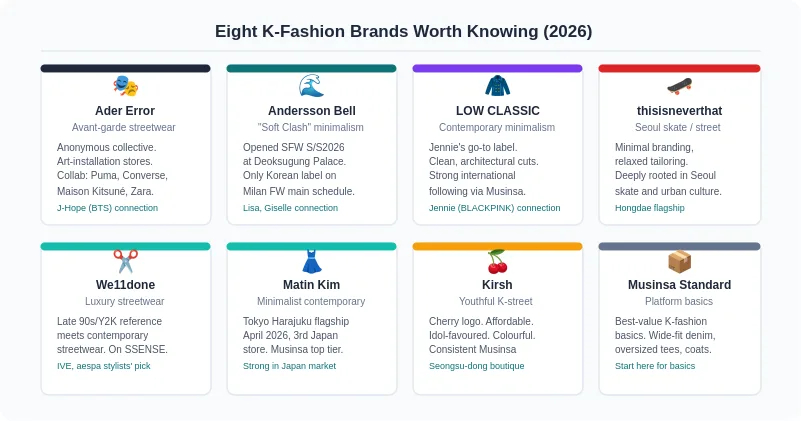
Ader Error is the Korean fashion brand that most confounds usual commercial logic. There is no named designer. No founder origin story. The brand was founded by a creative collective whose members remain anonymous, and every retail space they open functions more as an art installation than a conventional store. The clothes follow a similar logic: deconstructed basics, oversized proportions, and seasonal concepts that make their own visual argument rather than tracking trend currency. Collaborations with Puma, Converse, Maison Kitsuné, and Zara have brought the aesthetic to wider audiences without compromising the conceptual approach. BTS's J-Hope has become so consistently associated with the brand that industry analysis tracks Ader Error traffic spikes following his public appearances.
Andersson Bell has been making the case for Seoul as a global fashion capital in the most concrete terms available. The brand opened Seoul Fashion Week's 25th anniversary Spring/Summer 2026 edition along Deoksugung-gil — the first time an independent Korean label staged an opening show outside Dongdaemun Design Plaza. The collection, called "Soft Clash," drew inspiration from Mark Rothko's colour fields and the attitude of 1990s British musicians. Andersson Bell is also the only Korean label currently on the Milan Fashion Week main schedule. Lisa and Giselle's sightings in Andersson Bell consistently move the brand's international webstore into sellout territory within 24 to 48 hours.
LOW CLASSIC is the contemporary Korean brand most directly associated with Jennie of BLACKPINK, whose sightings in the label have driven consistent international traffic. The design language is disciplined: controlled silhouettes, high-quality fabrics, and a deliberate avoidance of anything that would date quickly. Available internationally through Musinsa Global and the brand's own webstore.
thisisneverthat is Seoul's authentic streetwear answer, rooted in the Hongdae district's skate and urban culture. Minimal branding, relaxed tailoring, oversized hoodies, caps, and graphic pieces that read as considered rather than loud. Among the brands in this guide, it has the most straightforward international purchasing process and the most accessible price points in the contemporary tier.
We11done was founded in 2015 by Dami Kwon and Jessica Jung and has built a global following through a specific aesthetic tension: late 1990s and early 2000s references applied to contemporary streetwear silhouettes in a way that reads nostalgic and modern simultaneously. Stocked on SSENSE — the most accessible entry point for international buyers unfamiliar with Korean platforms.
Matin Kim has been the clearest example of how Musinsa's editorial platform builds international brand demand before physical retail follows. Built almost entirely through Musinsa's content engine, the minimalist contemporary label developed a Japanese audience large enough that Matin Kim opened its Tokyo Harajuku flagship in April 2026 — its third Japanese location and first standalone store. Musinsa Global is the most reliable access point for international buyers outside Japan.
Kirsh is the accessible entry point to K-fashion's youthful, colourful register. The cherry logo, affordable price points, and playful seasonal graphics make it the brand that appears in everyday Seoul street photography rather than fashion week coverage. For visitors to Seoul, the Seongsu boutique is an easy stop. Internationally, it ships through Musinsa Global.
Musinsa Standard is the platform's own label and the most practical starting point for anyone building a Korean fashion wardrobe from scratch. The quality-to-price ratio is the strongest in the accessible tier, the proportions reflect the Korean fashion silhouette logic correctly, and it ships globally. Before spending on designer pieces, getting the basics right with Musinsa Standard means the expensive outerwear lands on a foundation that is already doing the right work.
Musinsa: what it is and how to navigate it
Musinsa is not simply a shopping site. It is the distribution infrastructure for Korean fashion's global expansion, the editorial platform that builds brand demand, and a physical retail operation that has opened stores in Seoul, Shanghai, and Tokyo simultaneously. When brands like ADLV, Covernat, and thisisneverthat entered Tokyo and Los Angeles with pre-built demand, that demand was created by Musinsa's editorial engine before the brands had any international retail presence.
Musinsa Global (global.musinsa.com) is the international storefront with English-language navigation and international payment support. It does not carry every brand or item available on the domestic Korean platform — some brands are Korea-only, some items do not have international shipping options — but it covers the most-searched international brands with reasonable reliability.
The sale tab on Musinsa Global is consistently underused by international buyers: past-season pieces from Korean designer brands appear here at significant discounts. Check it before making any full-price purchase.
The Musinsa Store Myeongdong, opened January 2026 across three basement floors covering 992 square metres, carries over 110 brands in a curated physical format aimed specifically at international visitors to Seoul. Combined with the Seongsu-dong location and individual brand flagships in Seongsu, it makes for a coherent shopping route that covers all three tiers in a single district walk.
Where to buy internationally
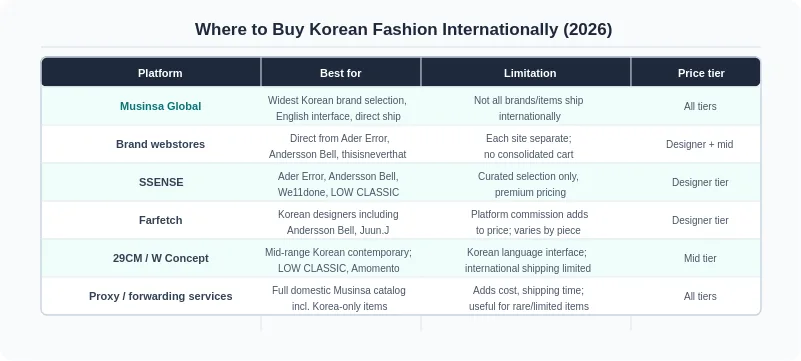
For the designer and concept tier, brand direct webstores are the most reliable first option. Ader Error, Andersson Bell, thisisneverthat, and Gentle Monster all operate international webstores with support for international payment methods. Musinsa Global carries many of these same brands with consolidated checkout. SSENSE is the international luxury retail interface most familiar to Western buyers, stocking We11done, Andersson Bell, LOW CLASSIC, and several other Korean designers at consistent pricing with reliable logistics.
For the contemporary streetwear tier, Musinsa Global covers the major labels reliably. The domestic Korean Musinsa platform carries a significantly wider selection but requires either a Korean account with a Korean phone number for verification or a proxy buying service. For one-off purchases of specific items not on the Global store, a proxy service is cost-effective.
Proxy services handle the domestic purchase and forward to international addresses. The additional cost runs between five to fifteen percent of the item price plus domestic shipping — worth calculating against the value of what you are buying.
Sizing, timing, and practical buying
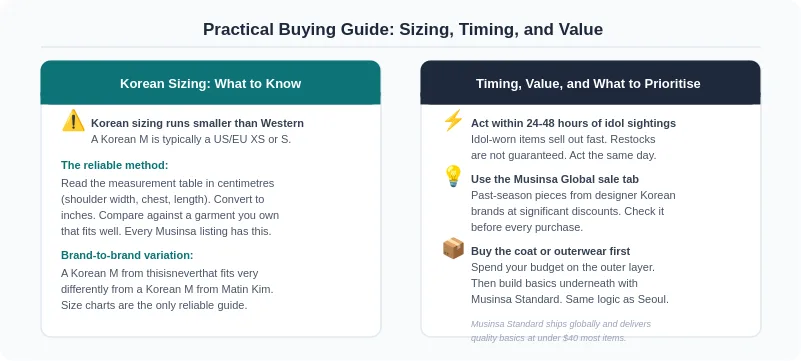
Korean sizing runs smaller than Western sizing in almost every brand. A Korean M is typically equivalent to a Western XS or S. The reliable approach is not to look at the size label but to read the measurement table on the product listing, provided in centimetres on every Musinsa listing. Shoulder width, chest measurement, and total length are the three figures that matter. Convert to inches, compare against a garment you own that fits correctly, and buy accordingly. Brand-to-brand variation is significant — a Korean M from thisisneverthat fits very differently from a Korean M from Matin Kim.
The timing of purchases matters for idol-adjacent pieces. When a major idol is photographed in a Korean brand, relevant items are typically sold out within 24 to 48 hours. If you see something you want, acting the same day is the only reliable approach.
The purchasing logic for building a Korean fashion wardrobe follows the Seoul street style sequence: spend the available budget on the outer layer first. Musinsa Standard handles the base layer efficiently. One designer coat over Musinsa Standard basics produces a more accurate Korean fashion result than a full designer outfit would at the same total spend.
- Start with Musinsa Global (global.musinsa.com) and check the sale tab before every purchase.
- Follow the idol stylists on Instagram, not just the idols themselves. Stylists often tag brands in advance of the airport photographs.
- Read measurement tables, not size labels. Korean M is Western XS/S in most brands.
- If visiting Seoul: Musinsa Store Myeongdong (opened January 2026) covers 110+ brands in one location. Combine with Seongsu-dong for the full picture.
- Act within 24-48 hours of any idol sighting involving a specific piece you want.
- The coat first. Everything else second.
For more on the Seongsu-dong and Hongdae districts where most of these brands have flagship stores, see the Seoul Street Style 2026 guide. For the idol airport fashion context, see the Idol Airport Fashion guide.
Related: Seoul Street Style 2026: Seongsu-dong and Hongdae | Idol Airport Fashion: How K-Pop Stars Travel | K-Pop Idol Makeup: Lingerie Skin, Gradient Lips, Glass Eyes