
K-pop idol makeup is not about drama. Stage lighting demands intensity, but the looks that have influenced global makeup culture are the off-stage, interview, and airport versions: a complexion so close to perfect skin it is hard to identify the product doing the work, eyes that look wider and more awake through placement rather than liner weight, and a lip colour that reads natural rather than applied. The aesthetic is built on techniques that are structurally different from Western makeup approaches, not just product swaps.
The three techniques that define the look — lingerie skin, glass eyes, and the gradient lip — are each learnable in one or two practice sessions. The difficulty is not the execution but understanding what you are trying to achieve with each one, because the goal runs counter to most Western makeup instincts.
What changes from Western makeup
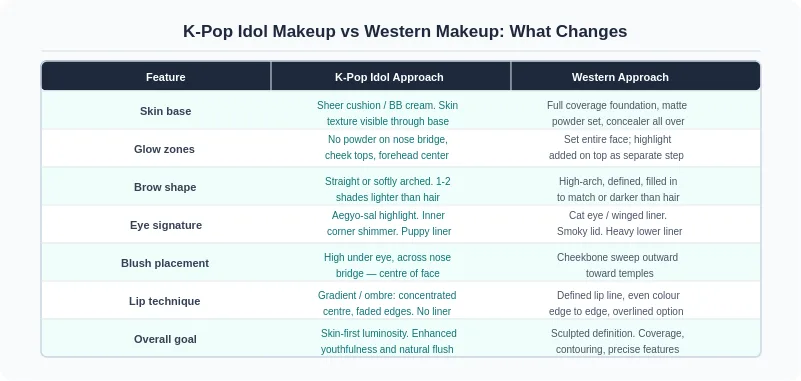
The structural differences between K-pop idol makeup and standard Western makeup run through every element of the face, and none of them are about product quality or brand names.
The base layer in K-pop idol makeup is a sheer cushion compact or BB cream pressed with fingers or a puff, not a full-coverage foundation buffed with a brush. The goal is the most even version of your actual skin, not a coverage layer that hides it. Skin texture is meant to be faintly visible. The T-zone and glow zones — specifically the nose bridge, the tops of the cheeks, and the centre of the forehead — are not set with powder. Keeping these areas underpowdered is what creates the water glow or glass skin effect. Setting powder goes only where oil control is genuinely needed.
The brow shape is straight or very softly arched rather than the high-arch Instagram brow. The colour is one to two shades lighter than natural hair, filled in with hair-like strokes using a thin-tip pencil rather than drawn on solidly. Lighter brows drop the contrast between brow and skin, which softens the overall face and contributes to the youthful register of the look.
Eye makeup avoids the outward wing of a cat eye and instead extends the liner almost straight out from the outer corner, producing the puppy eye or dropped eye effect. Aegyo-sal highlight and inner corner shimmer open the eye from the inside rather than the outside, creating a wider, more awake appearance without liner drama.
Blush moves inward and upward relative to Western placement. Where Western blush sweeps along the cheekbone and outward toward the temples, K-pop idol blush sits high under the eye, blended upward toward the cheekbone, and often crosses the nose bridge in a gentle wash. This centre-of-face colour placement produces the healthy flush rather than the sculpted cheekbone effect.
The gradient lip concentrates colour at the centre and diffuses it to near transparency at the edges. No lip liner. No defined edge. The graduated fade is applied with a fingertip after depositing a velvet tint or lip stain at the centre.
The nine-step sequence
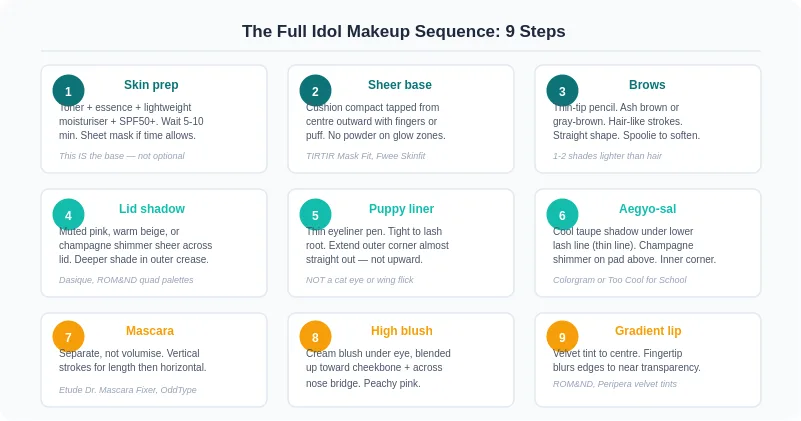
Step 1 — Skin prep. Toner, essence, lightweight moisturiser, and SPF50+ applied in layers, with a five to ten minute wait after the last moisturiser. If time allows, a sheet mask before makeup is the step most Korean makeup artists cite as their most consistent practice. The prep step is not optional — the sheer base cannot cover what is underneath.
Step 2 — Sheer base. Cushion compact applied with fingers or a damp puff in light tapping motions from the centre outward. Not all-over coverage — an even complexion with faint skin texture remaining visible. Skip the nose bridge and upper cheek tops (glow zones). A drop of face oil pressed over the base in those zones intensifies the glass skin effect.
Step 3 — Brows. Thin-tip pencil in ash brown or gray-brown. Hair-like strokes following natural growth direction. Straight or softly arched shape. Spoolie through after filling to soften. Should look full but not drawn on.
Step 4 — Lid shadow. Soft shimmer in muted pink, warm beige, or champagne, swept sheer across the entire lid. A slightly deeper shade into the outer crease, blended upward. Dimension without a smoky eye.
Step 5 — Puppy liner. Thin-tip eyeliner pen tight to the upper lash roots. Extend very slightly past the outer corner, moving almost straight out rather than flicking upward. The tail direction is what separates a puppy eye from a cat eye.
Step 6 — Aegyo-sal. Cool taupe shadow in a thin line below the lower lash fat pad. Champagne or pearl shimmer on the fat pad above it. The same shimmer at the inner corner. (See the full aegyo-sal section below.)
Step 7 — Mascara. Separate, not volumise. Vertical strokes first for length, then horizontal for definition. The lash look should read natural and individual, not volumised and heavy.
Step 8 — High blush. Cream blush under the eye, blended upward toward the cheekbone and lightly across the nose bridge. Peachy pink or soft coral. Warmth, not colour statement.
Step 9 — Gradient lip. Velvet tint to the centre of the lips only. Fingertip blurs the edges to near transparency. No liner. Clear gloss over the centre after the tint sets adds dimension.
Glass eyes: the aegyo-sal technique in full
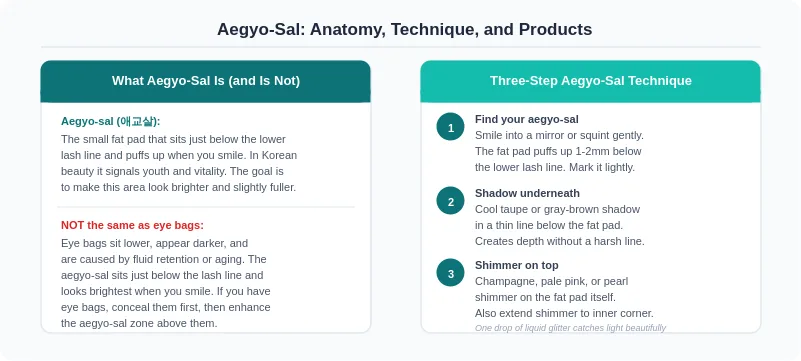
Aegyo-sal (pronounced ay-gyo-sal, meaning "charming fat") refers to the small fat pad that sits just below the lower lash line and becomes more visible when you smile. In Korean beauty, a visible aegyo-sal reads as youthful and approachable. The technique uses shadow and shimmer to enhance and brighten this area — the opposite of Western under-eye technique, which uses concealer to minimise it.
Aegyo-sal vs eye bags: The aegyo-sal fat pad sits 1 to 2 millimetres below the lower lash line and looks brightest when you smile or squint. Eye bags sit further below, appear darker, and are associated with fatigue. If you have eye bags, conceal them first, then work the aegyo-sal zone above them.
To find your aegyo-sal: smile into a mirror or squint gently. The fat pad puffs up just below the lower lash line. If you cannot see it, look downward and feel along the lower lash area to find the slight natural fullness.
The three elements:
- A cool-toned taupe or gray-brown shadow in a very thin line below the fat pad, creating the shadow that suggests the aegyo-sal is naturally raised above it.
- Champagne, pale pink, or pearl shimmer on the fat pad itself, to catch light and make it appear brighter and slightly fuller.
- The same shimmer colour at the inner corner of the eye, connecting the aegyo-sal highlight to the overall eye brightening.
Colorgram's All-In-One Aegyo-Sal Maker is the most recommended 2026 option: a dual-ended pencil with a shimmer crayon on one end and a cool-toned contour stick on the other. Too Cool for School's Frottage Eye Pencil provides similar functionality. A tiny dot of Peripera Sugar Twinkle Liquid Glitter at the centre of the fat pad adds the glass eye sparkle visible in high-definition fancam footage.
Lingerie skin: the base technique in detail
The lingerie skin finish requires three things: a sheer or light-coverage formula, application with fingers rather than brushes, and deliberate skipping of powder on the glow zones.
Korean cushion compact foundations are specifically engineered for this method. The cushion puff presses and taps product into the skin rather than buffing or blending, producing a finish that sits on skin rather than sinking into it. TIRTIR Mask Fit Cushion is one of the most recommended products in this category: sheer-to-medium coverage, a dewy satin finish, and a formula that photographs as skin in most lighting. Fwee's Skinfit Base sits slightly sheerer.
The water glow technique, which is the 2026 iteration, adds one step: a single drop of face oil or water-glow serum pressed over the cushion base in the glow zones before any powder is applied. Applied to the nose bridge, the upper cheekbones, and the centre of the forehead. One drop. More than that tips into greasiness.
Powder goes only in the T-zone where oil control is genuinely needed. Setting the entire face kills the dewy finish and produces the flat, covered-over result that sits opposite to the lingerie skin goal.
The gradient lip
The gradient lip concentrates colour at the centre and fades it to near transparency at the lip edges. The technique uses a fingertip rather than a brush, and the product choice matters: a velvet tint or lip stain formula that blends while still wet and sets into a soft, diffused finish.
ROM&ND's Juicy Lasting Tint and Peripera's Ink Airy Velvet are the two most-referenced products for this technique in Korean beauty communities in 2026. Both deposit concentrated, buildable pigment that blurs at the edges with a fingertip, and both settle into a finish that is neither fully matte nor fully glossy. Colour palette for 2026: glazed lavender (ILLIT), muted peachy beige, coral, soft red, sheer caramel brown.
Application: Blot the bare lip with a tissue first. Apply the tint to the centre of the lips only, avoiding the outer edges on the first pass. Use the ring or index finger to press and blur the colour outward, stopping before the lip edges. Target: saturated at the very centre, lighter toward the middle, barely detectable at the outer edges. A single coat of clear gloss over the centre after the tint sets adds glassy dimension.
The most common mistake is applying tint too close to the outer edge on the first pass. Start smaller than you think you need and build outward from there.
The 2026 look variations
The Jennie reference uses the most minimal base possible, inner corner shimmer in cool silver, and beige or nude at the gradient lip centre. The result reads understated and expensive. The only strong colour signal is typically accessories.
The Wonyoung reference moves the blush higher and more generously across the nose bridge, toward the office siren aesthetic. The lip colour is a soft muted pink or mauve. Mascara is more defined. The overall result reads fresh and deliberately put-together.
The ILLIT reference — the fifth-generation look of 2026 — uses glazed lavender at the gradient lip, slightly more shimmer across the full lid alongside the inner corner, and a softer cloud-like blush placement. The most distinctive variation, and the one with the most visible product presence while remaining within the natural enhancement framework.
Korean products: what to get
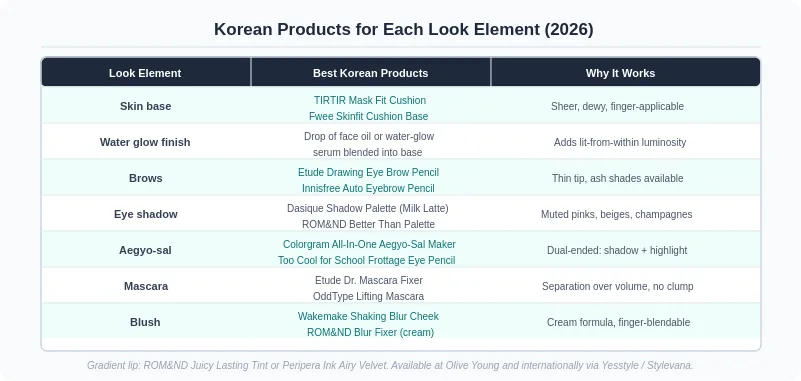
All products referenced are available at Olive Young in Seoul and internationally via Yesstyle, Stylevana, and global Musinsa. The total product cost for the full look runs between $80 and $150 USD, excluding skincare.
The single most impactful investment is a Korean cushion compact — the formula and application method are specifically designed for the lingerie skin finish that Western compact foundations typically do not produce. Everything else can be approached gradually.
For more on the skincare foundation that makes the lingerie skin base work, see the What Is Lingerie Makeup? article and the How K-Pop Idols Take Care of Their Skin guide.
Related: What Is Lingerie Makeup? The Korean Skin-First Trend of 2026 | How K-Pop Idols Actually Take Care of Their Skin | K-Beauty Treatments Going Viral in 2026