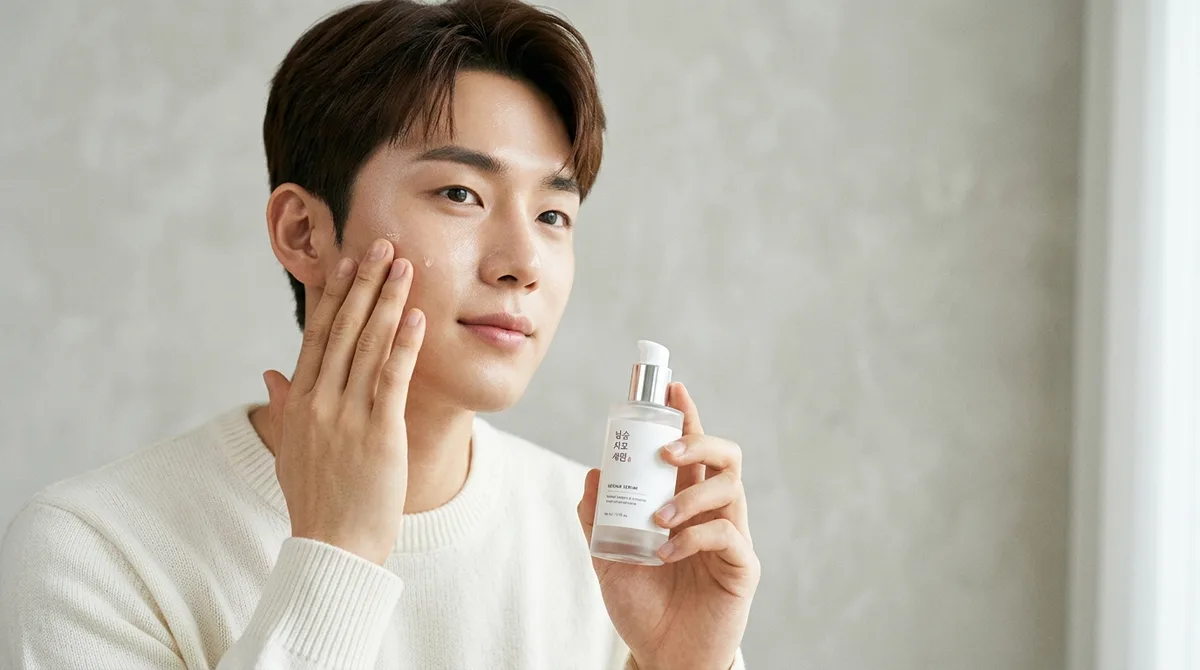
In most of the world, men's grooming still means a shave and a bar of soap. In Korea it means something closer to a discipline. Korean men are among the highest per-capita spenders on skincare on the planet, and the polished, well-kept look is the default on the streets of Gangnam and Hongdae rather than the exception. It is tied to a cultural idea called kwan-ri, self-management: clear skin and neat hair read as signs that a man has his life together, not as vanity.
That mindset has built the most advanced men's grooming culture in the world, and it shows no sign of slowing, the male grooming market in Korea is now worth well over a billion dollars. For men curious about where to start, whether you live in Seoul or are flying in, here is the honest guide to Korean skincare and aesthetics built for how male skin actually behaves.
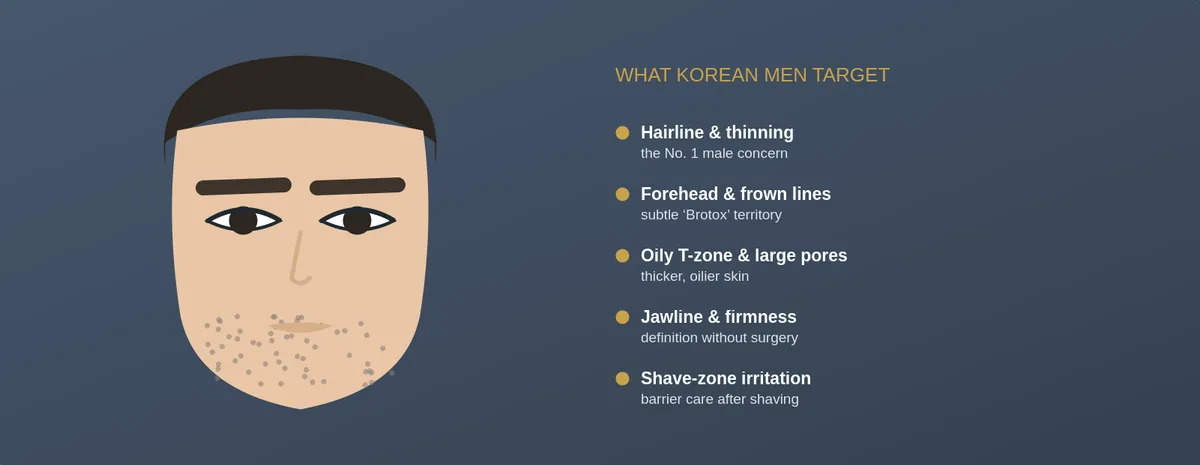
Why men's skin needs a different approach
Male skin is not just female skin with stubble. It is roughly 20 to 25% thicker, produces noticeably more oil, and tends to have larger, more visible pores. It also takes a daily beating from shaving, which strips the barrier and causes irritation, and it ages on a different schedule, often showing fewer changes early on, then deeper lines more suddenly later. None of this calls for a more complicated routine; it calls for the right one. The goal is oil control without stripping, hydration that never feels greasy, and protection, which is why Korean men's products lean on lightweight gels, water-based fluids, and matte finishes rather than the rich creams marketed to women.
The routine: simpler than you think
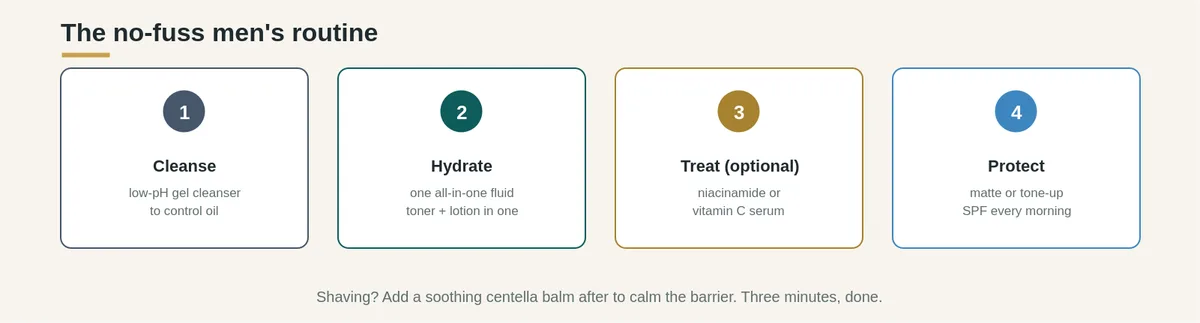
The classic Korean men's routine rests on three pillars and takes a few minutes. Start with a low-pH gel cleanser to clear oil and grime without over-drying. Follow with a single all-in-one fluid, the category that dominates men's K-beauty, which combines toner, lotion, and essence into one ten-second step of lightweight hydration. Finish every morning with sunscreen, ideally a matte or subtle tone-up formula that protects without feeling heavy or looking made-up.
That is the whole foundation. From there, an optional treatment serum earns its place: niacinamide to control oil and refine pores, or vitamin C to fade acne marks and brighten a dull, tired complexion. If you shave, the most useful add-on is a soothing centella balm afterward to calm the barrier and reduce irritation, the same gentle Korean actives that anchor women's routines work just as well here. This minimalist approach is not a compromise; it is the smarter skip-care philosophy that modern Korean skincare has embraced across the board, and you can read more about the calming ingredients in our guide to centella, mugwort and rice.
Into the clinic: the rise of male aesthetics
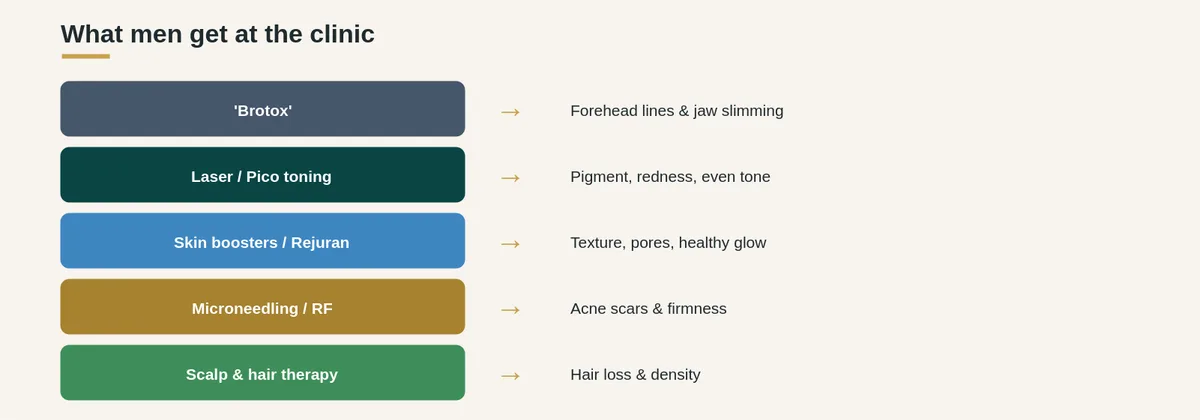
The bigger shift in 2026 is how normal it has become for Korean men to walk into a dermatology clinic. The stigma has largely gone, helped along by a playful nickname, Brotox, for the anti-wrinkle injections men increasingly book. The defining feature of male aesthetics here is restraint: men overwhelmingly want to look sharper, less tired, and more defined without anyone being able to tell why. Clinics tailor treatments to male anatomy, which is thicker, oilier, and more angular, and aim for natural, masculine results rather than transformation.
The popular menu reflects male concerns. Botox softens forehead and frown lines and can subtly slim a heavy jaw while keeping it masculine. Laser and Pico toning tackle pigmentation, redness, and uneven tone with minimal downtime, which is why it is a favourite among office workers and expats. Skin boosters and Rejuran improve texture, pores, and overall skin quality. Microneedling and radiofrequency target adult acne scars and firmness. And because so many men come in for skin and scalp at once, hair treatment has become one of the biggest categories of all.
Hair loss: the concern men care about most
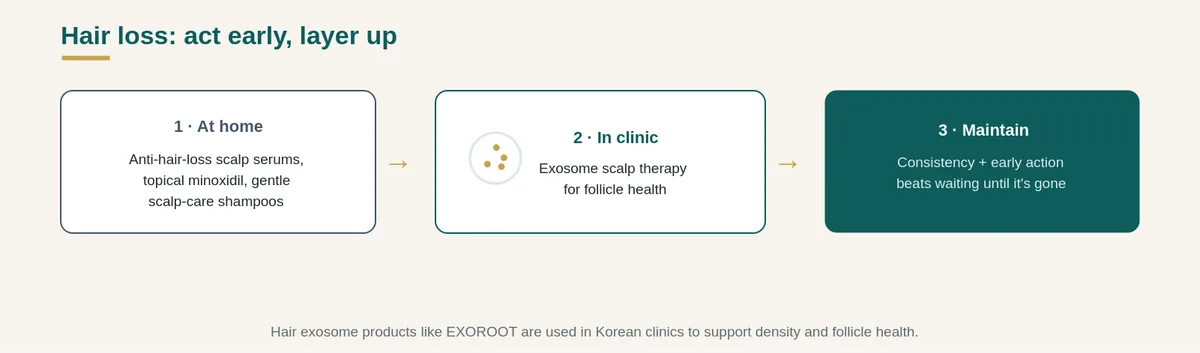
If there is one issue that brings men to Korean clinics, it is hair. Male-pattern thinning is the concern men most want solved, and Korea treats it as a serious, multi-layered category rather than a lost cause. The approach combines at-home and in-clinic care. At home, that means dedicated anti-hair-loss scalp serums and essences, topical minoxidil, and scalp-care shampoos that keep the foundation healthy. In the clinic, exosome scalp therapy has become a leading option, using cell-signalling vesicles to support follicle health and circulation alongside other regenerative treatments.
The single most important principle is to act early. These treatments are far better at maintaining and strengthening the hair you still have than at recovering hair long gone, so the men who do best start while thinning is mild and stay consistent. Hair exosome products such as EXOROOT are used in Korean clinics specifically to support density and follicle health, and if you want to see how the leading options compare, our guide to the top hair exosome products breaks them down. For the science behind exosomes generally, our exosome explainer is the place to start.
Match the concern to the fix
| Concern | At home | In clinic |
|---|---|---|
| Oily skin, large pores | Low-pH cleanser, niacinamide | Laser toning, pore treatments |
| Adult acne & scars | BHA, gentle actives | Peels, microneedling, lasers |
| Tired, dull, early lines | Vitamin C, SPF, sleep | Skin boosters, light Botox |
| Soft jawline / firmness | Consistency, SPF | RF/ultrasound lifting |
| Thinning hair | Scalp serums, minoxidil | Exosome scalp therapy |
Getting started, without overthinking it
The best entry point is almost embarrassingly simple: a good cleanser, one all-in-one moisturiser, and daily sunscreen, used consistently for a month. That alone visibly improves most men's skin, and it costs very little. Add a targeted serum once the basics are a habit, and only consider clinic treatments for the specific things a routine cannot fix, stubborn pigmentation, acne scarring, early hair loss, or firmness. If you are visiting Korea, Olive Young is the easiest one-stop shop to assemble a starter routine, and most Seoul clinics now offer English-friendly consultations if you want to go further.
Above all, drop the idea that any of this is unmanly. In Korea, taking care of your skin and hair is simply part of taking care of yourself, the same as fitness or a decent haircut. The men who look effortlessly sharp are almost never doing nothing; they are doing a little, consistently, and starting before they feel they have to.
Common mistakes men make
A few habits hold men's skin back more than any missing product. The biggest is over-washing: scrubbing with harsh foaming cleansers or a bar of soap several times a day strips the barrier and, counterintuitively, makes oily skin produce even more oil. Skipping sunscreen is the other near-universal one, since most men were never taught to wear it daily, yet it is the single most effective anti-ageing step there is. Many also reach for heavy, greasy creams that clog male skin, when a light fluid would serve far better.
On the treatment side, the mistakes are about timing. Men tend to ignore hair loss until it is advanced, when it is hardest to treat, rather than acting at the first sign of thinning. And first-timers at the clinic sometimes go too aggressive too fast, chasing a dramatic change instead of the subtle, maintenance-led results that actually look natural on men. The fix for all of these is the same Korean instinct: gentler, lighter, earlier, and consistent beats harsh, heavy, late, and sporadic every time.
The takeaway
Korean men's grooming works because it is practical: a short routine tuned for thicker, oilier skin, sunscreen treated as non-negotiable, and clinic treatments used with restraint for the things that genuinely need them. Tackle oil and protection first, address acne, tone, and firmness as needed, and take hair loss seriously and early. Do that, and the polished, well-rested look that seems to come naturally to Korean men turns out to be exactly what it is, a small set of good habits, done consistently.