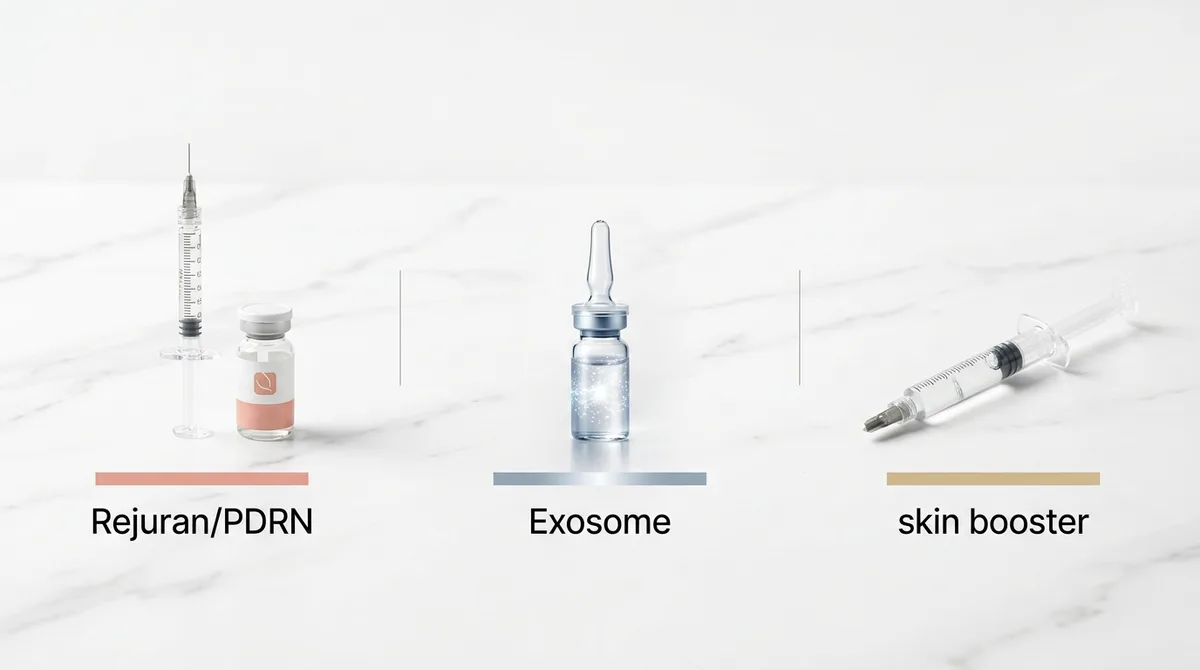
Walk into any Gangnam skin clinic and the consultation sounds like alphabet soup. Rejuran, exosomes, Profhilo, Skinvive, polynucleotides, PDRN, skin boosters. They get bundled into packages, recommended in combination, and marketed with the same promise: glass skin, glow, rejuvenation. For someone flying in for a three-day treatment trip, telling them apart is genuinely hard.
The good news is that they sort into three clear families, each doing a different job. Once you understand what each one actually is, choosing, or combining, becomes simple. Here is the honest breakdown of Korea's most popular skin-quality treatments, and how to work out which is right for you.
First, what a 'skin booster' actually is
Skin boosters are injectable treatments that improve skin quality, hydration, texture, firmness, and glow, rather than adding volume or changing your shape the way dermal fillers do. They are micro-injected across an area instead of placed in one spot, and they work with your skin rather than sitting on top of it. The category has exploded because it delivers that lit-from-within glass-skin look without surgery or downtime, which is exactly what is driving Korea's dermatology-tourism boom.
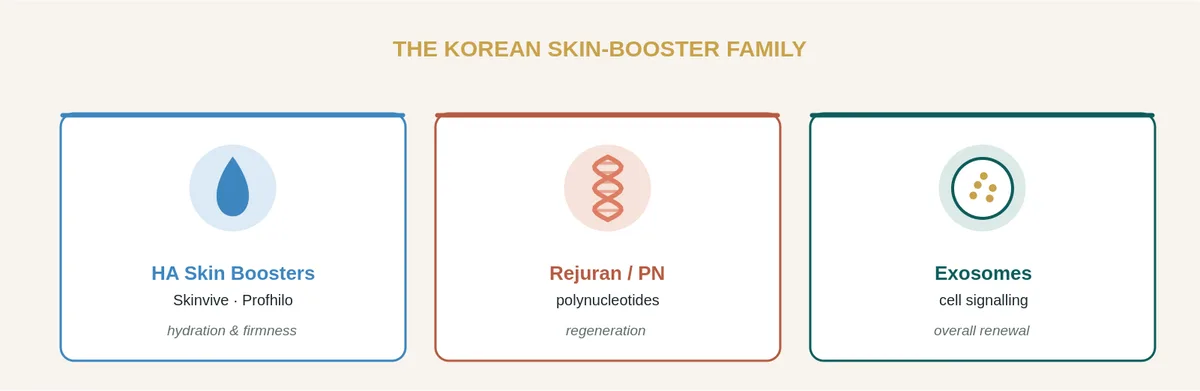
Within that umbrella sit three different technologies that often get lumped together but work in completely different ways: hyaluronic acid boosters, polynucleotides like Rejuran, and exosomes. Here is each one.
The three families, explained
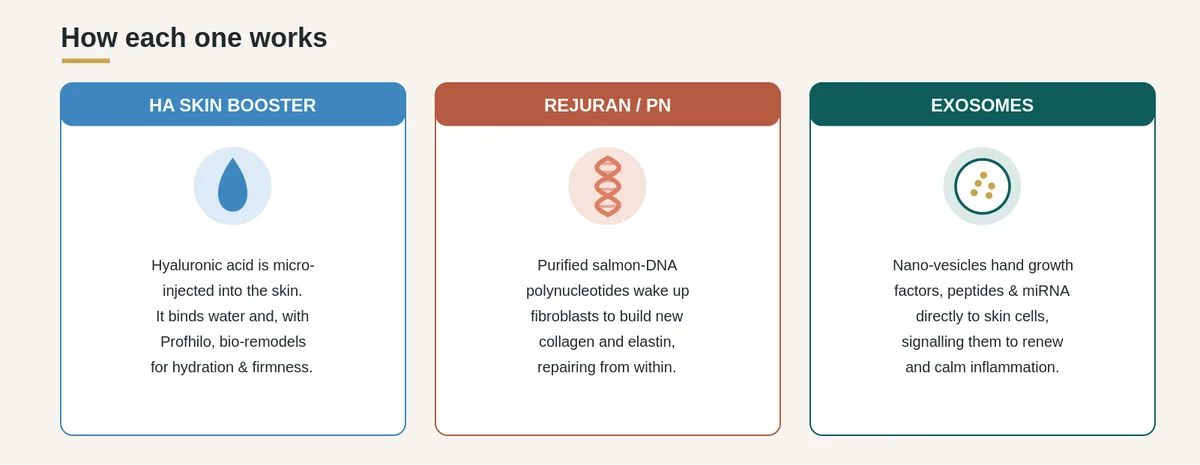
HA skin boosters use hyaluronic acid, the moisture-binding molecule your skin already contains. Classic boosters like Skinvive (known internationally as Juvederm Volite) deliver cross-linked HA in micro-droplets for deep hydration, smoother fine lines, and that radiant glass-skin finish. Profhilo is the standout sibling: it uses one of the highest HA concentrations on the market and a bio-remodelling action that spreads under the skin to stimulate collagen and elastin, so it tightens and firms rather than just hydrating. Neither adds volume; both improve skin quality.
Rejuran, the polynucleotide treatment, is the salmon-DNA injectable that gave Korean glass skin its clinical name. Its active ingredient is purified polynucleotides, also called PDRN, fragments of DNA extracted from salmon because salmon DNA is highly compatible with human skin and carries low viral risk. Injected into the dermis, polynucleotides wake up fibroblasts, the cells that build collagen and elastin, and have anti-inflammatory and antioxidant effects. The result is genuine regeneration: better texture, smaller pores, improved elasticity, and real help for acne scars and thin under-eye skin.
Exosomes are the newest of the three. They are nano-vesicles, isolated from stem cells or plant cultures, that act as messengers between cells, carrying growth factors, peptides, and microRNA. Applied over microchannels from microneedling, they signal skin cells to regenerate and calm inflammation, which makes them especially good for overall renewal, redness, and post-procedure recovery. Korean clinics increasingly layer them after lasers, microneedling, or alongside Rejuran.
At a glance
| Treatment | What it is | Best for | Course / lasts |
|---|---|---|---|
| HA skin booster (Skinvive) | Micro-droplets of hyaluronic acid | Hydration, glow, fine lines | 1 session; ~6 months |
| Profhilo | Bio-remodelling high-dose HA | Laxity, firmness, crepey skin | 2 sessions; ~6 months |
| Rejuran (PN/PDRN) | Salmon-DNA polynucleotides | Texture, pores, scars, under-eye | 3–4 sessions; 6–12 months |
| Exosomes | Stem-cell or plant signalling vesicles | Overall renewal, redness, recovery | Short course; varies |
A quick orientation: HA boosters are about water and, with Profhilo, firmness. Rejuran is about regeneration and repair. Exosomes are about signalling and overall renewal. They overlap at the edges, but those are their centres of gravity.
Which one is right for you?
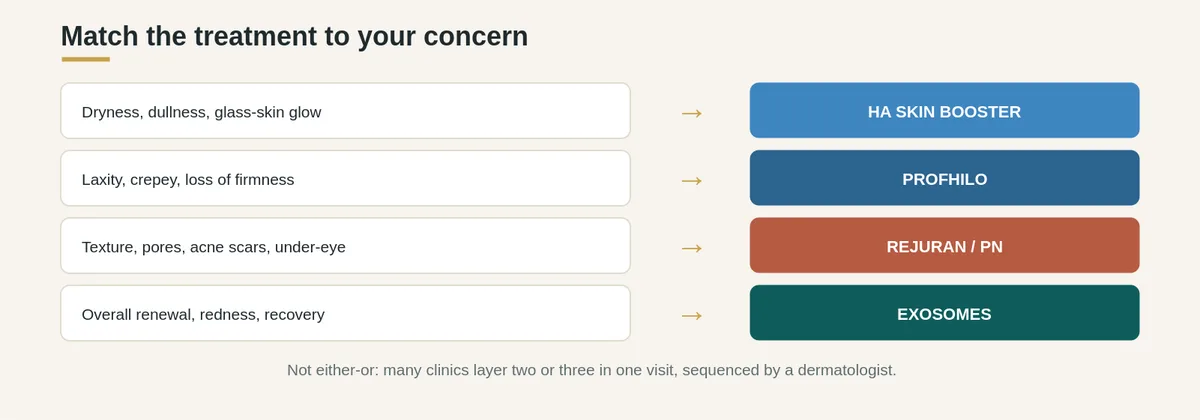
The simplest way to choose is to start from your main concern rather than the buzziest product. If your skin is dry, dull, and you want that instant glass-skin glow, a hyaluronic acid booster like Skinvive is the natural starting point. If your concern is laxity, crepey texture, or loss of firmness, Profhilo's bio-remodelling is built for that. If you are dealing with rough texture, enlarged pores, acne scars, or thinning under-eye skin and want true regeneration, Rejuran and the polynucleotides are the strongest fit. And if you want overall rejuvenation, calmer redness, or faster recovery after another treatment, exosomes are the layer to add.
Age and skin maturity matter too. Polynucleotides tend to suit people from their late twenties through their fifties who are seeing early-to-moderate signs of ageing, while HA boosters work across a broad range and are a gentle entry point for first-timers. None of this is rigid, which is exactly why a good clinic consultation matters more than a marketing label.
Why clinics combine them
Here is the part the rivalry framing misses: these treatments are not really competitors. Because they do different jobs, a dermatologist often sequences two or three in a single visit or course. A common Seoul combination is Rejuran for under-eye and texture, an HA booster for cheek hydration, and exosomes layered in for overall recovery and glow. Gangnam clinics now sell Rejuran-plus-exosome packages precisely because the regeneration of polynucleotides and the signalling of exosomes complement each other.
That is also why you should be wary of any clinic that pushes a single product as the answer to everything. The right plan depends on your skin, your concerns, and how the treatments are layered, not on which one the clinic happens to be promoting that month.
The next step: several actives in one product
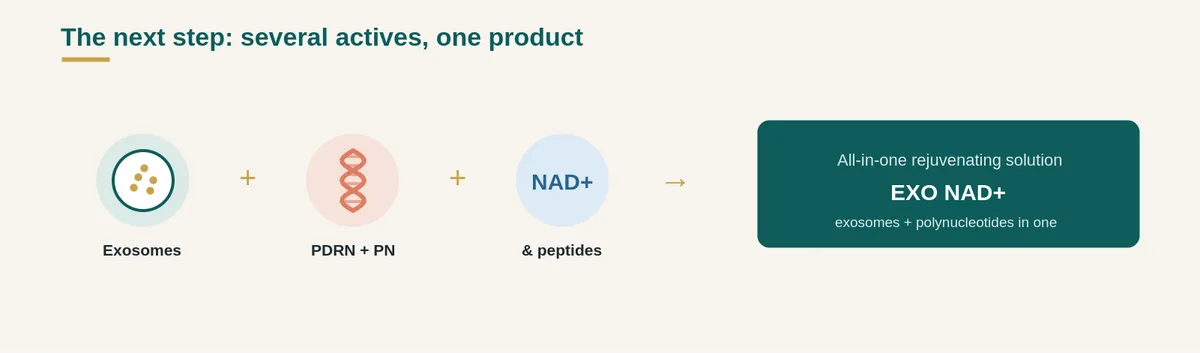
If clinics are combining these technologies, it was only a matter of time before formulators put them in a single product. That is the logic behind the newest generation of Korean rejuvenating treatments, which fold multiple actives into one. EXO NAD+ is a clear example: it combines plant-derived exosomes with PDRN and polynucleotides, the same salmon-DNA-class actives behind Rejuran, plus NAD+ and peptides, in one all-in-one solution. It is essentially the combination protocol, exosomes plus polynucleotides, built into a single treatment rather than layered injection by injection. If you want the deeper science on those actives, our guide to PDRN, exosomes and polynucleotides breaks them down.
Costs and what to expect in Korea
Pricing is one of the biggest reasons people travel to Seoul for these treatments. A single Rejuran session in Korea typically runs roughly $110 to $370, with premium Gangnam clinics charging more, and a full three-session course often lands between about $300 and $900, well below Western pricing. HA boosters and exosome add-ons vary by clinic and area treated. Across the board, expect a course rather than a one-off: most of these treatments need three to four sessions a few weeks apart, with results building over weeks and lasting six to twelve months before a maintenance top-up.
Downtime is mild. Rejuran can leave small bumps and redness for one to three days, HA boosters and exosomes settle quickly, and none requires the recovery of surgery. That low-commitment profile is exactly why a Friday-to-Monday treatment trip works.
Safety and choosing a clinic
All three are well tolerated in trained hands, but a few cautions matter. Rejuran is derived from salmon, so it is not suitable for anyone with a fish allergy, and it is avoided in pregnancy, breastfeeding, and active skin infection. Its popularity has also produced a counterfeit market, so it is worth choosing a clinic that uses verified, authentic product from the original manufacturer. Exosomes are approved in Korea as topical cosmetics applied over microchannels rather than as licensed injectables, and their quality varies between manufacturers, so sourcing and how they are administered are the things to ask about.
The practical rule is the same one we give for every clinic treatment: ask exactly which product is being used, where it is sourced, and how it will be delivered. A reputable Seoul clinic will answer all three without hesitation. For the regenerative side specifically, it also helps to understand how exosomes compare to older options like PRP before you book.
The takeaway
Rejuran, exosomes, and HA skin boosters are not rivals so much as different tools for different jobs. Hyaluronic acid boosters hydrate and, with Profhilo, firm. Rejuran and the polynucleotides regenerate and repair. Exosomes signal renewal and speed recovery. Match the treatment to your actual concern, expect a short course rather than a miracle visit, choose a clinic that uses verified product, and do not be surprised when the smartest plan turns out to be a combination. That, increasingly, is the Korean approach, and it is why Seoul stays a step ahead.