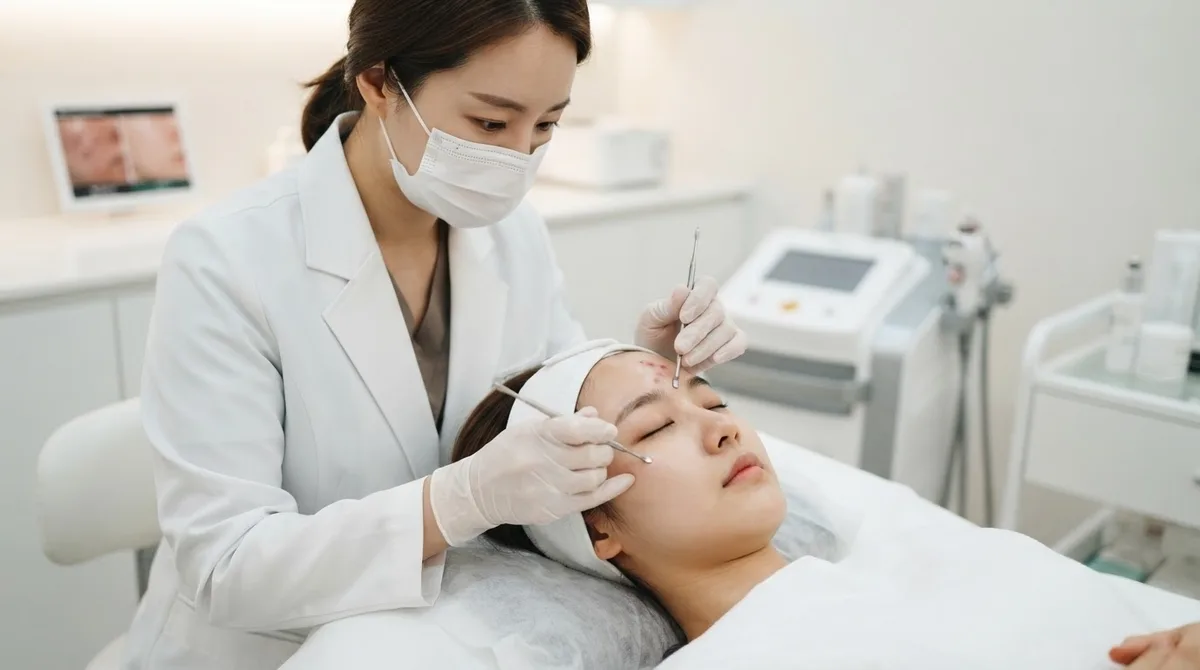
The Korean skincare market produces genuinely effective acne products. BHA cleansers, CICA toners, niacinamide serums, pharmacy-grade acne creams like Acnon — all of these work, and work better than many of their Western equivalents at comparable price points. They are also not what a Seoul dermatology clinic does.
The gap between what a well-curated skincare routine can do and what a dermatologist in Gangnam can do is specific and significant. Products work on the surface and the upper layers of skin. Clinic treatments work at the level of the dermis, the follicle, the sebaceous gland, and in the case of acne scars, the fibrous tissue bands that sit beneath the skin surface. Understanding where one ends and the other begins is what turns a Seoul trip into a productive skin investment rather than an expensive version of what you could do at home.
Where products stop and clinics start
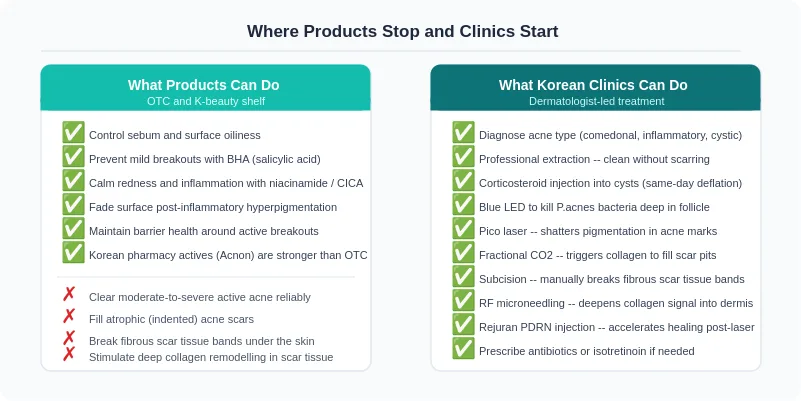
K-beauty products handle the fundamentals well. A salicylic acid BHA cleanser keeps pores from congesting. Niacinamide calms inflammation and regulates sebum. Korean pharmacy products like Acnon operate at quasi-drug concentration levels that outperform standard OTC acne formulas. Post-inflammatory hyperpigmentation — the flat dark marks left after a breakout — responds to topical tranexamic acid and niacinamide over weeks.
The ceiling is moderate-to-severe active acne. A blackhead buried three millimetres into a pore needs physical removal, not a better cleanser. A closed comedone that has developed into an inflammatory papule needs either a targeted intervention or will develop into a deeper lesion that is harder to treat. A cystic nodule inflamed at the sebaceous gland level will not deflate from a salicylic acid wash. And the atrophic scars left by previous acne — the icepick pits, boxcar depressions, and rolling surface irregularities — are structural problems that no topical product can address. They require collagen remodelling from below, which requires energy delivered into the dermis.
Active acne vs acne scars: two different problems
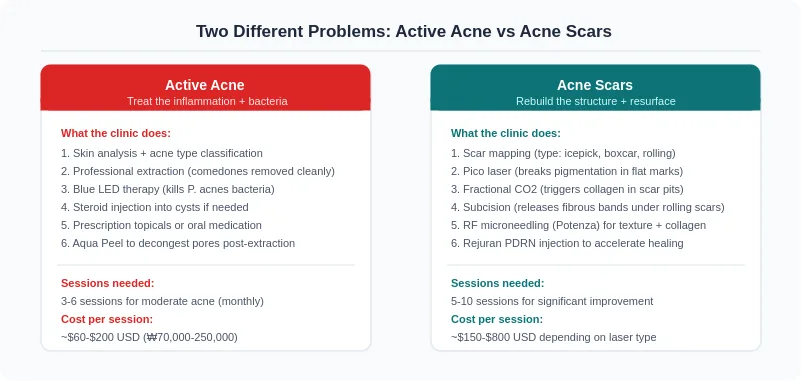
Korean dermatology clinics treat active acne and acne scars as distinct clinical problems with distinct treatment menus. Mixing them up in the same session is common in the West but less so in Korean clinical practice, where the diagnosis-first approach typically maps the current condition before determining which protocol applies.
For active acne, the clinic process begins with a skin analysis that categorises the acne by type: comedonal, inflammatory, or cystic. The type determines the treatment. Comedonal acne — blackheads and whiteheads — responds to professional extraction, which removes the contents of the follicle cleanly and without the damage that home squeezing produces. Following extraction, blue LED therapy delivers light at 415 nanometres, the wavelength that kills Propionibacterium acnes bacteria by generating reactive oxygen within the bacterial cell. Blue LED produces no downtime, but at clinical intensities, it reduces bacterial populations significantly more than over-the-counter LED devices manage.
Inflammatory and cystic acne may receive corticosteroid injections directly into individual lesions — a procedure that deflates a cyst significantly within twenty-four to forty-eight hours and prevents the deep scarring that untreated cystic acne reliably produces. Dermatologists also prescribe topical or oral antibiotics, retinoids, and in persistent cases, isotretinoin — prescription medications that no product can substitute for.
Acne scars require a completely different approach because the problem is structural rather than bacterial. A flat dark mark (post-inflammatory hyperpigmentation) is a pigment problem in the epidermis. A pitted or indented scar is a volume loss problem in the dermis, where inflammation destroyed collagen and the skin healed without replacing it fully. A rolling scar involves fibrous bands of tissue pulling the surface downward from underneath.
Pico laser addresses pigmentation — the dark flat marks — by delivering ultra-short picosecond pulses that shatter melanin particles without the heat that would risk post-inflammatory hyperpigmentation in darker skin tones. Korean clinics adopted pico laser technology ahead of most Western markets, and protocols for Fitzpatrick types III through V are refined from high treatment volumes that are hard to match elsewhere.
Fractional CO2 laser addresses atrophic scar depth. The laser creates controlled micro-injuries at specific depths in the dermis, triggering a wound-healing response that produces new collagen. That collagen, over weeks and months, fills the indentations from below. This is the mechanism no topical product can replicate — skin is specifically designed to prevent foreign substances reaching dermal depth.
Subcision targets rolling scars specifically, where a fine needle is inserted under the skin and moved laterally to break the fibrous bands pulling the surface downward. Without subcision, laser treatment on rolling scars can improve texture and pigmentation of the scar surface without addressing the tethering beneath it. The combination of subcision plus fractional laser plus Rejuran PDRN injection post-treatment is the protocol Korean dermatologists have refined for mixed scar presentations.
RF microneedling (using devices like Potenza) delivers radiofrequency energy through insulated needles at specific dermal depths, stimulating collagen production and skin tightening without the surface downtime of ablative lasers. Particularly useful for large pores associated with oily acne-prone skin and moderate texture irregularities.
What it costs
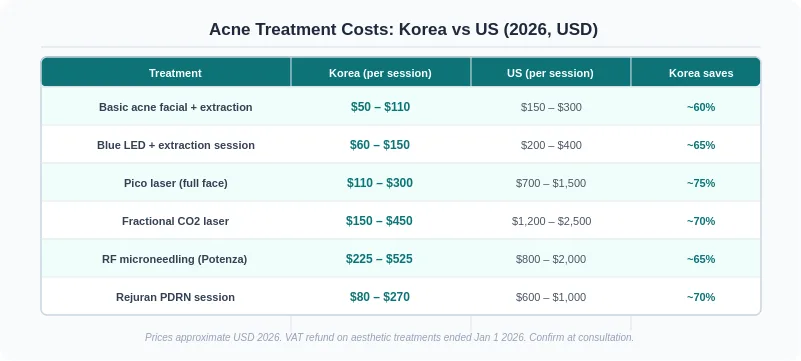
Korean acne clinic treatments run thirty to seventy percent cheaper than equivalent procedures in the US, with the gap widening on laser treatments where US facilities carry high malpractice insurance and equipment costs that Korean clinics spread across far higher patient volumes.
For active acne, a basic extraction and blue LED session runs from around fifty to one hundred and ten US dollars. More intensive protocols with steroid injections start around eighty to one hundred and fifty dollars.
For acne scars, the economics are most compelling on laser procedures. Fractional CO2 at one hundred and fifty to four hundred and fifty dollars per session compares to twelve hundred to twenty-five hundred dollars at a comparable US facility. Pico laser at one hundred and ten to three hundred dollars per session compares to seven hundred to fifteen hundred dollars. A complete acne scar treatment programme running five to ten sessions typically costs two thousand to five thousand dollars in Korea, compared to five thousand to fifteen thousand for equivalent treatment in the US.
The VAT refund on aesthetic medical treatments ended as of January 1, 2026. The ten percent tourist refund that previously applied to clinic procedures no longer exists. Confirm all pricing at consultation.
How a Seoul acne clinic visit actually works
The first visit always begins with consultation. A board-certified Korean dermatologist assesses the skin using both visual examination and digital imaging tools that map pore density, pigmentation distribution, sebum levels, and scar depth. The diagnosis determines the treatment plan, presented with a session schedule and cost breakdown before anything is agreed or paid.
Numbing cream is applied before any laser or injection procedure, typically for twenty to forty minutes. The procedure itself runs between thirty minutes and an hour depending on the protocol. Following treatment, soothing masks or LED recovery light are applied to manage immediate redness and inflammation. Most pico laser and extraction sessions produce redness that resolves within twenty-four to forty-eight hours. Fractional CO2 produces five to ten days of visible downtime with redness and peeling — book this early in a trip, not the day before departure.
English-speaking staff are standard at clinics that regularly treat international patients in Gangnam and Myeongdong. For visitors with complex acne histories, bringing documentation of previous treatments and a list of current skincare products and medications speeds up the consultation significantly.
Which to book for a Seoul trip
For visitors with active moderate to severe acne: book a dermatologist consultation first. Active acne that has not been adequately controlled is generally addressed before scar treatment begins. A three to five day trip can include an initial consultation, extraction and blue LED session, and a follow-up for prescription topicals to continue at home.
For visitors with acne scarring and no significant active acne: the scar treatment protocol is the focus. One Seoul trip can accommodate one or two laser sessions with adequate recovery time. Book the most intensive session (fractional CO2 or subcision) early in the trip so recovery does not conflict with sightseeing. Pico laser and RF microneedling have shorter recovery windows and fit better later in the visit.
For visitors managing mild to moderate acne at home with products: a Gangnam dermatology consultation is still worth doing for the skin analysis and prescription access. Korean dermatologists prescribe topical retinoids and antibacterial formulas at concentrations not available over the counter in most Western markets, at prices significantly cheaper than Western equivalents.
Preparing for your visit
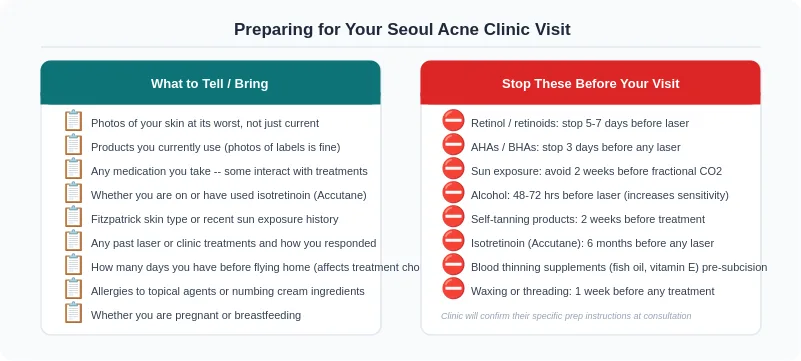
The most important preparation step is stopping retinoids and AHAs before any laser treatment — five to seven days for retinol, three days for exfoliating acids. Sun exposure should be avoided for two weeks before fractional CO2. Anyone who has used isotretinoin (Accutane) needs to confirm their cessation date with the clinic before any laser is booked — the standard waiting period before ablative laser is six months after the last dose.
Bring photos of your skin at its worst, not just how it looks on the consultation day. Acne is variable, and a dermatologist who can see the full range of your skin's condition makes a more accurate diagnosis than one working from a single day's presentation. Screenshots of your current product routine are also useful — the dermatologist may identify interactions or gaps that inform the prescription recommendation.
- Book an online consultation before arriving in Seoul if possible. Most clinics serving international patients offer remote consultations.
- Confirm English support in advance. Gangnam and Myeongdong clinics typically have this; smaller neighbourhood clinics may not.
- Stop retinoids five to seven days before any laser treatment.
- Plan your itinerary around recovery windows: fractional CO2 needs five to ten days; pico laser needs one to two.
- Ask for the written treatment plan in English before agreeing to any session or payment.
- Budget for Rejuran or exosome skin booster add-ons post-laser — the regenerative acceleration is clinically meaningful and manageable at Seoul prices.
For more on how skin booster treatments like Rejuran work, see our Rejuran vs Exosomes vs Skin Boosters guide. For the broader context of what Seoul clinics offer, see the Korea skin treatment cost guide and the medical tourism first-timer guide.
Related: Rejuran vs Exosomes vs Skin Boosters | Clinic-in-a-Bottle: At-Home Versions of Korea's Pro Treatments | How Much Do Skin Treatments Cost in Korea? 2026 Price Guide