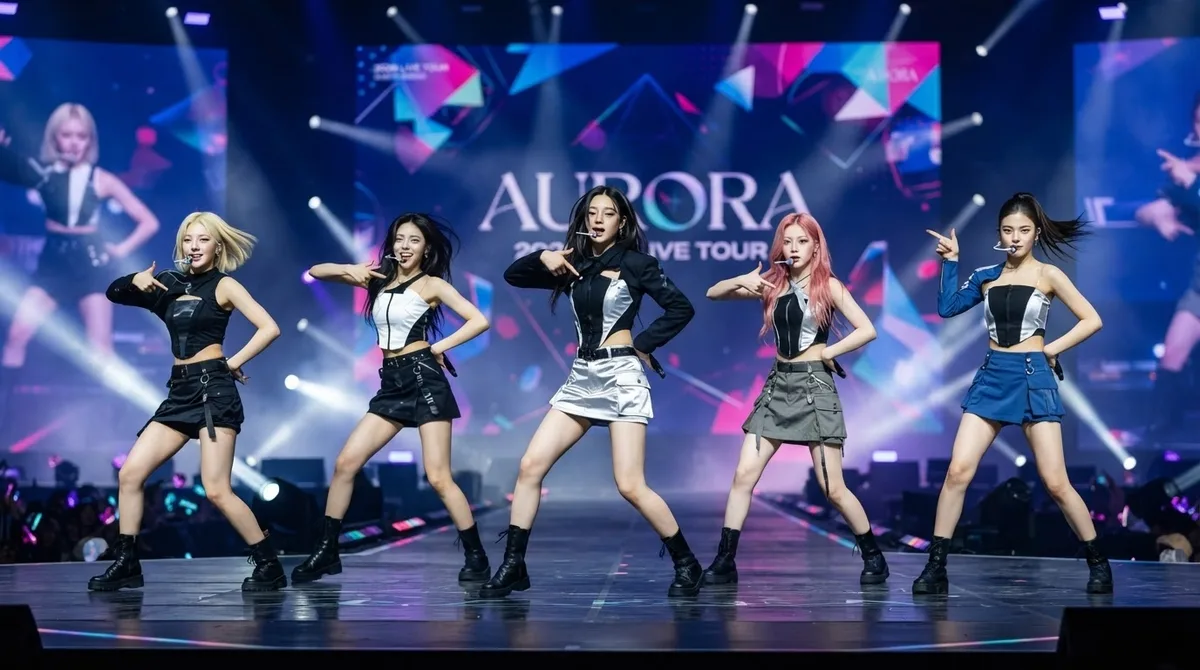
Ask ten K-pop fans when fifth generation started and you will get ten different answers. Some say it began with NewJeans in July 2022, because the aesthetic shift they represented was immediate enough to feel like a break with what came before. Some say the true fifth generation started in 2023 with RIIZE, ZeroBaseOne, and BABYMONSTER, because those are the groups that debuted under conditions clearly different from the fourth-gen standard. Some include aespa in the fifth generation despite their 2020 debut, because their AI-metaverse concept feels like it belongs to a different era entirely. All of these positions are reasonable. None of them are wrong.
That is the honest starting point: K-pop generations are fan-constructed categories, not official industry designations. There is no licensing body that certifies a group as fourth or fifth gen, no debut date that automatically assigns a label. The categories emerge retroactively as patterns become visible across multiple groups simultaneously -- shifts in sound, concept, platform strategy, and the relationship between artists and audiences. When enough groups change in the same direction at the same time, fans start talking about a new generation. The label is useful shorthand for describing something real, even though the borders are always contested.
The five generations: a clear overview
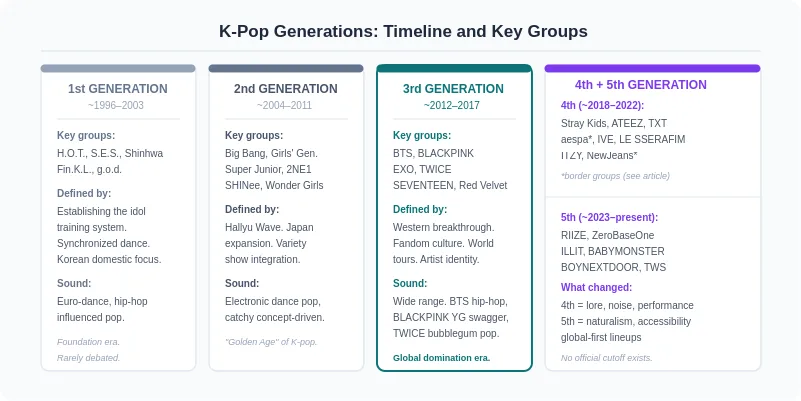
First generation (~1996–2003): H.O.T., S.E.S., Shinhwa, Fin.K.L., g.o.d. Established the modern idol training system, synchronized dance, coordinated visual identity, and a primarily Korean domestic audience.
Second generation (~2004–2011): Big Bang, Girls' Generation, Super Junior, 2NE1, SHINee, Wonder Girls. The Golden Age of K-pop. Expanded across Asia, dominated Japan, introduced variety show integration and individual branding. The role hierarchies inside groups -- main vocal, visual, main dancer, rapper -- were codified here.
Third generation (~2012–2017): BTS, BLACKPINK, EXO, TWICE, Red Velvet, SEVENTEEN. The global breakthrough era. YouTube, Twitter, and streaming replaced television as the primary discovery mechanism. BTS's four-year build from 2013 debut to international breakthrough was the characteristic growth pattern: slow fandom accumulation, then a tipping point. The music was stylistically varied -- hip-hop, bubblegum pop, electronic dance, YG swagger -- defined more by scale than by a single sound.
Fourth generation (~2018–2022): Stray Kids, ATEEZ, TXT, ITZY, (G)I-DLE, aespa, IVE, LE SSERAFIM, NewJeans. The performance-lore-self-production era. Technically demanding choreography, elaborate narrative universes (aespa's KWANGYA metaverse), self-production credibility (Stray Kids' 3RACHA, (G)I-DLE's Soyeon), and million-seller debut weeks. The 'monster rookie' standard -- immediate top-tier status from day one -- became expected.
Fifth generation (~2023–present): RIIZE, ZeroBaseOne, BABYMONSTER, ILLIT, BOYNEXTDOOR, TWS. A deliberate pull-back from fourth-gen maximalism. Melodic, easy-listening sound. Accessible, relatable concepts with no lore to invest in. Charm-prioritised choreography optimised for TikTok. Global from debut day. International members now standard rather than notable.
What changed between generations: five dimensions
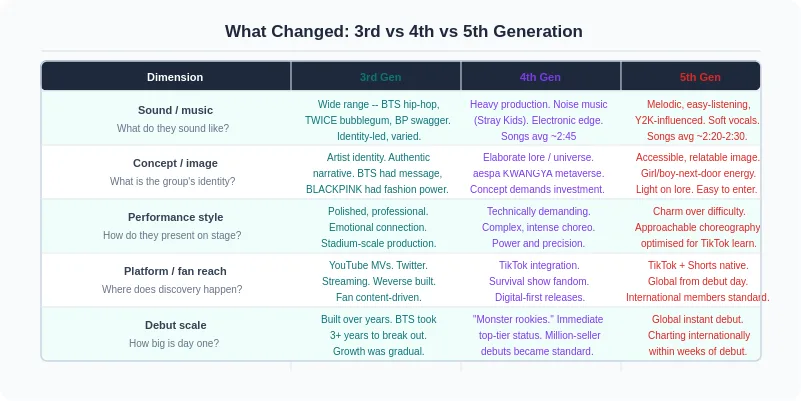
Sound. Third-gen music was stylistically varied. Fourth-gen converged on heavier production -- noise music as its most distinctive sonic signature, songs averaging around two and a half minutes. Fifth-gen has pulled back toward melodic, easy-listening pop, with average song lengths closer to two minutes and twenty seconds. The shorter format reflects how the music is consumed: TikTok's fifteen to thirty second hook shapes production choices from the ground up.
Concept. Third-gen groups built around artist identity -- BTS had a coherent message about youth and mental health that accumulated over years. Fourth-gen groups built around narrative universes: aespa's KWANGYA lore, TXT's coming-of-age narrative, ATEEZ's theatrical pirate world, all requiring audience investment and background knowledge. Fifth-gen groups have largely dropped the lore. The concept is either immediately accessible (girl/boy next door) or clean and visually distinctive without demanding prior knowledge. ILLIT's aesthetic is readable on first contact.
Performance style. Fourth-gen choreography was built to impress in arena settings and in high-quality fancam footage -- technically demanding, precision-focused, power-driven. Fifth-gen choreography is more often built to be learned by fans at home and replicated in TikTok challenge videos. ILLIT's Magnetic choreography became a global TikTok challenge specifically because it was charming and learnable, not because it was technically intimidating.
Platform strategy. Third-gen groups built international fanbases through YouTube MVs and Twitter -- a slower accumulation model. Fourth-gen groups integrated TikTok alongside traditional releases. Fifth-gen groups are native to TikTok and YouTube Shorts: the format of content, length of songs, structure of the hook, and design of choreography all assume short-form video as the primary consumption surface. The global fandom arrives faster -- where BTS built internationally across several years, fifth-gen groups chart internationally within weeks.
Debut scale. Third-gen groups built over time. Fourth-gen introduced the monster rookie standard -- million-seller debuts, top-tier status within months. Fifth-gen has inherited this expectation but globalised it: the audience driving debut-week sales is international from day one, not primarily Korean.
The border groups: where the real debate lives
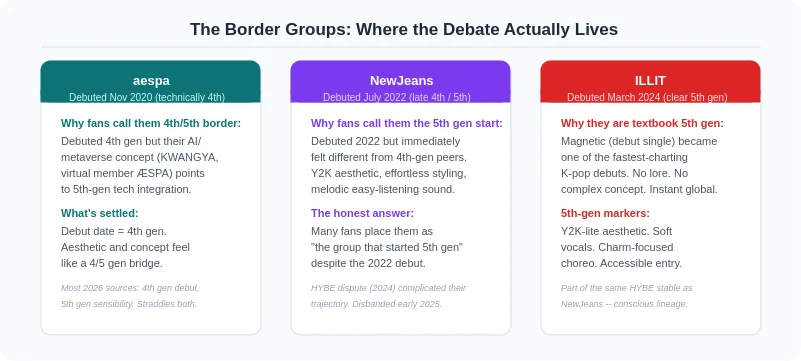
aespa debuted November 2020 -- firmly fourth generation by date, and that is where most 2026 sources place them. But the KWANGYA universe, virtual member avatars, and AI-integration themes of their early work point toward the same tech-integration direction that defines fifth-gen aesthetics. Most fans and analysts describe them as a bridge: fourth-gen debut, fifth-gen sensibility.
NewJeans debuted July 2022 and immediately felt different from their fourth-gen contemporaries. The Y2K aesthetic, deliberately effortless styling, soft vocal-led production, and multi-song debut strategy all felt like a break from the fourth-gen standard. Many fans credit NewJeans as the group that started fifth generation, regardless of debut year. Their trajectory was complicated by the HYBE-ADOR management dispute in 2024 and their dissolution in early 2025 -- leaving them one of the most influential and shortest-lived groups in recent K-pop history.
ILLIT debuted March 2024 and are the clearest fifth-generation example. Magnetic charted internationally immediately, entered Billboard charts, and became a TikTok challenge worldwide within weeks of release. No complex universe. No demanding concept. Soft vocals, Y2K-inflected styling, approachable choreography. HYBE explicitly positioned them as a new generation rather than a continuation of the fourth-gen groups in the same stable.
What 4th gen perfected, what 5th gen changed
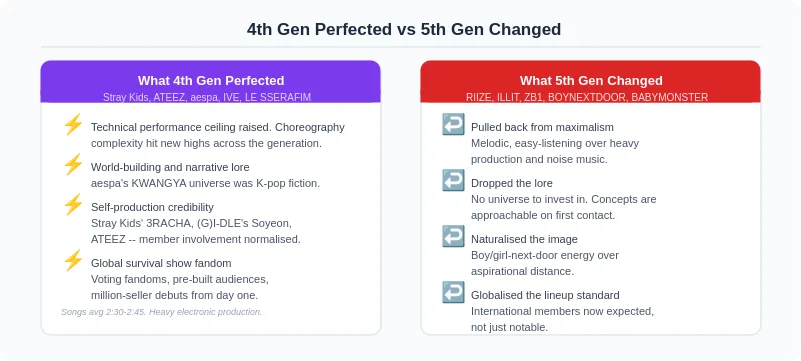
What fifth gen preserved from fourth gen: The technical performance standard. Self-production as a credibility norm. Million-seller debut expectations. Global fandom from day one.
What fifth gen walked back:
Maximalism in sound. Melodic and easy-listening over heavy production and noise music.
Conceptual lore. No universe to invest in. Concepts are approachable on first contact.
Aspirational distance. Boy/girl-next-door energy over the elevated, demanding identity of groups like ATEEZ or aespa.
The shift toward globalised lineups. International members were notable in fourth-gen groups (BLACKPINK's Lisa from Thailand was a specific and commented-upon fact). In fifth-gen groups, members from Japan, China, Thailand, Vietnam, and the United States are the expected baseline.
Why the debate matters and why it is fine that it is unresolved
The ongoing argument about which generation a group belongs to is not a failure of the classification system. It is evidence that the system is doing useful work. When fans argue about whether NewJeans is fourth gen or fifth gen, they are arguing about something substantive: what the aesthetic represented, whether it was continuation or break, and what it signals about where K-pop is going.
The most useful framing for a newcomer is not to resolve the border debates but to use the generational framework as an orienting tool. If you are drawn to concept-heavy, technically demanding, lore-rich groups -- Stray Kids, ATEEZ, aespa -- you are drawn to fourth-gen aesthetics. If you are drawn to immediately accessible, melodic, light-on-lore groups -- ILLIT, RIIZE, BOYNEXTDOOR -- you are drawn to fifth-gen aesthetics. If you want to start from K-pop's global breakthrough, start with BTS and BLACKPINK and work forward.
What 2026 has added is the concurrent active presence of multiple generations simultaneously. BTS's group comeback with the ARIRANG album runs alongside ILLIT's ongoing momentum. Big Bang members promote while fifth-gen rookies break debut records. The K-pop market in 2026 is multigenerational in a way that earlier periods were not, because the global scale means senior groups maintain relevance well past the point where newer arrivals would have displaced them in a smaller market.
Quick reference:
- BTS = 3rd generation (debuted 2013)
- BLACKPINK = 3rd generation (debuted 2016)
- Stray Kids, ATEEZ, TXT = 4th generation
- aespa = 4th gen by debut (2020), 5th gen in concept direction
- NewJeans = late 4th / early 5th gen border case. Disbanded early 2025.
- ILLIT, RIIZE, ZeroBaseOne, BABYMONSTER, BOYNEXTDOOR, TWS = 5th generation
- No official classification exists. The label reflects fan consensus built retroactively.
Related: BTS, BLACKPINK, aespa: Which Brands Do K-Pop Idols Actually Represent? | How K-Pop Idols Actually Take Care of Their Skin | Idol Airport Fashion: How K-Pop Stars Travel