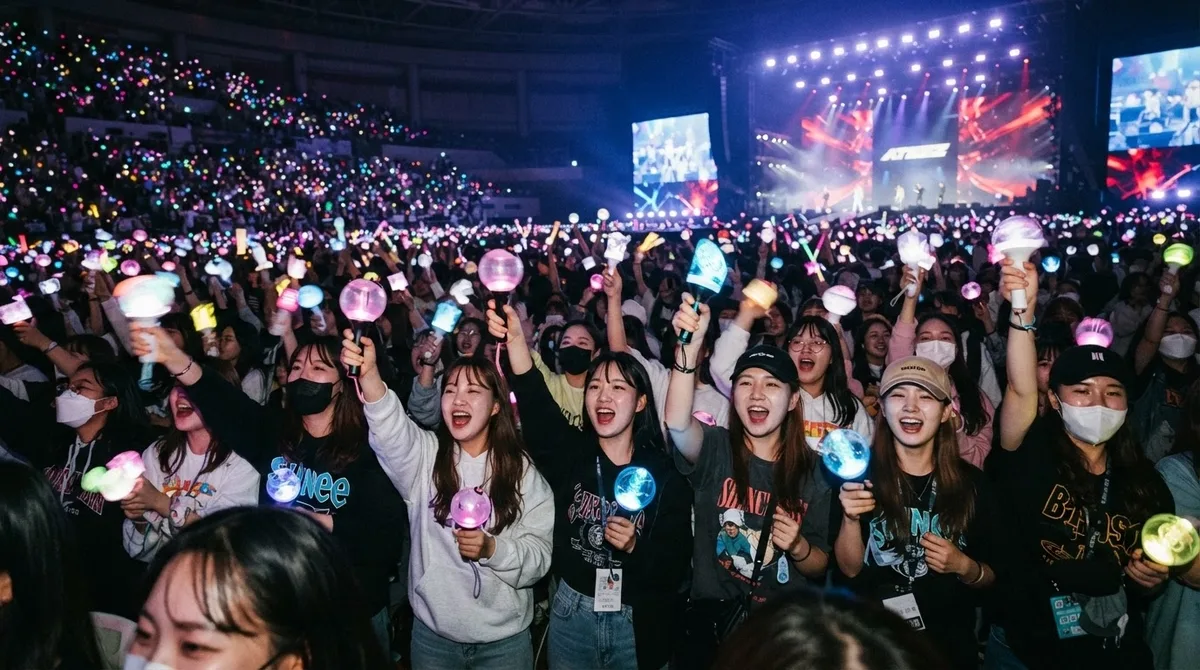
K-pop fan culture in Seoul is not a single thing. It is a layered set of parallel systems -- the official event infrastructure run by entertainment companies, the fan-organised parallel economy of cafes and swap meets and crowdfunded banners, the informal rituals around music show recordings and agency buildings, and the airport scene that produces the idol fashion photographs that circulate globally before a tour even begins.
This guide covers the mechanics. How a fan sign lottery works, step by step. What an idol cafe actually is and what you do when you walk into one. What happens at Incheon Airport and where the line between fan behaviour and sasaeng behaviour falls. What a photocard is and where the swap meets are.
Fan signs: the lottery, the album, the 30 seconds
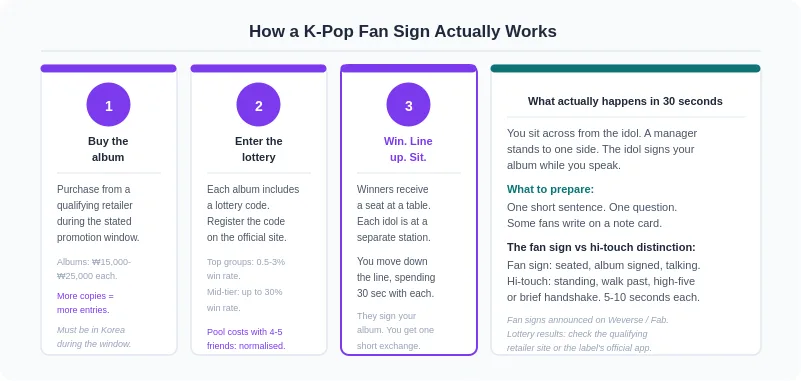
A fan sign event (팬사인회, paen-sa-in-hoe) is a formal event at which fans meet the members of a group in person, have their albums signed, and receive a short individual interaction. Fans are seated at a long table, idols sit or stand on the opposite side, and each fan moves down the line spending approximately thirty seconds with each member.
The entry mechanism is a lottery tied to album purchase. When a group releases new music, the entertainment company announces that purchases of the album from qualifying retailers during a specified promotional window will generate a fan sign lottery entry. Each album purchased registers one entry. Fans who want to improve their odds buy multiple copies -- a practice so normalised in K-pop fandom that fan communities routinely pool their resources, with groups of four or five friends splitting the cost of a larger album purchase to maximise collective entries. Albums range from approximately ₩15,000 to ₩25,000 per copy.
The odds of winning vary dramatically by group tier. For top-tier groups, winning rates range from 0.5 to 3 percent. For mid-tier groups with dedicated but smaller fanbases, winning rates can reach 10 to 30 percent -- making attendance a realistic goal for a visitor who times their trip to an active promotional period and targets groups at the right scale. Fan sign schedules are posted on Weverse, Fab, and the group's official social media; the qualifying album purchase must typically be made at a Korean retailer during the promotion window.
When a fan wins and takes their seat, the idol signs the fan's album -- usually with a personalised message if the fan has written their name and a short request on a note card. The fan has approximately thirty seconds to say what they want to say. Experienced fans prepare one short Korean phrase, one specific question, and accept that the conversation will end before it feels complete.
The fan sign vs hi-touch vs fan meeting distinction:
- Fan sign: seated, album signed, approximately 30 seconds per idol
- Hi-touch: standing, walk past, high-five or brief handshake, 5-10 seconds per idol
- Fan meeting: large event (1,000-3,000 fans) combining multiple interaction formats -- hi-touch, group games, Q&A
Idol cafes: birthday cafes, comeback cafes, and KWANGYA
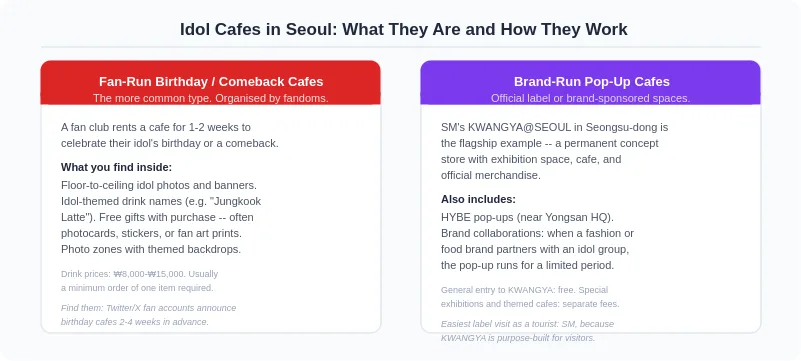
The term "idol cafe" covers two distinct things.
Fan-run birthday cafes and comeback cafes are the more common format. A fan club rents a cafe for one to two weeks to celebrate their idol's birthday or mark a comeback release. The fan club pays the rental fee and decorates the space floor-to-ceiling with photographs, banners, and fan art. The cafe's regular menu continues with drink names temporarily rebranded to idol-themed names. When you order, you receive a standard drink plus a small gift: typically a photocard, sticker sheet, or fan art print commissioned and paid for by the fan club. One drink is the usual minimum order. Prices: ₩8,000-₩15,000.
The experience inside a well-decorated birthday cafe is genuinely striking if you are unfamiliar with K-pop fan culture's intensity. Every surface is covered. The counter displays are themed. The free gift is wrapped in the group's colours. Birthday cafes are announced two to four weeks in advance through the fan club's Twitter or X account, and they are temporary -- the rental ends and the space returns to a regular cafe. Searching the idol's name plus "birthday cafe Seoul" or "생일 카페 서울" produces current results.
Brand-run pop-up cafes are the commercial equivalent. KWANGYA@SEOUL, SM Entertainment's permanent concept store in Seongsu-dong, is the flagship example: exhibition space, official merchandise, a cafe component, and rotating themed displays tied to SM's active groups. General entry is free; special exhibitions and themed cafe events within the space have separate fees or reservation requirements. It is the easiest label facility for international tourists to visit because it was designed for the fan visitor rather than as a working production building.
The standing principle across all label buildings: do not expect to meet idols by visiting company headquarters. The companies actively discourage it, and waiting outside is considered poor etiquette by the fan community itself.
What actually happens at the airport
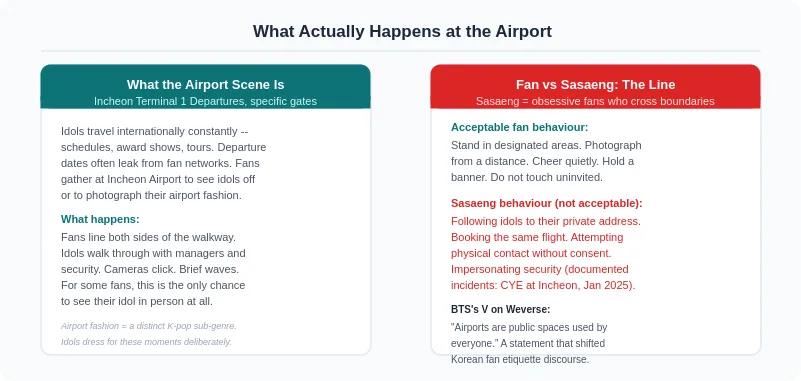
Idols travel internationally at a pace most recording artists do not. The result is a specific recurring scene at Incheon International Airport's Terminal 1 Departures. Fans gather along the walkway between check-in and the departure gates, lining both sides of the path the idol group's entourage will take. When the idols arrive, they walk through with managers and security while cameras click from both sides. The idols wave, acknowledge the fans, and continue toward their gate.
The idol's airport appearance is not an accident of public transit. It has become a distinct cultural format with its own conventions. Idols dress deliberately for airport appearances -- the photographs circulate globally within hours and generate fashion coverage that traditional entertainment media cannot replicate. "Airport fashion" is a genuine K-pop aesthetic category, produced by these departure moments.
The fan vs sasaeng distinction is specific and understood within Korean fan culture. Sasaeng (사생) refers to fans who violate the privacy and personal boundaries of idols -- who book the same flights, follow idols to their home addresses, attempt physical contact without invitation, or impersonate security personnel. The term carries significant stigma within Korean fan communities. Being identified as a sasaeng is not a compliment.
The airport crowd at Incheon, when well-behaved, consists of fans standing in designated areas, photographing from a respectful distance, cheering quietly, and holding banners. BTS's V posted a statement on Weverse asking fans to maintain orderly behaviour at airports and venues, describing them as "public spaces used by everyone" -- a statement credited with shifting the discourse around airport fan behaviour. The line is drawn at physical contact without consent and following to private locations. A documented January 2025 incident at Incheon, where a sasaeng impersonated a security officer and made physical contact with members of rookie group CYE, illustrates where the boundary falls and why it matters.
Music show recordings: seeing idols perform without a concert ticket
Korea's weekly music programs -- Inkigayo (SBS), Music Bank (KBS), Show! Music Core (MBC), M Countdown (Mnet), and The Show (SBS MTV) -- record with a live studio audience. For international fans who cannot secure concert or fan sign tickets, attending a music show recording is the most accessible route to seeing idols perform live in person.
Application process varies by show. M Countdown and Music Bank are most commonly cited as accessible for international fans. Spots are allocated by lottery or queue through the show's official social media channels. Requirements change per recording, so checking the show's official Twitter or X account within two to three weeks of your visit is the reliable approach. Some shows require a Korean phone number for registration -- a prepaid Korean SIM card at Incheon Airport is a practical first purchase.
The photocard economy and the fan merchandise ecosystem
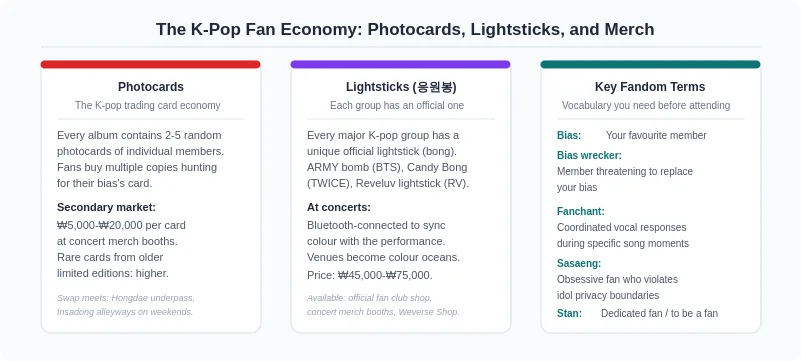
Every K-pop album includes a random selection of two to five photocards -- small rectangular cards printed with photographs of individual members. Albums are released in multiple versions, each featuring a different set. The randomness creates a hunting mechanic: fans who want a specific member's card buy multiple copies until they find it, or trade and purchase through the secondary market.
Secondary market prices: ₩5,000-₩20,000 per card at concert merch booths for common versions, higher for rare or limited-edition cards. Photocard swap meets occur in Hongdae underpasses and Insadong alleyways on weekends -- bring duplicates.
The lightstick (응원봉, eung-won-bong) is the collective fan identity object at K-pop concerts. Each major group has an officially designed lightstick; they connect via Bluetooth to the venue's production system during concerts, synchronising colour changes with the performance. A capacity arena with tens of thousands of synchronised lightsticks shifting colour simultaneously is one of the genuinely spectacular elements of large-scale K-pop concerts. Price: ₩45,000-₩75,000. Available through official fan club shops, Weverse Shop, and concert merchandise booths.
How to participate as a visitor to Seoul
Idol cafes are the most immediately accessible entry point. Birthday cafes for active groups are running somewhere in Seoul at almost any time. No advance booking. One drink purchase minimum. The tracking accounts for Seoul's idol cafes on Twitter/X update in real time.
Album stores in Hongdae and Myeongdong stock current and back-catalogue releases. The Hottracks in Myeongdong and independent stores in the Hongdae area carry photocards for purchase without album purchase in some cases, and have wall space where artists have signed copies.
KWANGYA@SEOUL in Seongsu-dong is the single most designed-for-visitors K-pop destination in Seoul. Free entry, purpose-built for the fan experience, located in the Seongsu neighbourhood that rewards additional time.
Music show recordings require the most advance planning -- two to three weeks lead time, possible Korean SIM requirement, uncertain lottery results -- but offer the most direct route to live idol performance without a concert ticket.
- Fan sign lottery: buy qualifying albums during the promotional window, register the code, 0.5-30% win rate depending on group tier.
- Fan sign = seated, signed album, 30 sec. Hi-touch = standing, high-five, 5-10 sec per idol.
- Birthday cafes: fan-run, temporary, announced via Twitter/X 2-4 weeks ahead. One drink minimum.
- KWANGYA@SEOUL in Seongsu: easiest label visit for tourists. Free entry.
- Airport at Incheon: photograph from a distance, hold a banner. Physical contact uninvited = not acceptable.
- Sasaeng = fans who violate idol privacy. A stigmatised term, not a compliment, within Korean fan culture.
- Photocard swap meets: Hongdae underpasses and Insadong alleyways on weekends. Bring duplicates.
- Lightsticks: ₩45,000-₩75,000, Bluetooth-connected to concert production. One of the genuinely spectacular elements of large-scale K-pop concerts.
For the choreography and performance side of K-pop, see the K-Pop Choreography guide. For the generational context of the groups you might encounter at these events, see the K-Pop Generations guide.
Related: How K-Pop Choreography Works: Point Moves, TikTok Challenges | ILLIT, NewJeans, aespa: 5th Gen K-Pop Explained | K-Pop Idol Brand Ambassadors: BTS, BLACKPINK, aespa 2026