Yes, ILLIT is 5th generation. That one is settled. aespa is 4th generation by debut date, though a separate debate about their concept direction keeps running. NewJeans is the genuinely hard one: they debuted in July 2022 which puts them inside the 4th gen window, but their aesthetic was different enough from the moment of debut that a meaningful portion of fans and analysts credit them with starting the 5th generation rather than closing the 4th.
Before getting into the individual cases: K-pop generations are fan and media constructs, not official industry designations. No licensing body assigns generation labels. The labels emerge retroactively as patterns become visible across multiple groups simultaneously, and the debates are a feature of the system rather than a flaw in it.
ILLIT: 5th generation, no serious debate
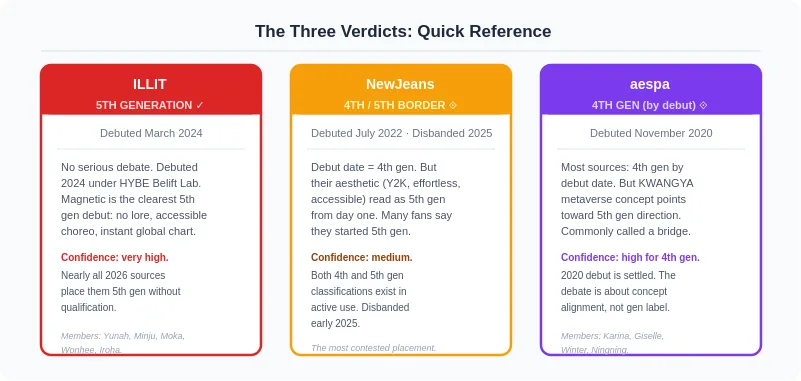
ILLIT debuted on March 25, 2024 under Belift Lab, a HYBE sub-label, through the 2023 JTBC survival show R U Next? Members: Yunah, Minju, Moka, Wonhee, and Iroha. Debut single: Magnetic -- one of the fastest-charting K-pop debuts in recent memory, entering the Billboard charts internationally and generating a TikTok challenge that spread globally within weeks.
The classification is as close to settled as any K-pop generation question gets. The 2024 debut date alone places ILLIT in the 5th gen window by any timeline that puts the 4th generation as ending around 2022. Every major K-pop generation guide published in 2025 and 2026 lists ILLIT as 5th gen without qualification. Kpopatlas.com's May 2026 analysis identifies ILLIT alongside RIIZE and BABYMONSTER as "the clearest early examples" of the 5th generation.
The content markers confirm what the debut date implies. Magnetic has no narrative lore. No universe to study, no villain to understand, no concept requiring background reading. The choreography is charming and learnable on TikTok in five minutes. The styling is Y2K-inflected and immediately accessible. HYBE positioned ILLIT explicitly as a new generation rather than a continuation of 4th gen groups within the same stable -- a deliberate choice the music and presentation backed up. The gap between LE SSERAFIM (May 2022, clear 4th gen) and ILLIT (March 2024) is twenty-two months.
If someone asks whether ILLIT is 4th gen or 5th gen: 5th gen, high confidence, no caveats required.
aespa: 4th generation with a concept that points elsewhere
aespa debuted November 2020 under SM Entertainment with Karina, Giselle, Winter, and Ningning. The 2020 debut date places them inside the 4th gen window -- the 4th gen covers roughly 2018 to 2022, and November 2020 sits comfortably within that.
The question that keeps this interesting is not when they debuted but what they built. The KWANGYA universe -- the metaverse narrative involving virtual member avatars, an antagonist named Black Mamba, and a documented fictional world -- is the most conceptually ambitious world-building exercise any K-pop group has attempted, and its character is closer to what 5th gen was moving away from rather than toward. aespa committed deeply to the narrative lore investment that defines 4th gen aesthetics.
The 5th gen argument relies on their technology integration -- the AI/metaverse concept, the virtual members, the tech-forward marketing. k-crush.com's April 2026 guide notes aespa is "heavily debated, they debuted in 2020 (technically 4th gen) but their sound and AI concept feel very 5th gen." Kpopatlas.com describes them as "a transitional moment rather than a clean line."
The practical resolution most 2026 sources land on: aespa is 4th gen by debut, with the observation that their concept direction pointed toward what 5th gen would formalise. They are a bridge group. The 4th gen classification is correct and well-supported. The 5th gen concept alignment observation is also correct and not in contradiction with it. Both things are true simultaneously.
NewJeans: the genuinely hard one
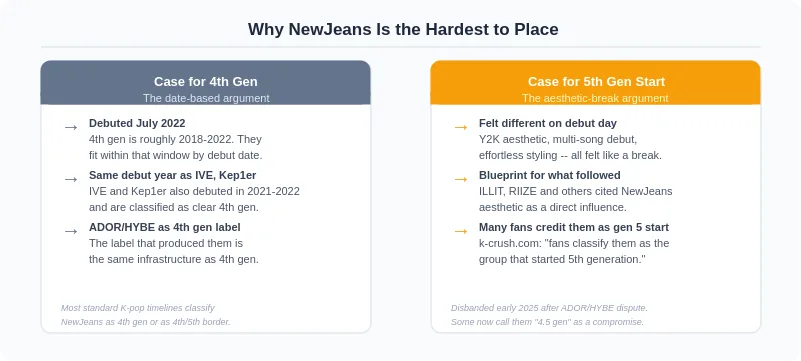
NewJeans debuted July 2022 under ADOR (HYBE sub-label) with Minji, Hanni, Danielle, Haerin, and Hyein. Multi-song simultaneous debut: Attention, Hype Boy, Hurt, and Cookie dropped together rather than building to a single title track. They disbanded in early 2025 following the HYBE-ADOR management dispute.
The 4th gen case is straightforward: July 2022 falls within the 4th gen window. IVE (December 2021), Kep1er (January 2022), LE SSERAFIM (May 2022) -- all classified as clear 4th gen without debate. On debut date alone, NewJeans belongs in the same group.
The 5th gen case is about what their debut felt like compared to what was happening around them. The Y2K aesthetic, the effortless casual styling contrasting with concept-heavy 4th gen contemporaries, the non-standard simultaneous multi-song debut, the instant multi-platform success that previous 4th gen groups took years to build -- all of these read as a break from 4th gen norms rather than a continuation. k-crush.com documents fan discourse directly: "Fans claim NewJeans started 5th gen by bringing Y2K concepts and effortless aesthetics. Everyone else argues about this constantly."
Korean media engaged with this directly when ILLIT debuted. A June 2024 kbizoom.com piece titled "NewJeans Is Gen 4 But ILLIT Is Gen 5? Korean Media Questions Standards For K-Pop Generation" documented the ambiguity: LE SSERAFIM (May 2022) is 4th gen, but ILLIT (March 2024), less than two years later, is 5th gen. The article also noted the emergence of the "4.5 generation" label as a compromise for groups sitting in the gap.
Hyoyeon of Girls' Generation offered a criticism of the whole framework: "I didn't like it because it felt like they are dividing teams within the 4th generation. We second generation idols don't have that feel." This is a legitimate observation -- the speed of label application may have outpaced the pattern recognition the labels are supposed to reflect.
The honest answer: both 4th gen and 4th/5th gen border are defensible. The 5th gen start argument has meaningful support from fans who experienced their debut as a break. The dissolution in early 2025 means the debate is now historical.
How the classification actually works
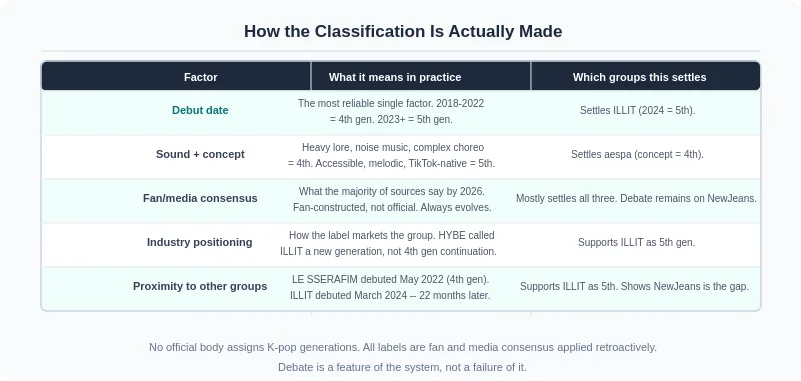
K-pop generation labels are assigned through a combination of debut date, aesthetic markers, fan consensus, and media coverage -- applied retroactively once enough groups with shared characteristics have accumulated. The process is messy precisely because it works from observable patterns rather than any predetermined schema.
Debut date is the most reliable single factor: objective, verifiable, no interpretive judgment required. The problem is that aesthetic shifts do not observe calendar years. NewJeans debuted July 2022 and felt like 5th gen. LE SSERAFIM debuted May 2022 and felt like 4th gen. Two months apart; meaningfully different aesthetic positions.
Sound and concept are where the interesting debates happen. 4th gen: elaborate narrative universes, heavy electronic production, technically demanding choreography, self-produced credibility as an identity marker. 5th gen: melodic and easy-listening sound, no lore, TikTok-optimised choreography, global-first lineups. aespa's KWANGYA universe is the extreme 4th gen end. ILLIT's Magnetic is the clear 5th gen end. NewJeans sits between them.
Fan and media consensus is the most democratic factor. When the majority of commentators converge on a classification, that consensus becomes the effective answer. For ILLIT: unanimous. For aespa: 4th gen with an asterisk. For NewJeans: split enough that "border case" is the honest description.
The Korean media debate highlights a real tension: if the gap between LE SSERAFIM (May 2022, 4th gen) and ILLIT (March 2024, 5th gen) constitutes a generational break, but the gap between LE SSERAFIM and NewJeans (July 2022, same year) does not, then what is doing the work in the classification? The answer: NewJeans's aesthetic was different from their contemporaries in ways that made the 4th/5th gen line feel like it ran through their debut rather than before or after it.
The full reference: which groups belong where
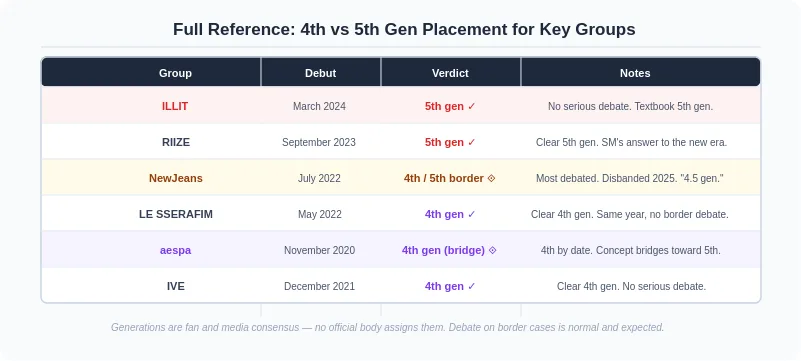
- ILLIT (March 2024): 5th gen. No debate.
- RIIZE (September 2023): 5th gen. Clear.
- BABYMONSTER (November 2023): 5th gen. Clear.
- BOYNEXTDOOR (May 2023): 5th gen. Name and concept state the position.
- ZeroBaseOne (July 2023): 5th gen. Clear.
- NewJeans (July 2022): 4th gen / 5th gen border. Both exist in active use. Disbanded early 2025.
- LE SSERAFIM (May 2022): 4th gen. Clear. Same year as NewJeans; notably different aesthetic position.
- aespa (November 2020): 4th gen by debut, concept bridges toward 5th. Bridge group.
- IVE (December 2021): 4th gen. Clear.
- STAYC (November 2020): 4th gen. Clear.
Quick answers:
- ILLIT = 5th gen. Debuted March 2024. No serious debate.
- aespa = 4th gen by debut date (November 2020). Concept points toward 5th gen direction. Bridge group.
- NewJeans = the debated one. July 2022 = 4th gen window. Aesthetic = pre-5th gen break. Both classifications have real support. Disbanded 2025.
- LE SSERAFIM (May 2022) is 4th gen without debate. NewJeans debuted the same year and the debate runs constantly. The classification is not just about debut date.
- The "4.5 generation" label emerged specifically for groups like NewJeans sitting in the gap. A workaround, not an answer.
- No official body assigns K-pop generations. All labels are fan and media consensus applied retroactively.
For the full breakdown of what defines each generation and which groups belong where, see the K-Pop Generations guide.
Related: ILLIT, NewJeans, aespa: How 5th Gen K-Pop Differs from 3rd and 4th | How K-Pop Choreography Works: Point Moves, TikTok Challenges | K-Pop Fan Culture in Seoul: Fan Signs, Idol Cafes, Airport