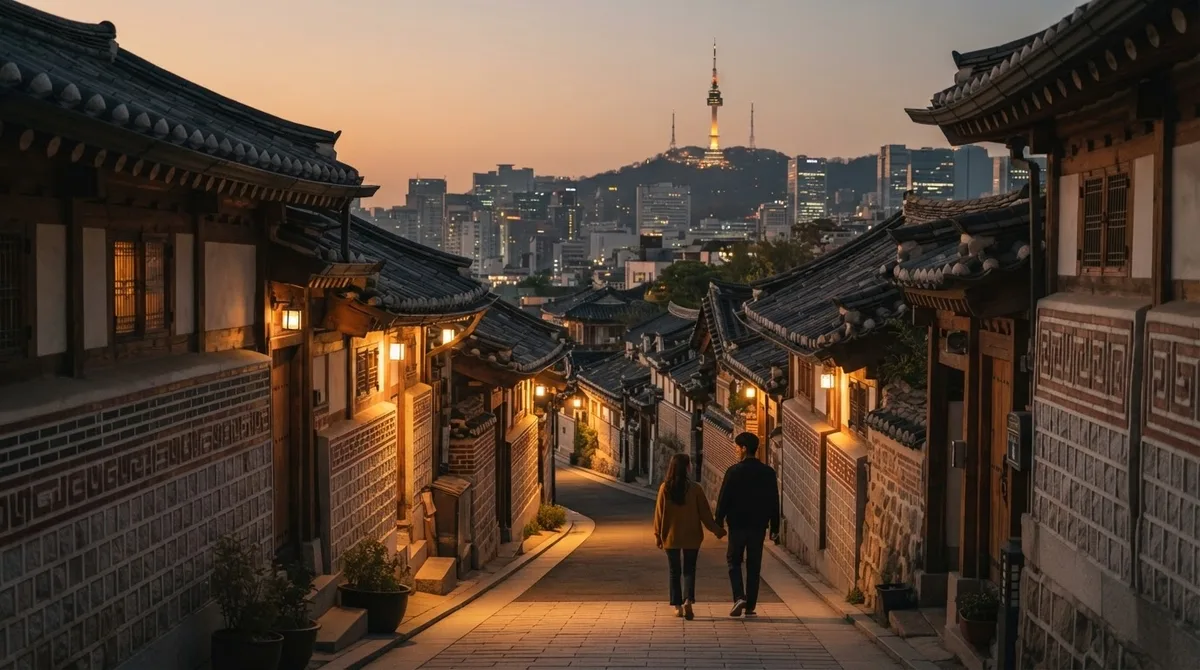
K-dramas are filmed on location. The coffee shop in the background is a real coffee shop. The bridge where the confession scene happens is a real bridge you can walk across. The alleyway where the two leads have their first argument is a real neighbourhood that still exists with the same stone walls and the same tile rooftops. Unlike most film industries, Korean drama production is built into the actual fabric of Seoul, which is why the set-jetting pull is so strong for international visitors. You recognise the city before you arrive.
This guide covers eight locations in Seoul that appear repeatedly across beloved dramas, all publicly accessible, nearly all free, and all worth visiting independent of any screen connection. Subway directions, best timing, what to actually expect on the ground, and two full-day routes to combine them efficiently.
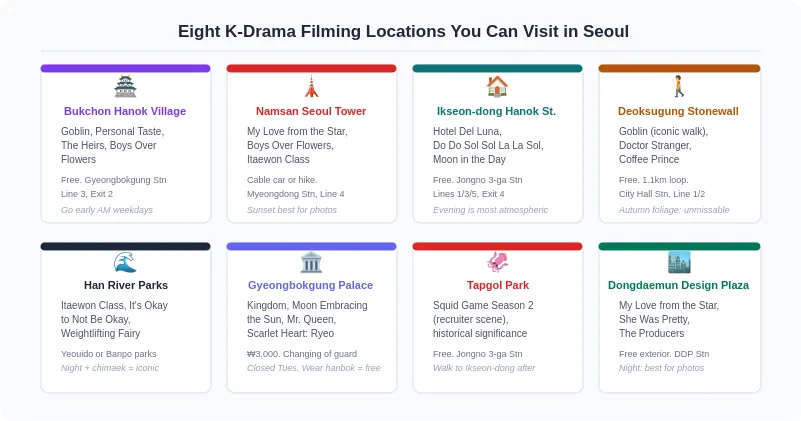
Bukchon Hanok Village
Dramas filmed here: Goblin, Personal Taste, The Heirs, Boys Over Flowers, Jewel in the Palace.
Bukchon is a living neighbourhood of more than nine hundred traditional Korean houses, wedged between Gyeongbokgung and Changdeokgung palaces in central Seoul. The narrow lanes and tile-roofed hanok buildings have appeared in more dramas than any other single location in the city, most famously in Goblin, where Kim Shin's supernatural encounters play out against the ancient stone walls and wooden gates. The Bukchon 8-gyeong viewpoint — the sharp alley on the hillside with the perfect perspective down the rooftop-lined lane — is the specific shot most visitors are looking for, and it does exist exactly as seen on screen.
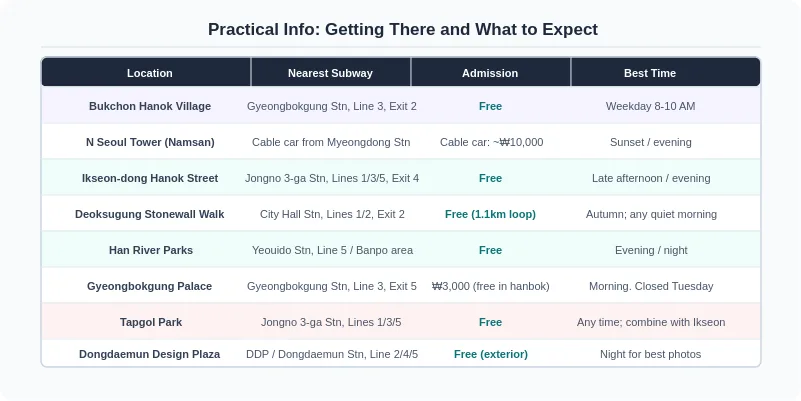
The honest visitor caveat: Bukchon is heavily trafficked and residents have made formal noise complaints about tourist volume. Silence on the alleys is expected. Go on a weekday morning, before 9 AM, and you will have the lanes largely to yourself for photographs and the experience the dramas convey. Arrive on a weekend afternoon and you will be navigating dense crowds. No admission fees. Access via Gyeongbokgung Station, Line 3, Exit 2, then a ten-minute walk.
Namsan Seoul Tower
Dramas filmed here: My Love from the Star, Boys Over Flowers, Itaewon Class, Goblin, and dozens more over four decades of Korean television.
N Seoul Tower sits on Namsan Mountain at 480 metres above sea level, visible from most of central Seoul, and represents what might be the highest density of K-drama filming scenes of any single landmark in the country. The love lock fence — thousands of padlocks attached by couples — appears in so many romantic scenes it has become a genre convention rather than a specific drama reference. The tower can be reached by cable car from Myeongdong Station, by bus, or by a forty-minute hike through Namsan Park. The cable car costs approximately ten thousand won return and is worth taking at least one way for the city views.
Go at sunset. The light on the padlocks and the cityscape below is the photograph everyone wants, and the timing matches the romantic hour that most dramas film at this location.
Ikseon-dong Hanok Street
Dramas filmed here: Hotel Del Luna, Do Do Sol Sol La La Sol, Moon in the Day, and numerous contemporary romance dramas.
Ikseon-dong is a 1920s hanok neighbourhood repurposed into one of Seoul's most atmospheric concentrations of specialty cafes, craft cocktail bars, and independent restaurants. The juxtaposition of traditional tile rooflines with specialty coffee menus is exactly what makes it cinematically appealing and genuinely enjoyable to walk through. Hotel Del Luna used the area's narrow, lantern-lit alleyways extensively for its romantic scenes, and the atmosphere that made those scenes work is entirely intact.
Unlike Bukchon, Ikseon-dong is set up for visitor spending rather than just photography — the businesses are there to serve you, the streets are designed for wandering, and the evening atmosphere when the lights come on is the best time to experience it. Access via Jongno 3-ga Station, Lines 1, 3, or 5, Exit 4. Combine with Tapgol Park, five minutes away.
Deoksugung Stonewall Walkway
Dramas filmed here: Goblin (the iconic walk scenes), Doctor Stranger, Coffee Prince.
The Deoksugung Stonewall Walkway, known locally as Doldam-gil, is a 1.1 kilometre loop around the perimeter of Deoksugung Palace in central Seoul. The stone wall, the overhanging trees, and the season-changing palette make it one of the most photographed walking routes in the city regardless of any drama connection. In Goblin, the walkway provides the setting for the drama's most visually distinctive scenes — the two leads walking in supernatural quiet along the stone wall in autumn light — and visiting in autumn, when the trees along the path turn gold and orange, reproduces that visual faithfully.
Worth knowing: the full 1.1 kilometre loop was only completed recently, after a section remained closed for over sixty years while the British Embassy occupied part of the perimeter. There is also a local myth that couples who walk here are destined to break up — a superstition traced to the Seoul Family Court once being located at the end of the path. The court has since moved. Access via City Hall Station, Lines 1 or 2, Exit 2.
Gyeongbokgung Palace
Dramas filmed here: Kingdom, The Moon Embracing the Sun, Mr. Queen, Scarlet Heart: Ryeo, Jewel in the Palace.
Gyeongbokgung is Seoul's largest palace complex, built in 1395 at the founding of the Joseon dynasty, and the default filming location for any drama set in the royal court. Kingdom used the palace exteriors for the scenes establishing the political power structures at the centre of the story — exterior courtyards and grand gates rather than interiors, which are largely reconstructed for filming.
Entry is 3,000 won. Arriving in hanbok gives you free entry, and rental shops operate immediately outside the main gate. The changing of the royal guard ceremony happens at the main gate at 10 AM and 2 PM daily, except Tuesdays when the palace is closed. The palace grounds take two to three hours to cover properly. Go in the morning when the light is best and the tour groups have not fully arrived.
Tapgol Park and Squid Game Season 2
Dramas and films filmed here: Squid Game Season 2 (the recruiter scene); multiple historical dramas.
Tapgol Park became one of 2026's most visited K-drama filming locations after Squid Game Season 2 featured it as the setting for the recruiter's opening sequence — where Gong Yoo's character distributes bread and lottery tickets to financially desperate Seoul residents before drawing them into the game. The scene was filmed in the park's central pavilion area, among elderly locals who regularly use the park for socialising and board games. Multiple visitors have documented accidentally discovering the location by recognising it from the drama.
Beyond the Squid Game connection, Tapgol Park holds significant historical weight as the site of the March 1st Independence Movement declaration in 1919, and houses the Wongaksa Pagoda, a ten-storey stone structure from the 15th century designated National Treasure Number Two. The park is small — thirty minutes covers it completely — and is best combined with an immediate walk to Ikseon-dong, five minutes away. Free entry. Access via Jongno 3-ga Station, Lines 1, 3, or 5.
Dongdaemun Design Plaza
Dramas filmed here: My Love from the Star, She Was Pretty, The Producers.
The Dongdaemun Design Plaza, designed by Zaha Hadid, is a flowing, curves-dominant structure that provides the visual language Korean drama directors reach for when they need a scene to feel metropolitan and contemporary. In My Love from the Star, the DDP provided the backdrop for the drama's fashion industry sequences and the alien protagonist's encounters with modern Seoul. The building functions as an exhibition and event space; the exterior is always accessible and free, and photographed most effectively at night when the LED-lit facade glows against the surrounding Dongdaemun market district. Access via DDP Station or Dongdaemun History and Culture Park Station, Lines 2, 4, or 5.
Han River parks
Dramas filmed here: Itaewon Class, It's Okay to Not Be Okay, Weightlifting Fairy Kim Bok-joo, My Mister.
The Han River runs through the centre of Seoul and the parks along its banks are where Koreans actually spend their leisure time — cycling, picnicking, flying kites, eating convenience store ramen on the grass. The drama scenes filmed here capture something real about how Seoul residents use public space. The chimaek ritual — fried chicken and beer, bought from convenience stores and consumed riverside — appears in Itaewon Class in a way that matches exactly what you can do yourself on any evening at Yeouido Hangang Park or Banpo Riverside Park.
Banpo Bridge's water fountain show, which runs in the evenings during warmer months, provides a cinematic backdrop worth seeing regardless of any drama connection. Access to Yeouido Hangang Park via Yeouido Station, Line 5. Both parks are free. Night visits are the most atmospheric.
Practical information
Two suggested day routes
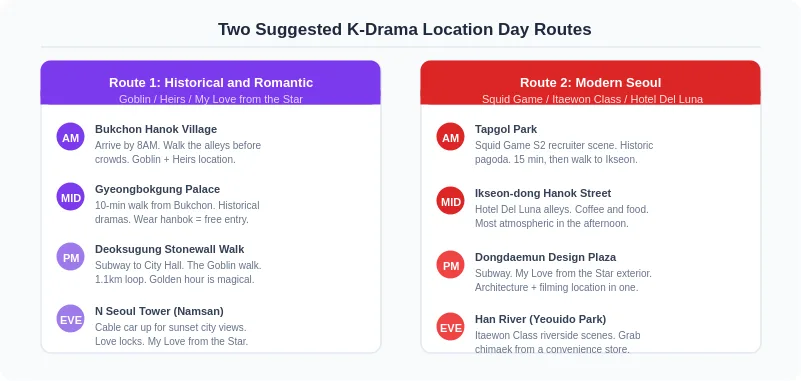
Route 1: Historical and romantic (Goblin / Heirs / My Love from the Star) — Bukchon Village early morning, Gyeongbokgung Palace mid-morning, Deoksugung Stonewall Walk afternoon, Namsan Tower at sunset. Works best on a clear day. All locations are walkable or a short subway hop from each other.
Route 2: Modern Seoul (Squid Game / Hotel Del Luna / My Love from the Star) — Tapgol Park morning, Ikseon-dong for lunch and afternoon exploring, DDP late afternoon for the architecture and night photography, Han River for the evening chimaek. The contemporary drama fan's itinerary.
What to know before you go
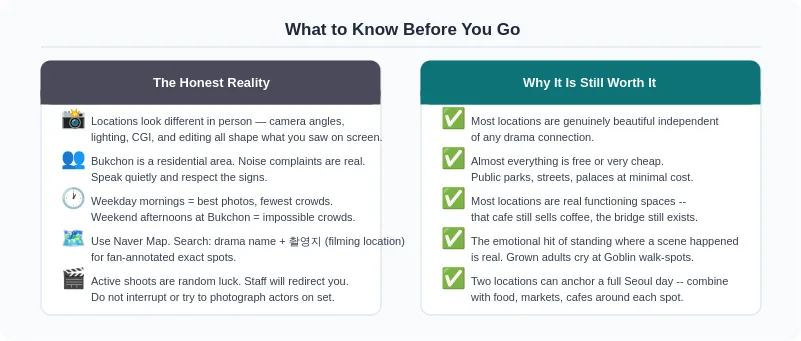
Locations look different in person from how they appear on screen. Camera angles, focal lengths, production lighting, set dressing, and increasingly CGI enhancement all shape the version you watched. The Deoksugung walkway in person is quieter and less cinematic than the Goblin version. Bukchon's famous alleyway is steeper and shorter than it appears in establishing shots. This is not a disappointment — the physical reality of these places is often more interesting and more genuinely beautiful than the drama-heightened version — but going with calibrated expectations is better than going with exact scene recreation in mind.
Bukchon is a residential neighbourhood with documented complaints about tourist disruption. Speak quietly on the alleys, respect the no-photography signs that some residents have posted, and treat the area as a living neighbourhood rather than an open-air film set. The respectful approach also produces the quiet, uncrowded early morning conditions that make the location look the way it does in the dramas.
For finding specific scene locations within the areas covered above, Naver Map is more useful than Google Maps in Korea. Search the drama name plus 촬영지 (filming location) and fan-annotated maps of exact spots often appear. Korean drama fan forums and subreddits maintain detailed location guides more precise than any generalised guide can provide.
- Bring a T-money card or transit app for subway travel between locations.
- Bukchon: weekday mornings only. Everything else is manageable on weekends.
- Wearing hanbok to Gyeongbokgung gives free entry and photographs that match the historical drama aesthetic.
- Combining Tapgol Park, Ikseon-dong, and Insadong in one afternoon gives three distinct atmospheres within easy walking distance.
- The Han River parks are best after 6 PM when the heat drops and city lights appear on the water.
Related: The 3-Day Seoul Skin-Treatment Trip | Seoul Street Style 2026: Seongsu-dong and Hongdae