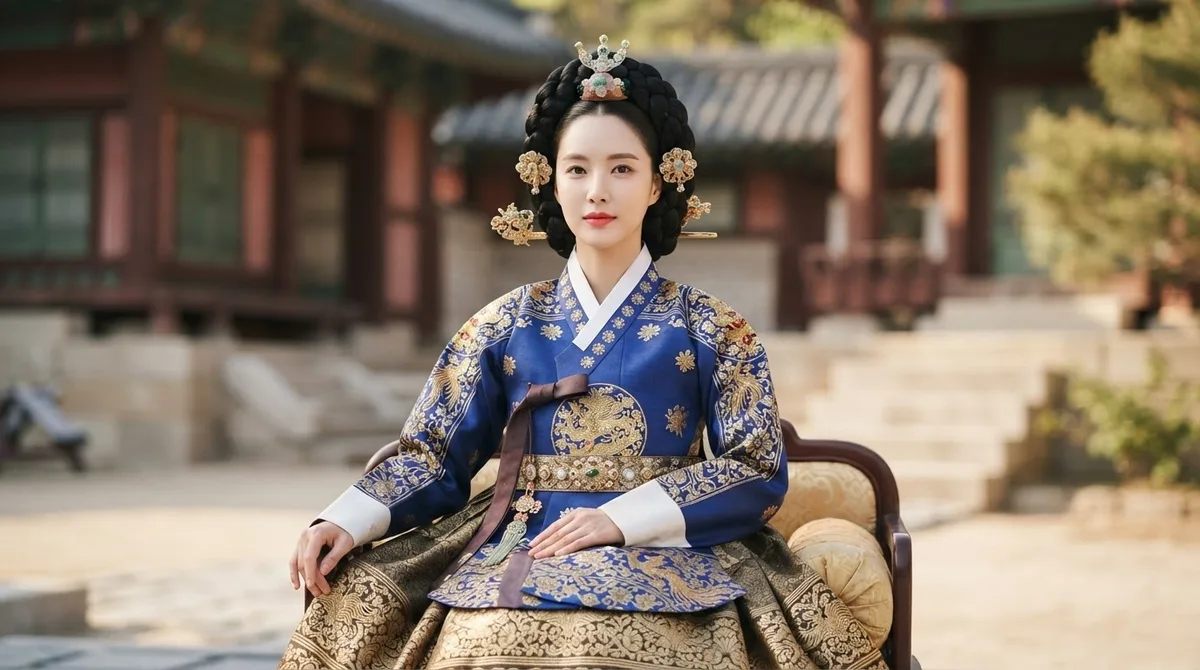
K-drama makeup is not decorative. It is a genre signal -- a visual grammar that tells the audience something about a character before she speaks, and about the story before the plot makes it explicit. The gradient lip and dewy glass skin of a romance lead communicate emotional availability. The pallid, hollow-eyed look of a thriller character communicates psychological pressure. The matte powdered complexion and red-stained lips of a sageuk queen communicate status and period. Each genre has a distinct beauty vocabulary, and the vocabulary is consistent enough that experienced K-drama viewers can read a character's trajectory from the first close-up.
This is not a coincidence. K-drama productions employ dedicated makeup directors who make deliberate decisions about what each character's face communicates at each stage of the story. The romance lead's dewy skin is not the result of a good skincare routine happening to photograph well on set. It is a calculated choice by the makeup team to signal approachability, emotional openness, and the particular quality of readiness for love that the genre requires. The thriller's hollow-eyed, colour-depleted look is not neglect. It is the makeup team's method for inscribing psychological pressure directly onto the face.
The genre beauty matrix
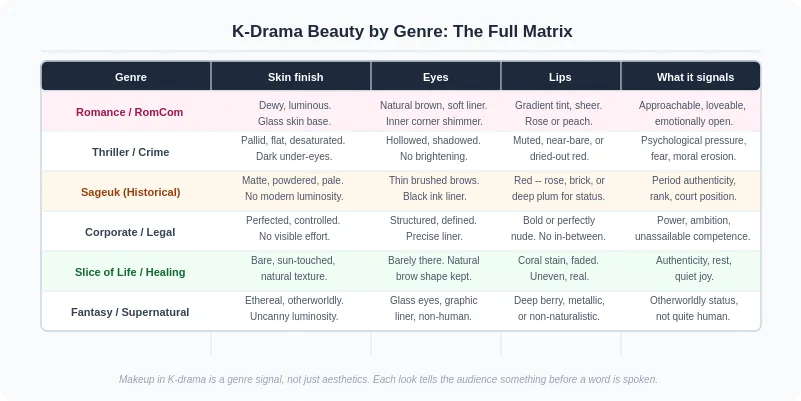
Six genres dominate K-drama production in 2026, and each has a recognisable set of beauty conventions.
Romance / RomCom: Dewy, warm, approachable. Glass skin or honey skin base, cream blush placed high on the cheekbones, soft brown or neutral eyeshadow with inner corner shimmer, gradient lip tint in rose or peach. The gradient lip is the single most recognisable K-drama beauty technique and the one most directly associated with the romance genre. The beauty throughout a romance drama is designed to be consistently appealing -- when the romance lead's makeup becomes more dishevelled or muted, it is a narrative signal that something has gone wrong.
Thriller / Crime: Pallid, flat, desaturated. Dark circles left visible or subtly reinforced. Minimal lip -- bare or the muted near-red of someone stressed and not thinking about their appearance. No luminosity because luminosity is a warmth signal, and the thriller has systematically removed warmth from its visual palette. Hair left loose and slightly disordered.
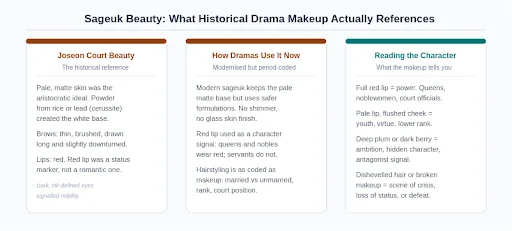
Sageuk (Historical): Matte, porcelain, pale. No modern luminosity. Thin brushed brows drawn long and slightly downturned. Black ink liner. Red lip as a status marker, not a romantic one. The matte powder finish is the genre signal.
Corporate / Legal: Controlled, perfected, no visible effort. Structured liner, defined brow, statement lip (bold) or precisely applied nude (nothing casual). Makeup as armour -- never dishevelled, never warm in the romance sense. When it finally falters, that faltering is the drama's signal that something is cracking.
Slice of Life / Healing: Bare, sun-touched, natural texture. Barely-there eye. Coral stain applied unevenly and allowed to fade. Freckles visible. The genre where beauty adapts to the character's life rather than curating it.
Fantasy / Supernatural: Ethereal, otherworldly. Uncanny luminosity. Graphic or non-naturalistic liner. Metallic or deep non-natural lip colours. Signals non-human or supra-human status.
Romance: the gradient lip, the inner corner, the glass skin base
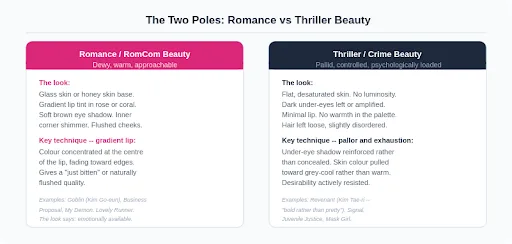
The romance look has three structural elements that appear consistently across productions and time.
The glass skin or honey skin base. Romance leads are never shown with visible pores, texture, or the signs of inadequate sleep, regardless of plot. The skin is luminous, even-toned, and specifically dewy -- warmer and softer than the corporate drama's controlled polish. In the 2026 K-drama context, the romance base has shifted from the wet, reflective glass skin that dominated 2020-2021 productions toward the softer, diffuse luminosity of cloud glow or honey skin -- still radiant but less aggressively shiny.
The gradient lip. A lip tint applied to the centre of the lips and blended outward until it fades naturally toward the outer edges. The result looks like a natural flush rather than a product application. The colour is almost always warm: rose, coral, peach, or the Korean strawberry red that reads as youthful and energetic. Deep wines, nudes, and graphically applied opaque lipsticks belong to other genres. When a production uses the gradient lip on a corporate lead or thriller character, it is a deliberate signal that this character has an emotional life she is not showing in her professional context.
The inner corner shimmer. A small dot of shimmer at the inner corner of each eye -- where upper and lower lids meet at the nose. Brightens and enlarges the eye without adding product elsewhere. Harper's Bazaar Korea's 2026 trend report identifies inner corner highlight as one of the seven dominant K-beauty makeup trends of the year, associating it with both K-pop idol aesthetics and K-drama leads.
The fourth consistent element is the watercolour flush: cream blush applied higher on the cheekbone than Western conventions would place it, blended with more transparency so it reads as a flush of emotion rather than a product. The blush placement above the cheekbone extending toward the temple creates the impression of a face lit from within.
Thriller: what happens when K-drama makeup removes beauty
The thriller genre's beauty treatment is best understood as a deliberate removal of the romance aesthetic's signals. Every element that communicates warmth, openness, and approachability is reduced, neutralised, or reversed.
Kim Tae-ri's appearance in Revenant is the benchmark. Tatler Asia's February 2026 analysis describes it precisely: her skin is often pallid, her eyes ringed with fatigue, her hair left loose in ways that feel uncontrolled rather than romantic. Makeup choices lean into exhaustion and fear rather than enhancement -- darkened under-eyes, flattened colour, a sense of physical depletion. The look resists desirability and instead emphasises psychological erosion. It's rare for a K-drama to let a female lead look truly haunted, and rarer still for that to be the point. In Revenant, the haunted look is not a failure of the beauty team. It is the achievement.
The technical moves are the inverse of the romance moves. The skin base is pulled toward cool or grey tones. Where the romance base adds luminosity, the thriller base removes it. Under-eyes left visible or subtly enhanced with cool-toned shadow. The lip is near-bare -- not the glossy nude of lingerie makeup, but the dried-out, depleted look of someone who is not hydrating properly and not thinking about their mouth. Hair genuinely loose or slightly disordered, suggesting loss of control rather than artful casualness.
The corporate thriller -- Hong Cha-young in Vincenzo, the female prosecutors in Signal, the judges in Juvenile Justice -- occupies a hybrid. The makeup is controlled because professional competence requires it. But it is cooler in tone than the romance lead's warmth, and more rigid. The eyebrows are precisely shaped. The lip is bold and intentional or perfectly nude with no warmth. The skin is flawless in the way armour is flawless: perfectly maintained, but not warm.
Sageuk: reading Joseon court beauty
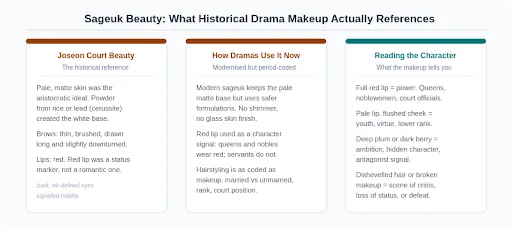
The Joseon dynasty (1392 to 1897) is the setting for most K-drama sageuk, and its beauty codes are distinct from modern Korean beauty in ways that well-designed productions reference accurately.
The Joseon court ideal for aristocratic women was pale, matte skin -- a complexion that read as sheltered from outdoor labour and therefore high status. The makeup formulations of the period used rice powder and, in some cases, lead-based preparations to achieve the white base. Modern sageuk productions recreate the pale matte finish using contemporary safe formulations but maintain the aesthetic: no luminosity, no dewy finish, no shimmer. The glass skin ideal that dominates contemporary K-beauty would be completely wrong for a Joseon court setting.
Eyebrows in sageuk are drawn rather than filled -- thin, elongated, extending slightly beyond the natural brow line and turning subtly downward at the outer end. The black ink liner at the eye, extending subtly at the outer corner to lengthen rather than lift, completes the period-specific eye look that distinguishes sageuk from every other K-drama genre.
The red lip is the most symbolically loaded element. Queens, high-ranking noblewomen, and female court officials wear full, stained red lips that communicate power and status. Lower-ranking women wear softer or pale lip colour. The antagonist or ambitious noblewoman often wears a deeper red tipping toward plum or berry -- the lip colour as a visual signal of hidden ambition. When a character's makeup is deliberately disturbed -- hair falling from its structured style, powder disturbed, lips depleted -- it signals loss of status, political crisis, or genuine vulnerability that the court context otherwise suppresses.
Corporate and legal drama: makeup as armour
The corporate drama's beauty convention is built around controlled, deliberate perfection -- makeup that communicates the character never has an off day, never lets her guard down publicly, and has explicitly chosen her appearance as a professional statement.
Jeon Yeo-bin's Hong Cha-young in Vincenzo is the most cited example. Her look is consistently flawless across the drama, and when the drama finally shows her composure cracking, the change in her appearance -- slightly less controlled hair, a lip that has lost its fresh application -- is the visual register of the crack. The specific makeup elements: a more structured brow than the romance genre would use, defined eye with clean liner, and a lip that is either a definite statement colour (red, burgundy, dark berry) or a precisely applied nude with no warmth or softness. The skin is perfect but not dewy -- polished rather than natural.
Slice of life and healing: the genre that removes the curation
Slice of life and healing drama is where K-drama makeup gets closest to actually looking like no makeup. The most demanding approach technically because it requires studying casualness that remains consistent under studio lighting.
Shin Min-a's look in Hometown Cha-Cha-Cha is the reference for the genre's 2026 aesthetic. Tatler Asia notes that "the beauty doesn't aestheticise rural life; it adapts to it" -- describing a look where freckles are left visible, coral blush fades unevenly rather than sitting precisely on the cheekbone, and hair moves naturally rather than being styled for camera conditions.
The distinction between the romance genre's artful naturalness and the slice of life genre's actual naturalness is a matter of intent. The romance lead's "no-makeup makeup" is constructed to be maximally appealing, every element calculated to produce the impression of effortless beauty. The slice of life lead's appearance is allowed to be slightly imperfect in ways that matter to the story -- a windburned cheek that doesn't look like blush, a lip that isn't moisturised because the character has been working.
How to recreate each look: practical steps
The romance look: Honey skin or cloud glow base. Skin tint or sheer foundation. Cream blush in peach or warm rose, high placement, blended upward. Shimmer dot at the inner corner of each eye applied with fingertip. Gradient lip: concentrate tint at the lip centre with a fingertip, blend outward until it fades naturally. No powder anywhere -- any mattifying step removes the dewy quality that defines the look.
The thriller look: Cool-toned or neutral base, no warm tones. Skip or minimise concealer under the eyes. Cool grey or taupe shadow blended into the socket -- no shimmer, no brightening. Near-bare lip or deliberately dry application of a slightly muted berry. Hair left loose and unstyled. Resist the impulse to add warmth, glow, or blush.
The sageuk look: Full-coverage matte base pulled toward cool or neutral, not warm. The skin should look powdered and porcelain. Brows drawn thinner than natural, extended longer, with a subtle downward turn at the outer end. Black liner at the lash line, extended subtly at the outer corner to lengthen. Full, stained red lip -- coverage not sheerness, no blurred edge, a deliberate statement of the face rather than a natural attribute of it.
- Romance: dewy base, gradient lip (centre-concentrated tint), inner corner shimmer, high cream blush. No powder, no contouring.
- Thriller: cool-toned base, visible under-eyes, grey socket shadow, near-bare or dried-out lip, loose disordered hair. Desirability actively resisted.
- Sageuk: matte porcelain base, thin elongated brows (slightly downturned), black liner extended at outer corner, full stained red lip. No shimmer anywhere.
- Corporate/legal: controlled skin, structured brows, defined liner, statement lip or precise nude. Makeup as armour.
- Slice of life: deliberately imperfect naturalness. Freckles visible, coral blush unevenly applied, hair functional not decorative.
- Fantasy: uncanny luminosity, graphic or non-naturalistic liner, metallic or deep non-natural lip. Signals non-human status.
- The gradient lip is the single most recognisable K-drama beauty technique. It belongs to romance specifically. Its appearance in other genres is always a deliberate signal.
For the skincare base that K-drama beauty is built on, see the Honey Skin guide and the Cloud Glow Skin guide. For K-drama filming locations where these looks appear, see the K-Drama Filming Locations Outside Seoul guide.
Related: Honey Skin: The Korean Beauty Trend That Comes Before Glass Skin | Cloud Glow Skin: The 2026 Korean Trend That Replaced Glass Skin | K-Drama Tropes Explained: Airport, Wrist Grab, Slow Burn