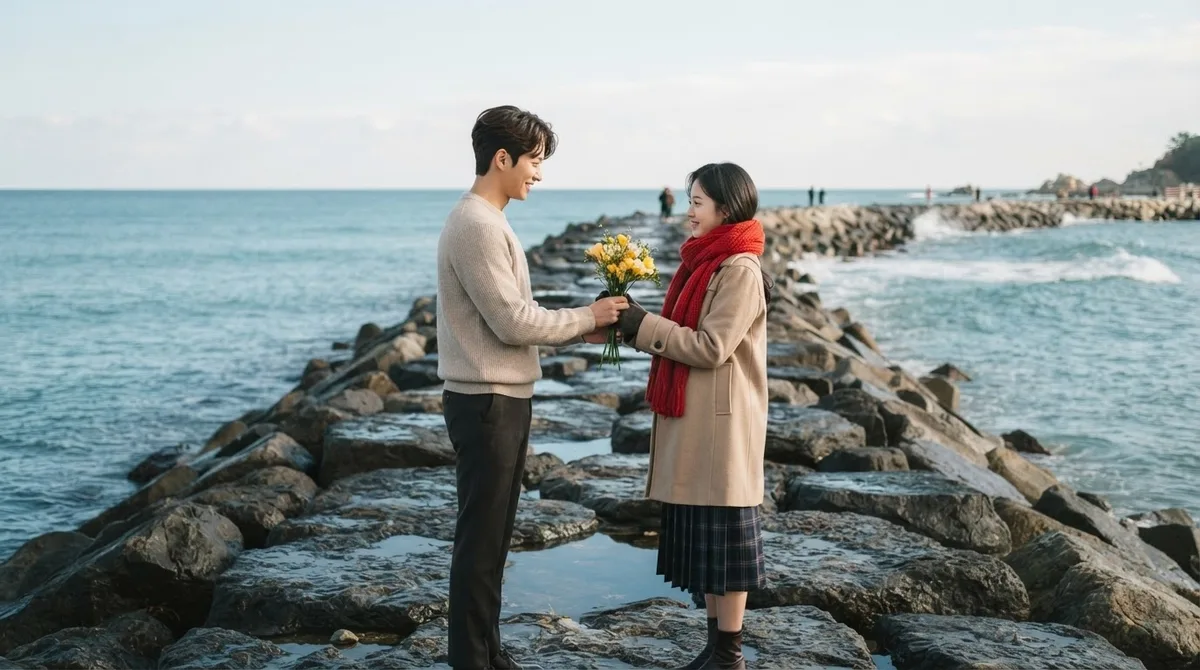
The most iconic single moment in Goblin -- Ji Eun-tak standing on a concrete breakwater above the East Sea, candle in hand, waiting for Kim Shin to appear from nothing -- was filmed at Jumunjin Beach in Gangneung, two hours from Seoul by KTX. The four lead actors returned there in May 2026 to film the drama's 10th anniversary special at the same breakwater. That is the particular quality of K-drama filming locations outside Seoul: they are specific enough to be exactly as you remember them, and real enough to have their own life beyond what the camera captured.
Location overview: getting there from Seoul
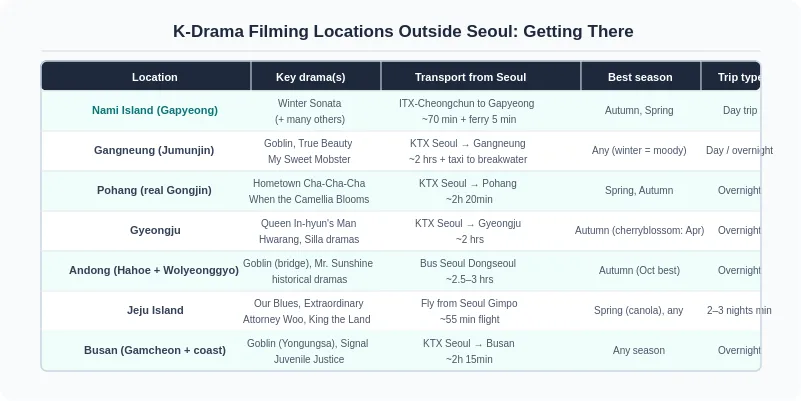
Korea's filming locations outside Seoul cluster into three geographic zones: the Gangwon Province coastal and mountain zone to the northeast (Gangneung, Sokcho, Nami Island), the eastern and southeastern zone (Pohang, Gyeongju, Andong, Busan), and the south and island zone (Jeju, Yeosu, Suncheon). The KTX bullet train reaches most of these within two to two and a half hours from Seoul Station, making day trips viable for some and overnight trips appropriate for most.
The practical approach: cluster by geography rather than by drama. A Gangneung day trip covers Goblin's breakwater and the coast's other drama locations. A Pohang overnight combines with a Gyeongju day trip via local bus. Busan and Andong combine on a three-day southeast route. Jeju requires its own trip of at least two nights.
Gangwon-do: Goblin's coast and Nami Island
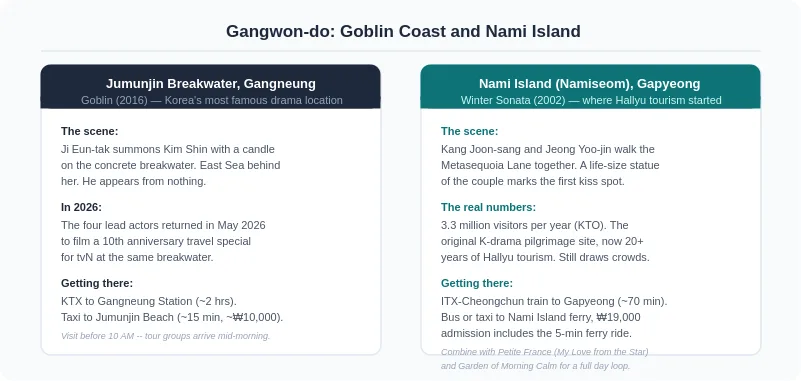
The Jumunjin Breakwater in Gangneung is Korea's single most visited drama filming location. The concrete breakwater juts into the East Sea at Jumunjin Beach, and the camera angle from Goblin -- looking from the beach toward the open sea, Ji Eun-tak's red scarf caught by the coastal wind -- is reproducible from the same position the production camera occupied. A photo zone at the site recreates the scene with drama stills for reference. The location has since been used in True Beauty (2020-21), My Sweet Mobster (2024), and Love Next Door (2024).
In May 2026, Gong Yoo, Kim Go-eun, Lee Dong-wook, and Yoo In-na returned to Jumunjin to film a 10th anniversary travel special for tvN at the same breakwater. The breakwater itself has not changed. The sea looks exactly as it did on screen.
Getting there: KTX to Gangneung Station (~2 hrs), taxi to Jumunjin Beach (~15 min, ~₩10,000). Visit before 10 AM -- tour groups arrive mid-morning. Beyond Jumunjin, Anmok Beach Coffee Street, Gyeongpo Beach, the Sacheon Beach area, and Chodang Sundubu Village (soft tofu restaurants, also in Goblin) all reward more time in Gangneung.
Nami Island (남이섬, Namiseom) sits on the Bukhangang River in Gapyeong, about seventy minutes from Seoul by ITX-Cheongchun train to Gapyeong Station. The island's Metasequoia Lane became the backdrop for Bae Yong-joon and Choi Ji-woo's iconic scenes in Winter Sonata (2002) -- this is where Hallyu tourism began. Japanese viewers flooded Gapyeong in such numbers after Winter Sonata aired that the KTO credits the drama with establishing K-drama tourism as a travel category. Nami Island now draws approximately 3.3 million visitors per year (KTO data).
A life-size statue of the Winter Sonata couple marks the first kiss spot. Adult admission of ₩19,000 includes the five-minute ferry crossing. The most efficient Seoul day trip combines Nami Island with the Garden of Morning Calm and Petite France -- the French-themed village used in My Love From the Star and Secret Garden, about twelve minutes away by taxi.
Pohang: where Gongjin actually is
The fictional seaside village of Gongjin in Hometown Cha-Cha-Cha (2021) does not exist. The real filming locations are spread across Pohang's Cheongha-myeon area in North Gyeongsang Province, approximately two hours and twenty minutes from Seoul by KTX to Pohang Station.
What visitors find is something arguably better: a working coastal community that had the warmth and simplicity the drama required without being constructed for that purpose. Pohang is not an overbuilt tourist city imitating Gongjin. It already was the peaceful seaside place the production needed.
Cheongha Market served as Gongjin Market. The city government added a squid statue and 'Gongjin Market' marker in Korean after the drama aired. The market operates on days ending in 1 or 6 as a traditional rotating market -- visit on those days for an atmosphere closest to what the drama captured. Wolpo Beach, where Hye-jin and Du-sik first met, is a fifteen-minute bus ride from the market. Sabang Memorial Park (Mugeunbong Peak), where the mysterious boat overlooking the sea appeared in episode one, requires a twenty-minute uphill walk from the park entrance.
Pohang's filming locations are genuinely spread across the city -- one visitor described the full set as equivalent in size to two Manila metropolitan areas. A rental car makes the visit manageable. Two days is the minimum. Gyeongju, thirty to forty-five minutes from Pohang by bus, makes a natural second stop.
Gyeongju and Andong: historical drama territory
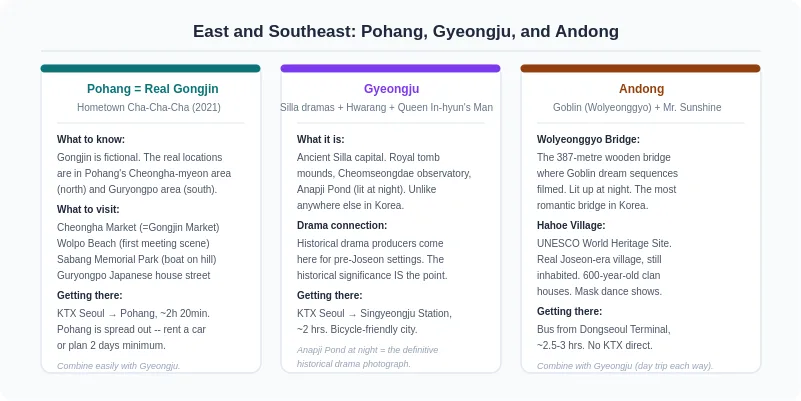
Gyeongju is the ancient capital of the Silla kingdom -- which preceded the Joseon dynasty that most dramas default to -- making it uniquely suited to historical productions set before the Confucian era. The royal tomb mounds (대릉원), Cheomseongdae astronomical observatory, and Anapji Pond (Donggung and Wolji) create an atmosphere unlike anywhere else in Korea. Anapji Pond at night, when the ancient pavilions are reflected in still water under illumination, is one of the better photographs available in Korean drama tourism.
Getting there: KTX to Singyeongju Station (~2 hrs). Bicycle-friendly. Cover the main historical and filming sites in a single day.
Andong provides two specific locations that no other region can replicate. The Wolyeonggyo Bridge is a 387-metre wooden bridge spanning the Nakdong River that appeared in Goblin's dream sequences, illuminated at night, consistently described as the most romantically atmospheric bridge in Korea. Hahoe Village (하회마을) is a UNESCO World Heritage Site -- 600-year-old clan houses still inhabited -- a real Joseon-era aristocratic village rather than a purpose-built drama set. The traditional Hahoe Byeolsingut mask dance has been performed here for centuries and has been featured in dramas.
Getting to Andong: bus from Dongseoul Terminal (~2.5-3 hrs). No direct KTX. Combine with Gyeongju as a day trip in each direction.
Jeju Island: the escape setting
Jeju is where K-dramas go when a character needs distance from ordinary life. The volcanic coastlines, stone walls, open agricultural fields, and haenyeo diving culture produce visual language Seoul cannot approximate. Our Blues (2022), Extraordinary Attorney Woo (2022), King the Land (2023), and When Life Gives You Tangerines (2025) all used Jeju for distinct emotional registers.
Extraordinary Attorney Woo's Jeju filming is particularly accessible for location-hunting: Gwaneumsa Temple for the team's hike, Sindo Port for the dolphin episode, the Saeyeongyo Bridge for the evening walk -- all in or near Jeju City on the northern coast. King the Land filmed the hotel interior at the Parnas Hotel in Jeju, bookable for visitors who want to stay in the drama location. Gapado Island, accessed by ferry from Jeju's southern coast, appeared in King the Land for the bicycle scenes.
One honest note: the yellow canola field scenes in Jeju-set dramas are sometimes filmed in Gochang in southwestern Korea, not Jeju, because Gochang's fields are more dramatic on camera. Jeju's own canola blooms between February and April and is photogenic on its own terms.
Getting there: Fly from Gimpo Airport (~55 min). Minimum 2 nights. Rent a car -- the filming locations are spread around the island's coastal perimeter.
Busan: coast, colour, and the Goblin temple
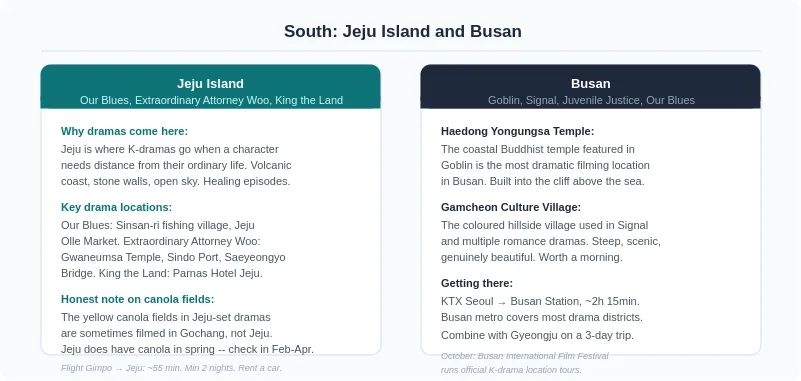
Haedong Yongungsa Temple near Haedong in Busan -- the coastal Buddhist temple built into the cliff above the East Sea -- provided the seaside backdrop for Goblin. It is one of the few Buddhist temples in Korea built directly on the coast rather than in a mountain interior, which gives it visual character that justifies the visit independently of any drama connection.
Gamcheon Culture Village, the colourful hillside district built into steep terrain above Busan's southwest, appeared in Signal and multiple romance drama exterior shots. Steep, scenic, and genuinely atmospheric -- early morning provides the least crowded version.
Getting there: KTX from Seoul to Busan Station (~2h 15min). Busan metro covers most drama districts. October advantage: the Busan International Film Festival runs official K-drama location tours pairing screenings with bus trips to nearby filming sites.
Practical planning notes
- Visit Korea app (free, KTO): GPS-tagged filming spots. Most useful free navigation tool for locations outside Seoul.
- Klook, KKday, Trazy: Goblin and Winter Sonata tours from Seoul, ₩80,000-130,000 per person with English-speaking guides.
- Best windows: March to May and September to November. Avoid Korean public holidays and drama finale weekends.
- Location accuracy: not all scenes attributed to a location were filmed there. Jeju canola scenes are sometimes Gochang. Gongjin is Pohang. Some Goblin outdoor scenes filmed in Quebec City, Canada. Treat filming locations as places a drama made visible rather than accurate reconstructions of the story's world. The Jumunjin breakwater is a real concrete pier in Gangneung that produces a specific image. That image still exists.
For Seoul filming locations, see the K-Drama Filming Locations in Seoul guide. For photography-specific guidance on the Seoul locations, see the Bukchon, Ikseon-dong and Beyond photo guide.
Related: K-Drama Filming Locations in Seoul You Can Actually Visit | Bukchon, Ikseon-dong and Beyond: Seoul K-Drama Photo Guide | K-Drama Tropes Explained: Airport, Wrist Grab, Slow Burn