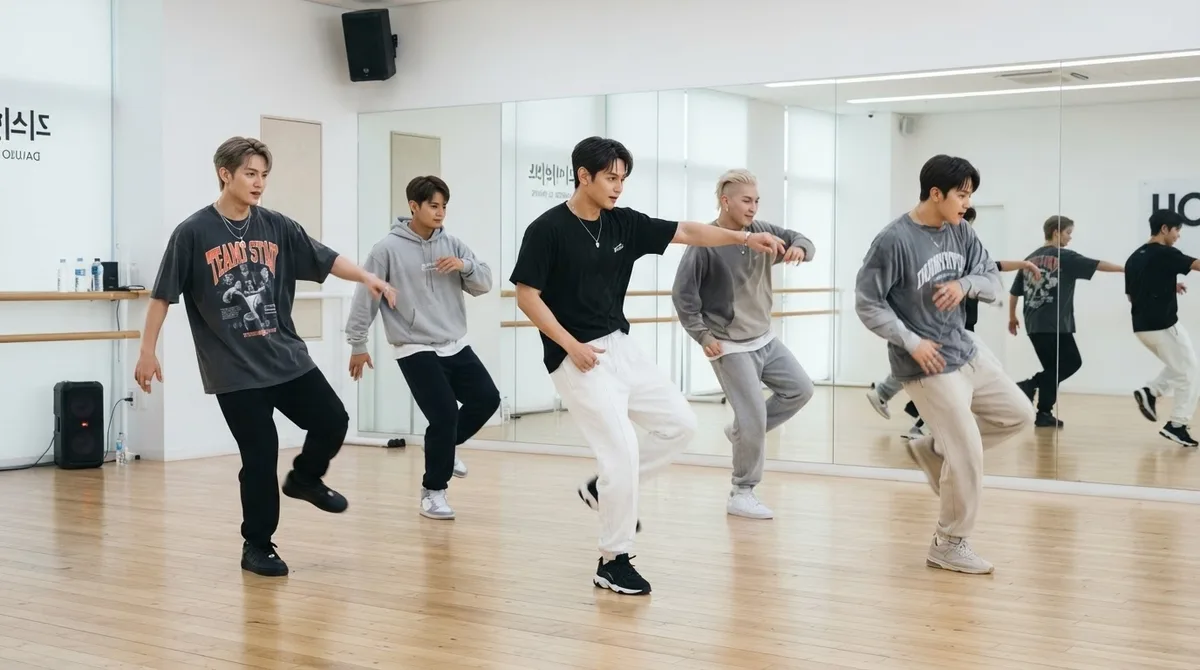
There is a specific four seconds inside ILLIT's Magnetic that became the most recreated K-pop dance moment of early 2026. The finger tutting loop in the chorus -- a precise sequence of interlocked finger movements that unfolds at the song's drop -- spread across TikTok within days of the official release, generated hundreds of thousands of user-created versions, and entered the kind of global cultural circulation where people who had never heard of ILLIT learned the move before they knew the song. That did not happen by accident.
Point choreography is the K-pop industry's most reliable marketing mechanism, and it is designed rather than discovered. The specific move, placed at the specific moment in the song, constructed to satisfy four conditions simultaneously -- alignment with the hook, learnability in one attempt, visibility in a 9:16 vertical frame, and an invitation for idols to post their own version and tag the fandom -- is the output of a deliberate choreographic and commercial decision process. Understanding how that process works makes both K-pop performances and the TikTok challenges they generate significantly more interesting to watch.
The anatomy of a K-pop routine
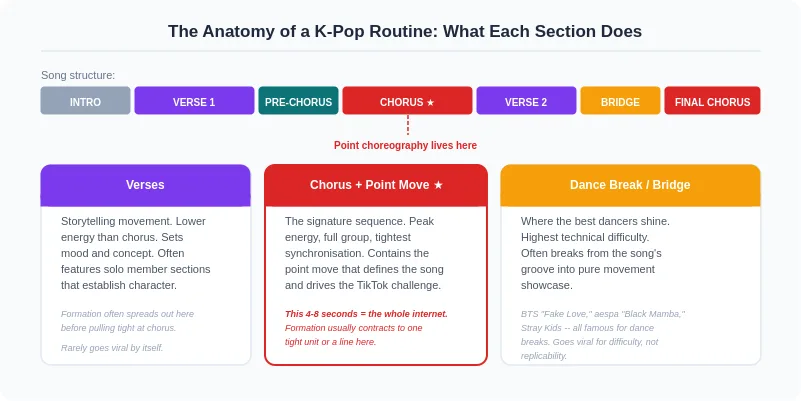
A standard K-pop song has roughly four choreographic sections that each serve a distinct function, and the distribution of difficulty and visual impact across those sections is not random.
Verses carry the narrative weight of the choreography. Movement here is typically more fluid, lower in energy than the chorus, and structured to allow individual member moments that establish character. Formations spread out during verses -- members occupy more stage space and perform sections that distinguish individual presence within the group. Verse choreography rarely goes viral because it is designed to build toward the chorus rather than stand alone.
The chorus is where everything concentrates. The formation pulls tight, the synchronisation becomes stricter, the energy peaks, and the point move appears. This section is choreographed to be the most visually impactful thirty to forty-five seconds of the routine, planned for the specific camera angles used in the music video and the live performance camera switching. The point move is the signature gesture of the song: two to eight seconds of distinctive, replicable movement that captures the song's entire personality in a form that anyone can recognise and attempt to recreate.
The dance break or bridge is where the most technically skilled members are showcased in the most demanding sequences of the full routine. Stray Kids' dance breaks, aespa's Black Mamba performance sections, BTS's Fake Love breakdown -- these sequences are choreographically complex in a way that the verse and chorus are not, because their function is to demonstrate capability rather than to drive social media engagement. Dance breaks go viral for a different reason than point moves: they circulate because people find them impressive and share them as evidence of skill, not because they are inviting participation.
Point choreography: what it is and how it is designed
The point choreography -- 포인트 안무 (point anmu) in Korean -- is the short, signature portion of a K-pop routine designed to spread. It is the part idols film when they post a challenge. It is the part fans practice first. It is the four to eight seconds that the entire promotional machinery of the release is built around.
Classic point moves span the full history of K-pop and each illustrates a different design principle. The TWICE TT move -- fingers placed over the eyes in a T shape, mirroring the song's onomatopoeic title -- is iconic because the gesture is literally the song's name made physical. The Girls' Generation finger heart from Gee arrived before the finger heart became a standard Korean affection gesture, making the choreography part of cultural history. The BIGBANG shooting step from Bang Bang Bang used a gunshot motion that matched the song's production aesthetic and converted a hip-hop gesture into something specific and ownable. All three are simple enough to execute with no dance background in under two minutes. All three are aligned with the song's hook at the exact moment of maximum audio impact.
In 2026, the ILLIT Magnetic finger tutting sequence represents the fifth-generation evolution of the point move concept: gesture-based, upper-body-dominant, designed to survive the portrait crop of a TikTok video, and constructed so that the slightly-difficult quality of getting it exactly right rewards the learner without requiring dance training. The tutting is satisfying to execute correctly in a way that simpler point moves are not, which is why the challenge produced so many earnest attempts alongside the humour videos of people getting it wrong.
Why some moves go viral and others do not
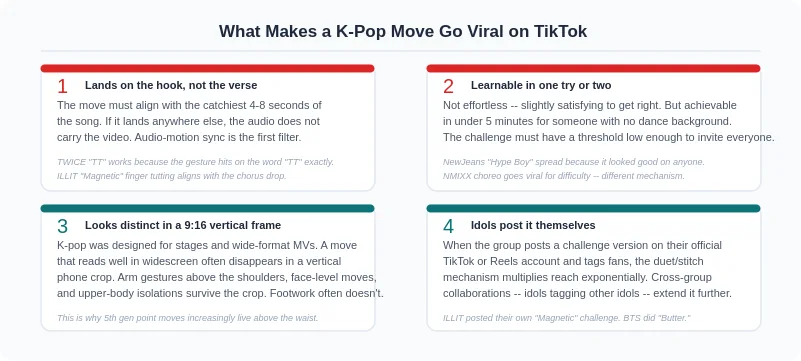
1. The move must align with the hook. The audio and the gesture must arrive together at the moment of maximum sonic impact. TWICE TT works because the TT gesture lands on the word "TT" in the song. ILLIT Magnetic works because the finger tutting begins exactly at the chorus drop. A technically impressive move that lands over a verse or a bridge does not generate a challenge, because the audio that carries the video does not carry the gesture.
2. The move must be learnable in one attempt or two. Not effortless -- slightly satisfying to get right. But achievable in under five minutes for someone with no dance background. The functional zone is the slightly-difficult move that looks noticeably better when done correctly than when done approximately. NewJeans Hype Boy spread because the choreography was charming and accessible to anyone willing to spend three minutes learning it. NMIXX routines go viral for the opposite reason -- people share them because they look impossible, and the challenge is watching rather than participating.
3. The move must survive the vertical crop. K-pop was designed for wide-format stages and horizontal fancam footage. A formation change that reads as spectacular when members shift positions across a wide stage disappears when the video is cropped to a 9:16 phone screen. This is why fifth-generation point choreography has shifted toward upper-body and face-level moves: hand gestures, arm positions, facial expressions, shoulder movements. These elements survive the vertical crop. Complex footwork and floor work do not.
4. The idols must post it themselves. When a group posts a challenge version on their official TikTok -- ideally with two or three members doing the move in a casual setting -- the platform's duet and stitch mechanics allow fan responses to be directly connected to the original. When idols tag other idol groups to participate, the challenge propagates through the fandom network. The official challenge version is the seed; the duet mechanism is the growth system.
How formations work
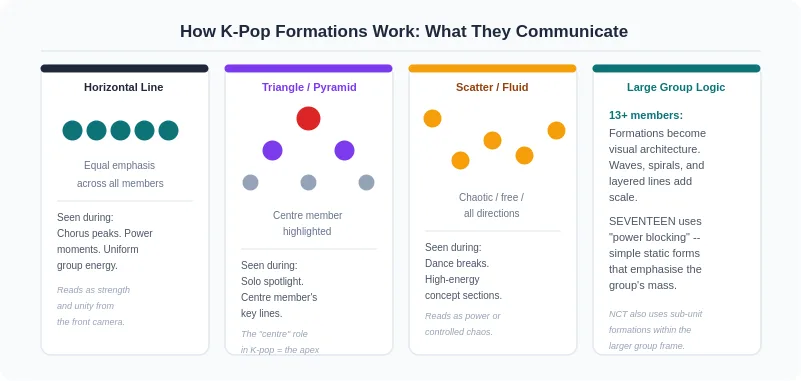
K-pop formation design is choreographic architecture. The positioning of group members on stage is planned to create specific visual impressions when seen from the audience and from the multiple camera angles used in music video production. Formation changes communicate as much as the movement itself.
The horizontal line is the formation of equal emphasis. All members form a single line facing the audience at full stage width. The message is collective power and group unity. This appears at peak chorus moments when the choreography is making its strongest statement.
The triangle or pyramid places one member at the apex. This is the formation that signals the centre position -- the member highlighted for a solo moment, a vocal line, or a particularly distinctive individual move. In K-pop, the centre position in a performance is a significant creative and commercial assignment, and the triangular formation is the visual grammar that marks it.
Scatter formations, in which members distribute across the stage without geometric logic, communicate controlled chaos and high energy. They appear during dance breaks and concept sections where the visual goal is dynamism and unpredictability rather than unified power.
Large group choreography from SEVENTEEN (thirteen members) and NCT adds a dimension that smaller groups cannot access: wave effects, layered lines, sub-unit formations within the larger group frame, and the sheer visual scale of synchronised mass movement. SEVENTEEN specifically uses power blocking -- holding simple, static formations for extended periods where the group's mass and synchronisation produce impact rather than movement complexity.
The trainee system that produces the precision
The synchronisation that makes K-pop formation changes and point choreography visually impressive is not natural ability. It is the product of a training system that is among the most rigorous in commercial entertainment.
K-pop trainees typically train for two to five years before debut, spending several hours daily in dance training alongside vocal work, language classes, and media training. Chaewon from LE SSERAFIM started training at fourteen with no prior dance background. Wonyoung from IVE was scouted at twelve for her height, not her dance skills. The shared characteristic is the training system: a structured methodology that breaks choreography into small, repeatable segments, drills them in isolation until they are automatic, then reintegrates them with other members.
Dance training sessions at major agencies follow a structured progression: individual technique, learning the full choreography in small groups of three to five, synchronisation practice with the full group, and performance-level execution under camera conditions. The final stage -- syncing the full group's movement -- is the most time-consuming phase, because the margin for individual variation acceptable in small-group practice becomes visually disruptive when multiplied across a full-group stage performance.
This consistency is what allows formations to work as planned. A formation that depends on every member hitting the same spatial position at the same moment requires that every member has internalised the choreography to the point of automatic execution. The point move that fans learn in five minutes is the same gesture the idol has executed hundreds of times in practice before the first fan ever sees it.
4th gen vs 5th gen: what changed and why
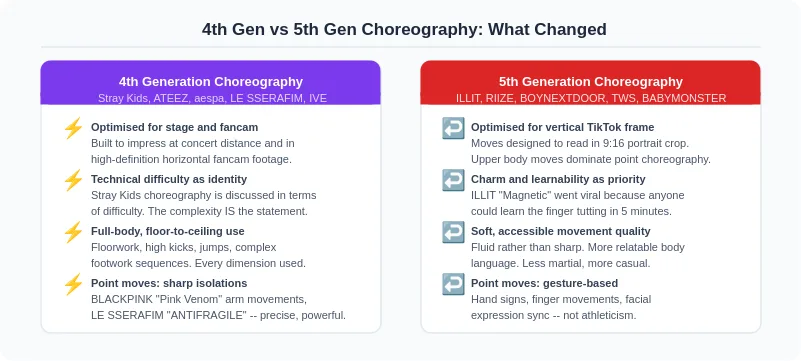
The shift from fourth-generation to fifth-generation choreography philosophy reflects the same broader trend shift as the generations themselves: a move from maximalism toward accessibility, driven by a change in the primary platform the choreography is designed for.
Fourth-generation choreography was built for the concert stage and the horizontal fancam. Stray Kids' routines are discussed in terms of technical difficulty -- the complexity and intensity of the movement is central to the group's identity. ATEEZ's theatrical choreography is designed to read at arena scale. BLACKPINK's Pink Venom arm sequence and LE SSERAFIM's ANTIFRAGILE choreography are precise, powerful, and designed to photograph sharply in high-definition horizontal footage. These are not point moves designed for TikTok challenges: they are choreographic statements about power and precision.
Fifth-generation choreography is built for the 9:16 vertical phone screen. ILLIT's Magnetic finger tutting was almost certainly designed with the TikTok frame in mind: upper-body-only, gesture-based, slightly-difficult in a way that invites participation, and aligned precisely with the chorus drop. RIIZE's choreography uses a softer, more casual movement quality than the sharp isolations of fourth-gen groups. BOYNEXTDOOR's dances lean toward the boy-next-door relatability of the group's concept, with charm-first movement rather than athleticism-first.
The most significant structural shift: fourth-gen choreography invested in difficulty across the full routine, with dance breaks and verse sections as technically demanding as the chorus. Fifth-gen choreography concentrates investment in the point move and the chorus, keeping everything else relatively accessible, because the platform logic of 2026 dictates that the four seconds that matter commercially are the four seconds of the challenge, and everything else is context for arriving at that moment.
- Point choreography (포인트 안무) is the 4-8 second signature move in the chorus that defines the song, drives the TikTok challenge, and anchors the promotional campaign.
- The four conditions for viral dance challenges: hook alignment, learnability in one attempt, survival in the 9:16 vertical crop, and idol participation in the challenge format.
- Formation changes are architectural decisions: the horizontal line signals collective power, the triangle signals individual spotlight, the scatter signals chaos and energy.
- Dance breaks go viral for difficulty, not learnability -- they circulate as evidence of skill, not participation invitations.
- 5th gen choreography is designed for TikTok first: upper-body dominant, gesture-based, charm over technical difficulty.
- The trainee system produces synchronisation through hundreds of hours of drilling. Chaewon from LE SSERAFIM had no prior dance background when she began training at 14.
For more on fifth-generation K-pop groups and what distinguishes their overall aesthetic, see the K-Pop Generations guide. For the idol visual aesthetic beyond choreography, see the K-Pop Idol Makeup Look guide.
Related: ILLIT, NewJeans, aespa: K-Pop Generations Explained | BTS, BLACKPINK, aespa: Which Brands Do K-Pop Idols Represent? | How K-Pop Idols Actually Take Care of Their Skin