
Glass skin had a long run. The wet, almost reflective finish -- achieved by stacking hydrating toners, serums, and face oils until your skin looked freshly rained on -- defined Korean beauty goals from 2019 through most of 2024. Seoul-based beauty insiders started using the phrase "wet look fatigue" in late 2025 to describe a shift in consumer aspiration: the new target was skin that looked effortlessly healthy rather than aggressively dewy.
The term that emerged to describe the replacement finish is cloud glow, coined by Korean beauty influencers in late 2025. The analogy is precise: where glass skin looks like a polished mirror, cloud glow looks like soft light transmitted through cloud -- diffuse, dimensional, three-dimensional rather than flat and shiny. The surface does not reflect uniformly. It glows from within. The difference between the two finishes is not just aesthetic: it reflects a shift in the underlying skincare philosophy, from maximum-hydration layering toward barrier-first repair with multi-active efficiency.
Glass skin vs cloud glow: what actually changed
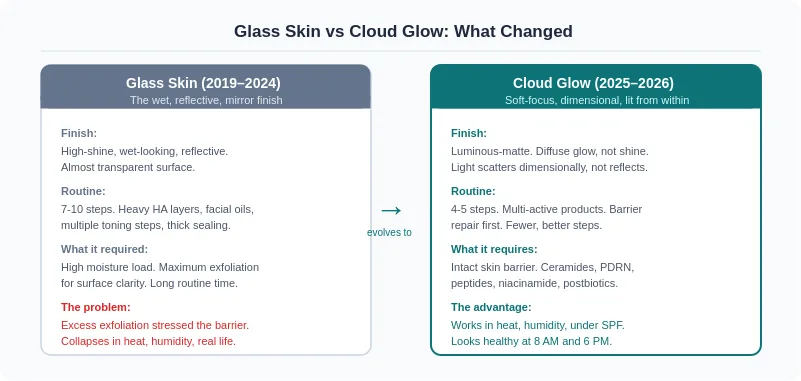
Glass skin achieves its reflective finish by maximising surface moisture -- heavy hyaluronic acid layers, face oils, occlusive sealers -- creating a surface that reflects light uniformly and directly. The result looks like the skin is wet. The problem is that this approach is entirely surface-dependent: any disruption to that moisture layer collapses the finish. The look also required the intensive exfoliation and high-concentration active ingredient use that Korean dermatologists began raising concerns about from 2023 onwards, noting that barrier damage from over-exfoliation was creating measurable increases in sensitivity and reactivity.
Cloud glow achieves its finish from the inside out. The scientific basis is in the skin's stratum corneum lipid architecture -- the intercellular matrix of ceramides, cholesterol, and free fatty acids that forms the physical barrier. When this matrix is intact and healthy, light does not reflect off the surface uniformly but transmits through it in a diffuse, three-dimensional way. Researchers at naturfactor cosmetics described this as "less reflection, more depth" -- a soft luminosity that reads as healthy rather than wet. The finish holds in heat and humidity because it comes from skin condition rather than applied product layers.
The routine shift that follows: from ten-step maximalism to four to five steps using multi-active products, each performing multiple functions simultaneously. A multi-active serum containing PDRN, peptides, and niacinamide does the work that three single-ingredient serums used to do. The fewer steps are not a compromise -- they are the point. Fewer layers means less barrier disruption, less product interaction risk, and a cleaner skin base for the cloud glow finish to emerge from.
The five-step routine
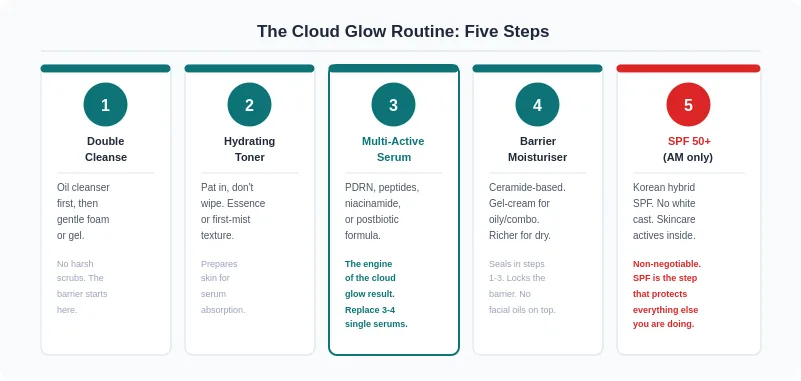
Step 1: Double cleanse. Oil-based cleanser first to dissolve sunscreen and any makeup, followed by a gentle pH-balanced gel or foam cleanser. The critical word is gentle: the double cleanse should leave skin clean but not stripped. The cloud glow approach reserves exfoliation for once or twice weekly, keeping daily cleansing as non-disruptive to the barrier as possible.
Step 2: Hydrating toner. A lightweight essence-texture or first-mist toner, patted in rather than wiped across the skin. This prepares the barrier to absorb the serum that follows. Not seven layers as in the old glass skin method -- one well-formulated application.
Step 3: Multi-active serum (the engine of the result). A single serum containing PDRN with peptides and niacinamide -- or a postbiotic-rich formula with ceramide precursors -- replaces the three to four single-ingredient serums the glass skin routine required. PDRN (polydeoxyribonucleotides, salmon-derived) supports cellular repair and tissue regeneration, producing the inner radiance that cloud glow describes rather than surface shine. Niacinamide at around five percent handles brightening, sebum control, and barrier support simultaneously. Peptides signal collagen production and contribute to the velvety, plump skin texture at the surface.
Step 4: Barrier moisturiser. Ceramide-based. For oily and combination skin, a gel-cream texture. For dry skin, a richer formula. What the cloud glow routine specifically avoids at this step is the face oil that glass skin used as a final sealing layer: a heavy facial oil on top of the moisturiser pushes the finish back toward reflective glass skin and away from the diffuse cloud glow outcome.
Step 5: SPF 50+ (morning only). Korean hybrid sunscreens in 2026 combine chemical and physical filters with skincare actives like niacinamide, centella, or PDRN, so the SPF step contributes to the routine's functional work rather than just sitting as a protective seal. No white cast. Lightweight textures that do not disrupt the cloud glow finish built in the steps below.
The ingredients behind the result
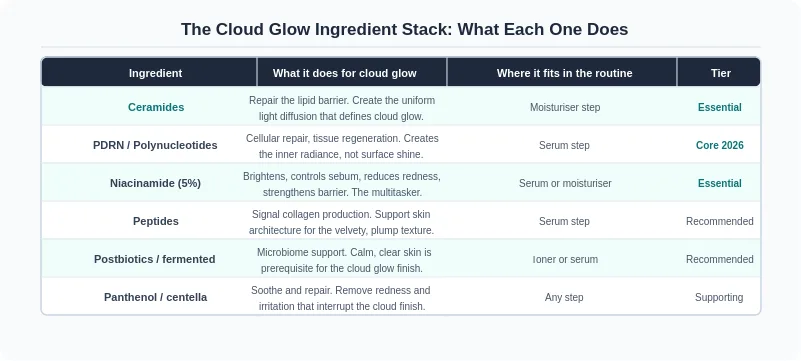
Ceramides are the structural foundation. The stratum corneum lipid matrix determines the physical behaviour of light at the skin surface. Intact ceramide architecture produces diffuse, even light transmission. Disrupted ceramide architecture produces uneven light reflection and the redness, sensitivity, and texture disruption that interfere with any luminous finish. Korean moisturisers in 2026 are heavily ceramide-focused -- Olive Young bestseller rankings dominated by ceramide-centred formulas from COSRX, Skin1004, and Aestura.
PDRN is the headline ingredient of 2026 Korean skincare -- so present on Olive Young shelves that beauty editors describe it as omnipresent. Derived from salmon DNA, PDRN supports cellular repair and tissue regeneration, producing genuine improvement in skin texture, hydration, and radiance rather than temporary surface shimmer. The inner luminosity that cloud glow describes is most directly supported by this cellular regeneration effect. Available for years in injectable skin booster treatments at Korean clinics; the topical versions reaching mainstream in 2026 translate clinic-level technology into at-home skincare.
Niacinamide at five percent is the multitasker that makes cloud glow achievable across skin types. It brightens by inhibiting melanin transfer to surface cells. It controls sebum. It strengthens the skin barrier independently of ceramides, reducing transepidermal water loss. It calms existing redness and sensitivity. One ingredient addressing four separate concerns simultaneously.
Peptides contribute to the structural quality that cloud glow requires. A skin with degraded collagen architecture cannot produce the velvety, plump texture that reads as cloud glow, regardless of how good the surface hydration is. The 2026 Korean serum market has moved heavily into signalling peptide formulations -- amino acid chains that actively communicate with skin cells rather than just coating the surface.
Postbiotics and fermented extracts support microbiome balance on the skin surface. A dysbiotic skin surface -- characterised by redness, irritation, and patchy texture -- cannot achieve the even, calm luminosity that cloud glow describes. Korean beauty's longstanding tradition of fermented ingredients now has a specific functional rationale in the microbiome science that has developed since 2022.
The makeup finish: what cloud glow looks like above skincare
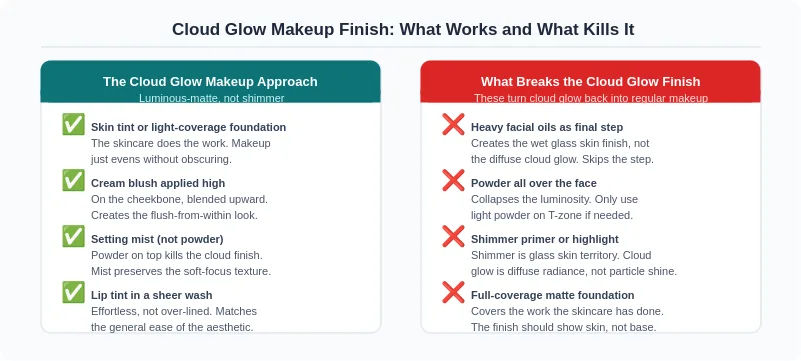
Cloud glow is primarily a skincare result, but the makeup approach either preserves or destroys it. The framing from Korean makeup stylists in 2026: luminous-matte. Not the mirror shine of glass skin and not flat matte coverage, but a texture that looks like skin -- even, calm, with the soft internal glow the skincare produced showing through.
A skin tint or light-coverage foundation allows the skin's own luminosity to show while evening the tone. Heavy full-coverage foundations cover the work the skincare has done. Korean makeup brands have responded with a generation of foundations specifically described as "luminous-matte" or "skin-first."
Cream blush applied high on the cheekbone and blended upward creates the flush-from-within appearance. The specific placement -- higher than conventional application, blended toward the temple -- mimics the natural flush of healthy skin.
Setting mist replaces setting powder as the finishing step. Powder flattens the soft-focus luminosity the skincare created. If T-zone oil control is genuinely necessary, a light dust of translucent powder on forehead and nose only -- leaving cheeks and temples untouched -- is the compromise that preserves the most cloud glow finish.
What breaks the cloud glow finish: heavy face oil applied as a final step pushes the look toward glass skin. Shimmer primer or highlighter adds particle-based shine that reads as glitter. Powder applied everywhere collapses the luminosity the skincare built.
Cloud glow at Seoul clinics
Beyond the at-home routine, Korean dermatology and aesthetic clinics have been developing professional treatments specifically described as cloud glow procedures since late 2025. The clinical translation takes the form of PDRN skin booster injections (administered intradermally at low concentrations), subtle laser treatments calibrated to improve skin texture rather than aggressively resurface, and RF treatments that support collagen architecture at the tissue level.
These treatments align with the broader shift in Korean aesthetic medicine documented since 2024: away from aggressive correction and toward preventive skin health. The approach is not a one-session fix but a series of low-intervention treatments that improve the structural quality of the skin over time, producing the conditions in which the topical cloud glow routine works more effectively.
For visitors to Seoul seeking cloud glow clinic treatments, the relevant categories are PDRN skin boosters (available at aesthetic clinics in Gangnam and Sinchon, typically from approximately 150,000 to 300,000 KRW per session -- confirm current pricing at consultation) and glow laser treatments that specifically target luminosity and texture.
- Cloud glow produces the finish from inside out -- barrier condition and cellular health, not product layers on the surface.
- The five-step routine: double cleanse, hydrating toner, multi-active serum, barrier moisturiser, SPF 50+.
- PDRN is the headline ingredient of 2026 Korean skincare and the most direct driver of the inner luminosity cloud glow describes.
- No face oils on top of the moisturiser. Heavy facial oils push the finish back toward glass skin.
- Cream blush high, setting mist not powder, skin tint not full coverage.
- Korean SPF 50+ in 2026 is formulated to contribute to the routine -- look for hybrid filters with niacinamide or PDRN included.
For the PDRN skin booster context at clinic level, see the Rejuran vs Juvelook vs Exosome guide. For the Korean sunscreen landscape specifically, see the Korean Sunscreen 2026 guide when published.
Related: Rejuran vs Juvelook vs Exosome Skin Booster: The Seoul Comparison | How K-Pop Idols Actually Take Care of Their Skin | Personal Color Analysis in Seoul