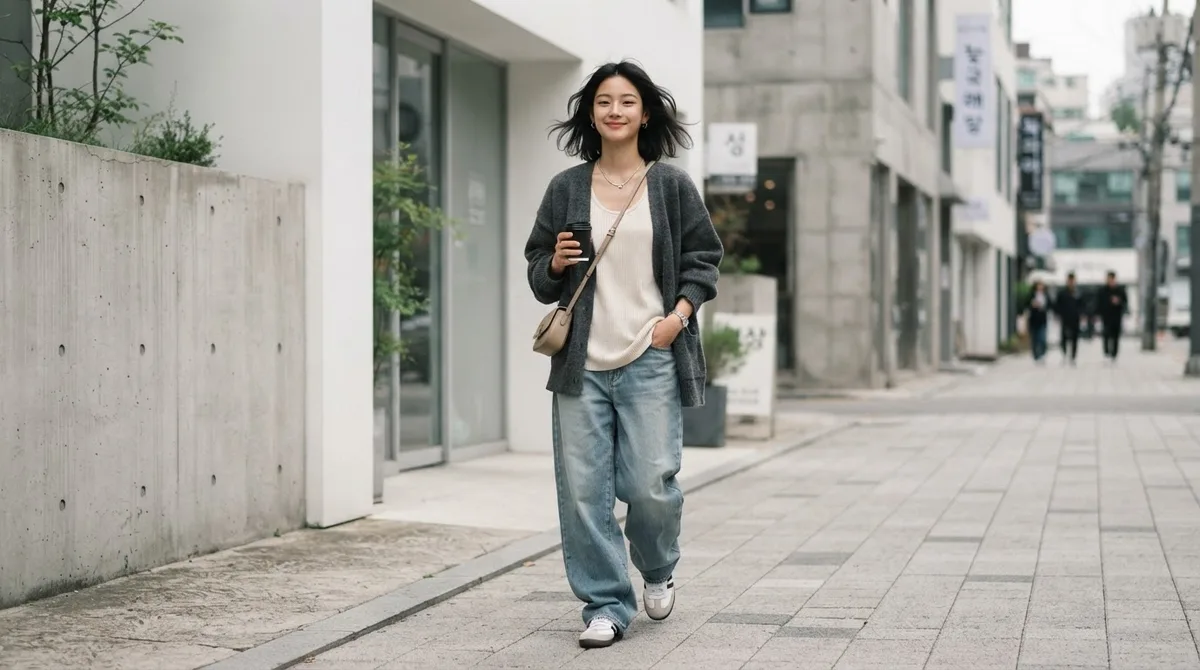
Acubi is the answer to a specific question: what do you wear when you want to look stylish without announcing it? Not the loud Y2K maximalism of a few years ago. Not the athleisure polish of clean girl. Something more understated, more distinctly Korean, and built on proportions rather than colour. CNN described it as "the rise of Korean quiet cool" when they covered its global spread in April 2026, and that framing captures something real: the look works through restraint rather than drama.
The name traces to Acubi Club, a Seoul brand from Hongdae whose grayscale, understated clothing gave the aesthetic its identity around 2021. The brand popularised a specific combination -- bolero cardigans, cargo pants, baby tees -- and the internet turned that combination into a generalised descriptor for the entire genre, the way "Jacuzzi" became shorthand for a type of hot tub regardless of who made it. In Seoul, "Acubi" still refers primarily to the brand. Internationally, it labels everything in the muted, oversized, minimalist-Korean-streetwear family. Google Trends for the term peaked in February 2026 in both the UK and the US, coinciding with K-pop appearances at London Fashion Week.
What Acubi is (and what it is not)
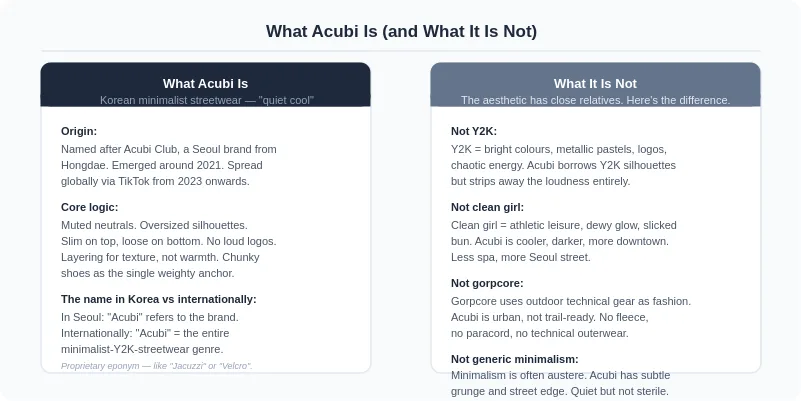
The core of Acubi is the pairing of a slim, fitted top with a voluminous, loose bottom in a muted, desaturated palette -- then grounding the whole thing with a chunky shoe. That is the complete formula. Everything else is detail.
Not Y2K: Y2K borrows Acubi's oversized silhouettes but not its restraint. Y2K reaches for neon, metallics, logos, chaotic colour clashes. Acubi strips all of that away. The colour palette alone makes the distinction immediately legible.
Not clean girl: Clean girl is athletic leisure and dewy glow and slicked-back hair -- spa-adjacent, wellness-coded. Acubi is street-adjacent. Cooler, darker, more downtown. A clean girl outfit reads like weekend wellness. An Acubi outfit reads like someone who lives in a city and has thought carefully about what comfortable and stylish actually means there.
Not gorpcore: Gorpcore uses outdoor technical gear -- fleece, trail shoes, cargo pockets, nylon shells -- as its building blocks. Acubi is urban, not trail-ready. The proportions overlap occasionally, the palette sometimes does too, but the cultural reference is city street, not trailhead.
Not generic minimalism: Standard minimalism tends toward austere precision. Acubi has subtle grunge in it -- a slouch, a drop, a slightly undone quality. It is quiet but not sterile. WGSN's Heewon Yuh put it precisely in CNN's coverage: the look is "cool," not "clean," and that word carries most of the distinction.
The formula: slim top, loose bottom, chunky shoe
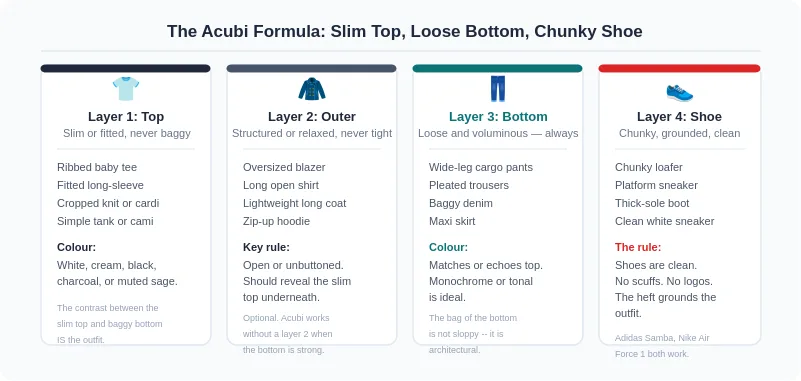
The Acubi silhouette follows a consistent proportion logic: slim at the top, voluminous at the bottom, heavy at the foot. The contrast between the fitted upper half and the loose lower half is not accidental -- it is the architectural principle that makes the look read as intentional rather than casual.
The top layer is always fitted or slim: a ribbed baby tee, a fitted long-sleeve, a cropped knit, a simple tank. Nothing baggy. The point of the slim top is to make the transition to the voluminous bottom feel deliberate. When both halves are loose, the result reads sloppy. When the top is slim and the bottom is loose, the result reads considered.
The outer layer, when present, is open or unbuttoned -- a blazer worn open over the slim top, a long shirt layered over it, a lightweight coat that falls open. It should reveal the slim top underneath rather than enclose the look. Acubi outfits work without an outer layer when the bottom is strong enough to carry the look on its own.
The bottom is the weight of the outfit. Wide-leg cargo pants, pleated trousers, baggy denim, a maxi skirt -- volume from hip to ankle. The looseness should be architectural rather than sloppy: clean in structure, not deflated. The silhouette is deliberate even when intentionally loose.
The shoe is the grounding element. Chunky loafers, platform sneakers, thick-sole boots, or a clean white sneaker like the Adidas Samba or Nike Air Force 1. The rule on footwear: clean. No scuffs. No heavy branding. The heft anchors the muted tones above without drawing the eye away from the proportion play.
The palette: muted, desaturated, tonal
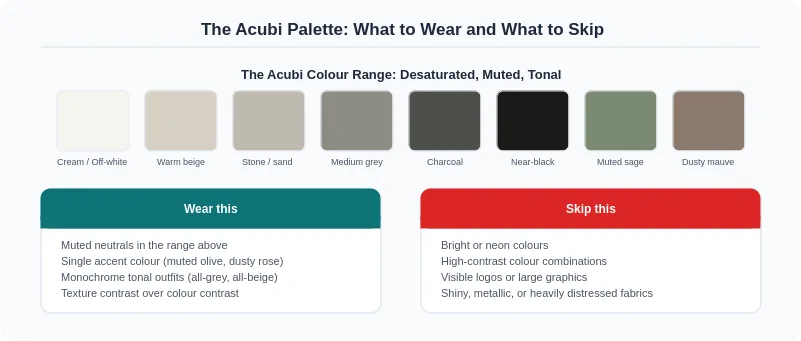
Acubi works in a specific colour range: cream and off-white on the light end, near-black on the dark end, and desaturated neutrals in between. Warm beige, stone, sand, medium grey, charcoal. Where colour appears, it is muted -- sage green at low saturation, dusty rose, faded olive. The defining characteristic of the palette is that every shade has its intensity turned down. Texture becomes the differentiator between garments rather than colour.
Monochrome tonal outfits -- all-grey, all-beige, all-black -- are one of the easiest ways to achieve the look, because the proportions do all the work when there is no colour contrast to manage. An all-grey outfit of fitted grey tee, open grey blazer, and wide-leg grey trousers with clean white sneakers is a complete Acubi look that requires almost no deliberate styling decision beyond the proportion of each piece.
What disqualifies a look: bright or neon colours, high-contrast colour combinations, visible logos or large brand graphics, and shiny or metallic fabrics. Distressed textures are also outside the aesthetic, which maintains a clean, polished surface even when the silhouette is loose.
Where the aesthetic comes from in Seoul
Acubi Club operates in Hongdae -- Seoul's youth culture and streetwear district adjacent to Hongik University. The Hongdae and Sinchon areas have been the incubator of Korean youth fashion since the 1990s, producing street styles that filter through Musinsa's editorial coverage into international awareness.
K-pop functioned as the accelerant rather than the origin. BLACKPINK, NewJeans, and aespa members wore the look during off-duty appearances and fashion week events, which pushed it through the fan photography infrastructure that moves Korean fashion trends into global visibility. "K-pop functioned less as the origin and more as an accelerator, transforming a local styling approach into a globally recognized look," Heewon Yuh of WGSN told CNN. By February 2026, when Stray Kids' Seungmin and Girls' Generation's Yoona appeared at Burberry's London Fashion Week show, searches for Korean fashion and Musinsa Standard peaked simultaneously in the UK and US.
The aesthetic has since entered mainstream Western retail. Zara, Minga London, and fast fashion platforms have produced Acubi-adjacent collections explicitly. Gucci's Cruise 2025 collection featured relaxed silhouettes, Fendi produced collections built around similarly minimalist designs -- signals that the proportional logic has moved into luxury territory.
How to build the look
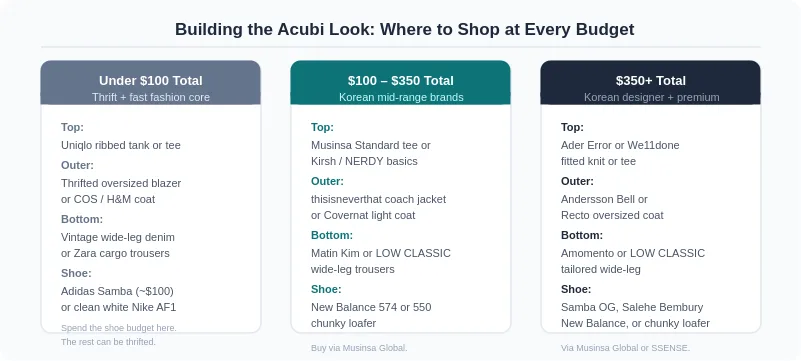
The most useful starting point is a wardrobe audit rather than a shopping list. The look is built on proportions and muted neutrals, both of which can often be assembled from what already exists. A fitted cream or white tee, a pair of wide-leg trousers or baggy jeans, an oversized blazer already in the closet -- these are the starting ingredients. The missing element is almost always the chunky shoe and the muted outer layer.
Under $100: Thrift stores are the most efficient source for the oversized blazer and the wide-leg bottom. Uniqlo handles fitted basics reliably. The shoe budget is where the entry-level build concentrates its spending -- a clean pair of Adidas Sambas or Nike Air Force 1s does more to pull the look together than any other single purchase.
$100 to $350: Musinsa Global is the primary access point for Korean mid-range brands. Musinsa Standard produces wide-fit denim, oversized tees, and lightweight coats in exactly the right proportions and palette at under fifty US dollars per piece. thisisneverthat's coach jackets and Covernat's understated outerwear handle the outer layer. Matin Kim and LOW CLASSIC produce the tailored wide-leg trouser at higher quality.
$350 and above: Ader Error and We11done for fitted tops with material quality and conceptual weight. Andersson Bell and Recto for oversized coats with architectural precision. Available through SSENSE internationally and directly from brand webstores.
- The ratio of slim top to loose bottom is the single most important styling decision. Get this proportion right and the look reads correctly regardless of budget.
- Shoes carry weight that anchors the muted tones above. Buy clean, buy chunky, keep them spotless.
- Monochrome tonal dressing removes most styling complexity and lets the proportions do the work.
- Acubi is inherently gender-neutral. The proportional logic works on every body type.
- If you are in Seoul: the Musinsa Store Myeongdong and Hongdae's independent boutiques are the best in-person sources. Acubi Club's own store in Hongdae is worth visiting as the named origin of the aesthetic.
For more on the Seoul districts and brands where the Acubi aesthetic lives, see the Seoul Street Style 2026 guide and the Korean Fashion Brands guide.
Related: Seoul Street Style 2026: Seongsu-dong and Hongdae | Idol Airport Fashion: How K-Pop Stars Travel | Korean Fashion Brands Worth Buying in 2026