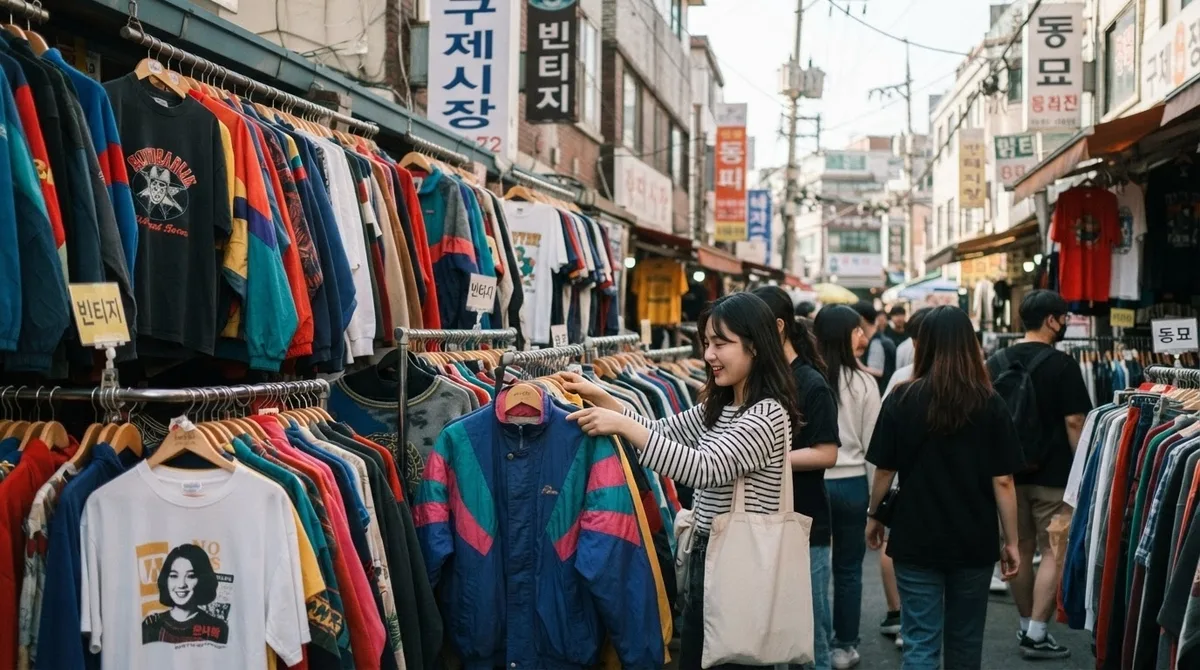
Dongmyo is the biggest flea market in Korea and one of the best in Asia. It sprawls across 30,000 square metres near Dongmyo Station, operates daily, and runs on a simple logic: the dig piles cost ₩1,000 to ₩5,000 per item flat regardless of what you find. People regularly pull authentic Levi's 501s, Pendleton wool shirts, Carhartt jackets, and Dickies workwear from those piles. Occasionally something more significant -- Burberry, Ralph Lauren, rare leather -- buried at the bottom where most people gave up.
The nearby district of Euljiro -- nicknamed Hipjiro by the locals who moved in over the past decade -- is a different proposition entirely. Curated vintage boutiques operating inside former printing workshops and electronics arcades from the 1960s and 70s, with craft cocktail bars in between. The Korea JoongAng Daily described it as "too cool to care," which is accurate: the neighbourhood has not been packaged for tourists, and the coexistence of working printing shops alongside vintage stores alongside speakeasy bars is not a concept installed for Instagram but a genuine layering of what was already there over what arrived later.
This guide covers both, plus Gwangjang Market's overlooked vintage floors and the Seoul Folk Flea Market in Sinseol-dong.
The four venues: a quick reference
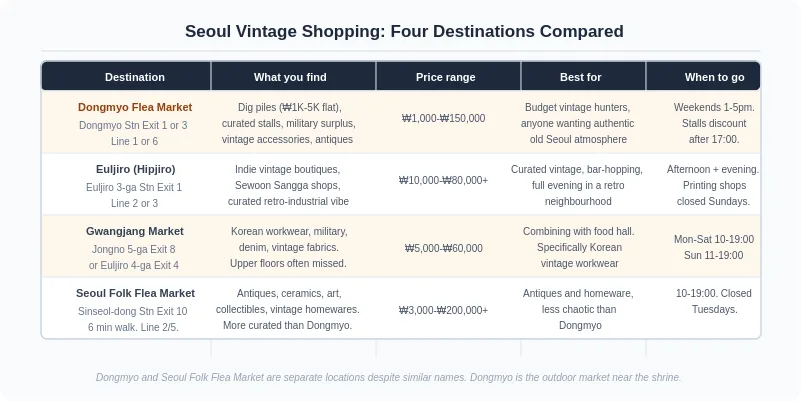
Dongmyo, Euljiro, Gwangjang, and the Seoul Folk Flea Market each serve a different purpose. Understanding which fits your goals prevents the mistake of going to Dongmyo expecting curated boutiques, or going to Euljiro expecting the raw market experience Dongmyo provides.
Dongmyo Flea Market is for volume, price, and the dig experience. Physically demanding, authentically chaotic, genuinely unpredictable. The price floor is the lowest of any vintage destination in Seoul. Attracts Korean shoppers of all ages alongside growing numbers of international visitors. G-Dragon filmed a show here -- its social media profile has grown without it yet becoming a tourist trap.
Euljiro is for a curated vintage experience embedded in neighbourhood culture. Higher prices than Dongmyo because vendors have pre-sorted quality. More legible for first-time visitors. The surrounding neighbourhood -- printing street, Sewoon Sangga rooftop, bar alleys -- provides several hours of content beyond the shopping itself. Converts into an evening plan without requiring another journey.
Gwangjang Market is for combining vintage shopping with one of Seoul's best food market experiences. The ground-floor food hall is the main draw, but the upper floors contain a significant vintage section focused on Korean workwear, military items, denim, and vintage fabrics. The food and vintage together make a full morning destination.
Seoul Folk Flea Market (Sinseol-dong) is for antiques, ceramics, vintage homewares, and collectibles over fashion. Less chaotic than Dongmyo and better for deliberate antique hunting.
Dongmyo: how to actually shop the market
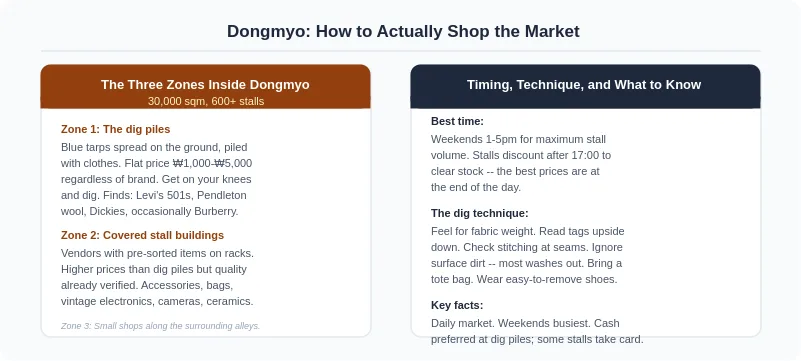
Dongmyo Station, Line 1 and Line 6. Exit 1 or Exit 3 -- the market begins immediately outside either exit. The 30,000 square metre site has three distinct zones.
Zone 1 -- The dig piles. Massive blue tarps spread on the ground, covered in mountains of clothing, all at a flat rate of ₩1,000-₩5,000 regardless of brand. The technique is physical: get down to the pile, feel for fabric weight rather than looking at visible labels, read brand tags upside down and sideways as you encounter them, check stitching at seams and zippers without fully extracting the item until you have a reason to. Finds: authentic Dickies, Levi's 501s, Pendleton wool shirts, and occasionally luxury labels buried at the bottom of piles. Surface dirt generally washes out; the fabric condition underneath is what matters. Bring a large tote bag. Wear shoes you can slip off easily.
Zone 2 -- Covered stall buildings. Vendors have pre-sorted and curated their inventory -- higher quality threshold, higher prices. Vintage accessories, bags, cameras, retro electronics, ceramics, antiques, military surplus alongside clothing. Prices from ₩1,000 for accessories to ₩150,000 for rare leather pieces.
Zone 3 -- Surrounding alleys. Smaller fixed shops in streets around the market. More specialist inventory, worth exploring after the dig piles and covered buildings.
Timing. Weekends between 1pm and 5pm have the highest stall volume. The best prices come at 5pm, when vendors begin discounting to clear stock rather than pack it up. Arrive at 1pm, work through dig piles and covered stalls, time a final pass through the outdoor area to coincide with end-of-day discounting. Cash preferred at dig piles. Street food stalls around the market perimeter handle lunch.
Euljiro: the retro district for curated vintage
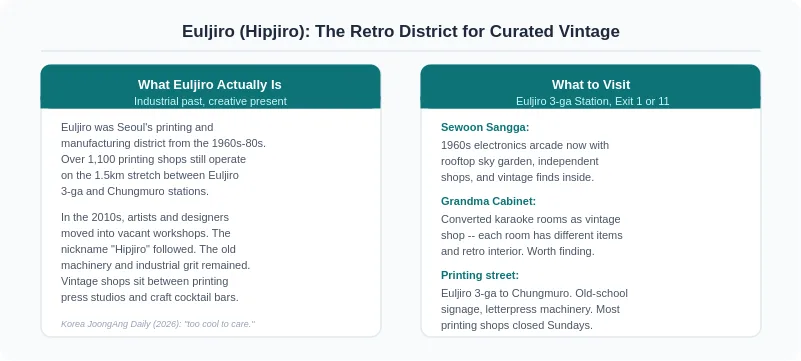
Euljiro was Seoul's printing and manufacturing district from the 1960s-80s. Over 1,100 printing shops still operate on the 1.5-kilometre stretch between Euljiro 3-ga and Chungmuro stations. The industrial grit was not preserved as a design gesture -- the businesses that created it are still there. In the 2010s, artists and designers moved into vacant workshops, and the Hipjiro nickname followed. The old machinery and industrial character remained, and vintage shops now sit between printing press studios and craft cocktail bars.
Sewoon Sangga is the anchor. The 1960s electronics arcade has a rooftop sky garden added in a regeneration project -- great for city views, with the printing district below and the Jongno high-rises beyond. Inside, original shop units coexist with independent businesses including vintage sellers, small design studios, and coffee shops.
Grandma Cabinet is the vintage store most consistently cited by Seoul fashion guides. A former karaoke facility whose individual rooms have been repurposed as separate retail spaces, each with a distinct retro interior and different category of vintage items -- clothing, accessories, ceramics, figurines, objects. Address: 42 Toegye-ro 27-gil, Pil-dong, Jung-gu, 3rd floor.
The printing street (Euljiro 3-ga to Chungmuro, 1.5km) is not a vintage shopping destination in itself but provides the context that makes the Euljiro experience coherent. Old-school signage, the sound of presses, the smell of ink, letterpress machinery visible through shop windows. Most printing shops closed Sundays -- visit on a weekday or Saturday for the full atmosphere.
The bar scene begins where the vintage shopping ends. Bars in converted factories, food tents, underground music venues within five minutes of each other. Many bars have no visible signage, operating by word-of-mouth. Afternoon vintage shopping in Euljiro transitions naturally into an evening without any additional transport.
Gwangjang Market: the vintage floor most visitors miss
Gwangjang Market is over a hundred years old. International visitors know it for the ground-floor food hall: bindaetteok (mung bean pancakes), mayak kimbap, yukhoe (beef tartare). The food section is genuinely worth the visit and provides the anchor for a morning at Gwangjang before heading to Dongmyo in the afternoon.
The vintage section is on the upper floors and is consistently overlooked. Korean workwear, military surplus, denim, vintage fabrics -- categories less well-represented at Dongmyo. Not as comprehensive as Dongmyo and not as curated as Euljiro, but for specifically Korean workwear and military vintage, the most concentrated source in Seoul.
Hours: Monday-Saturday 10am-7pm, Sunday 11am-7pm. Access: Jongno 5-ga Station Exit 8, or Euljiro 4-ga Station Exit 4.
Seoul Folk Flea Market: the antique alternative
The Seoul Folk Flea Market in Sinseol-dong operates from a covered building and focuses on antiques, ceramics, collectibles, and vintage homewares rather than fashion. Less chaotic than Dongmyo; vendors operate from enclosed stalls, making browsing calmer and inventory easier to assess without digging. Good for deliberate antique hunting.
Address: 21 Cheonho-daero 4-gil. Hours: 10am-7pm for shops, 10am-8pm for restaurants, closed Tuesdays. Access: Sinseol-dong Station Exit 10, 6-minute walk on Lines 2 and 5.
Seongsu and Hongdae: the boutique alternatives
Seongsu-dong boutiques announce new inventory drops on Instagram 24-48 hours before items hit the floor -- follow their accounts before your trip. Prices are higher than Dongmyo; the aesthetic skews gorpcore and granola core in 2026.
Vin Prime is a chain of subway-adjacent hybrid boutique-thrift stores with locations at Hapjeong, Gangnam, Express Bus Terminal (7th floor), and Hongik University area. Clean, organised, consistently affordable. Best for coats, blazers, and outerwear under ₩30,000. The practical choice when you want vintage without planning a full market day.
How to combine the markets: a one-day route
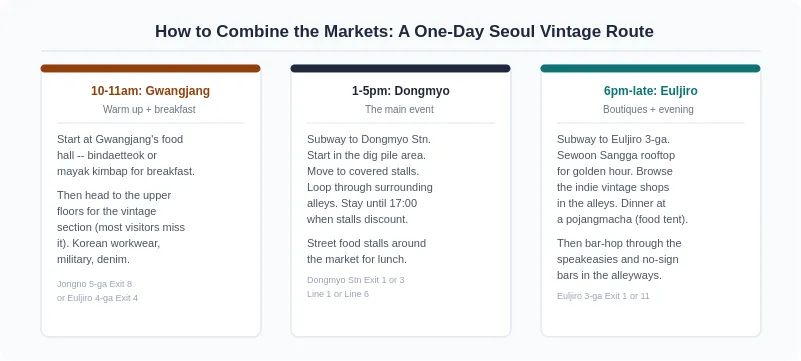
10-11am: Gwangjang Market. Start at the food hall -- bindaetteok or mayak kimbap for breakfast. Then the upper floors for the vintage section. Best in the morning when vendors have arranged fresh inventory. Jongno 5-ga Exit 8 or Euljiro 4-ga Exit 4.
1-5pm: Dongmyo. Subway or 20-minute walk along Cheonggyecheon Stream. Dig piles first, covered stalls through mid-afternoon, return to outdoor area at 5pm for end-of-day discounting. Street food for lunch. Dongmyo Stn Exit 1 or 3, Line 1/6.
6pm-late: Euljiro. Take Line 1 or 6 from Dongmyo toward the city centre, transfer or take Line 2 to Euljiro 3-ga. Sewoon Sangga rooftop at golden hour. Browse indie shops in the alleys. Dinner at a pojangmacha. Bar-hop through the speakeasy alleys as shops close. Euljiro 3-ga Exit 1 or 11.
- Dongmyo: ₩1,000-₩5,000 flat dig piles, weekends 1-5pm for peak volume, discount after 17:00. Dongmyo Stn Exit 1 or 3.
- Euljiro / Hipjiro: curated boutiques in 1960s industrial buildings. Printing shops closed Sundays. Euljiro 3-ga Stn Exit 1 or 11.
- Gwangjang vintage floors: Korean workwear, military, denim -- above the famous food hall. Mon-Sat 10-19:00, Sun 11-19:00.
- Seoul Folk Flea Market: antiques and homewares. Sinseol-dong Stn Exit 10. 10-19:00, closed Tuesdays.
- Grandma Cabinet, Euljiro: converted karaoke rooms as vintage shop. 42 Toegye-ro 27-gil, 3rd floor.
- Vin Prime: subway-adjacent hybrid boutique/thrift. Outerwear under ₩30,000. Multiple locations.
- Dig pile technique: feel for fabric weight, read tags upside down, check seams, ignore surface dirt. Cash. Tote bag.
- Best single day: Gwangjang morning → Dongmyo 1-5pm → Euljiro evening.
For sizing guidance when shopping Korean vintage clothing, see the Korean Sizing Guide. For the fashion aesthetics driving what Seoul shoppers hunt in vintage right now, see the Gorpcore in Korea guide.
Related: Korean Sizing Guide: How to Shop Musinsa Correctly | Gorpcore in Korea: Seoul's Outdoor-Street Trend | Acubi Fashion: Seoul's Quiet Cool Aesthetic