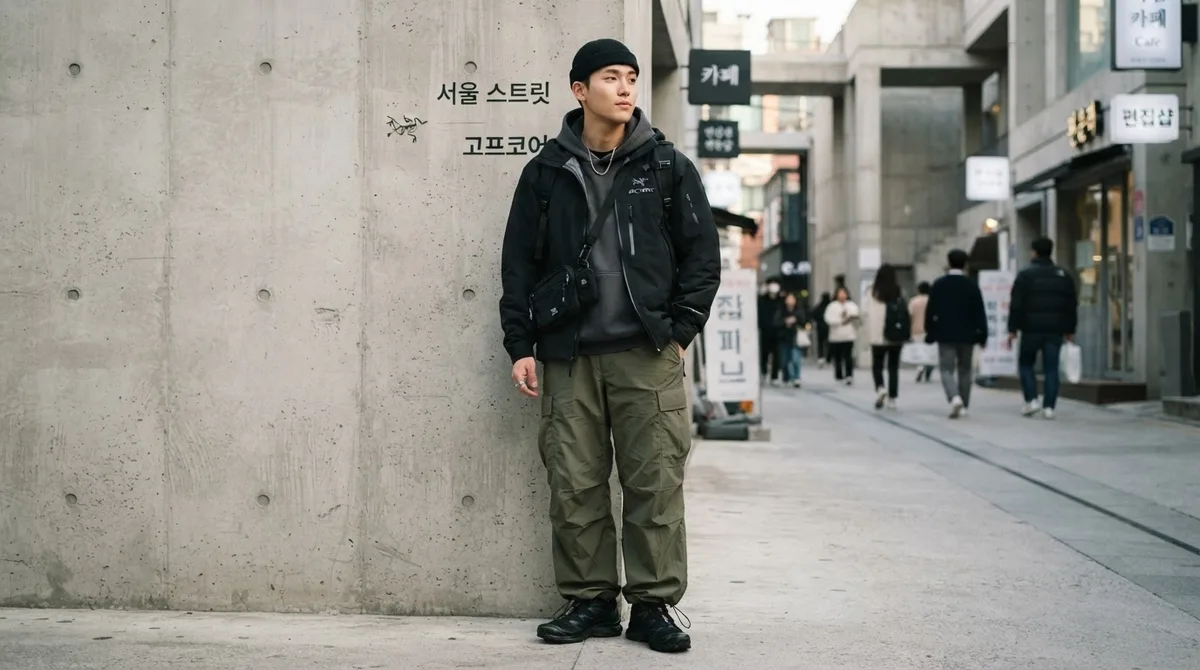
Gorpcore -- the fashion aesthetic built on hiking boots, Gore-Tex shells, and trail-running sneakers worn not on trails but on the streets of Seoul -- is the single most dominant fashion trend in Korea in 2026. The word comes from GORP, hiker slang for "Good Old Raisins and Peanuts," the trail mix that fuels long treks. The style is what happens when a city with the highest per-capita hiking rate in Asia decides its outdoor gear looks good enough to wear everywhere.
Seoul did not simply adopt gorpcore from the West. The Korea Herald documented the observation in 2023: the gorpcore trend sweeping international fashion media was, in Korea, the belated validation of something older Korean men (ajeossi) had been doing for decades -- wearing full technical outdoor gear to buy groceries, commute, and meet friends for lunch. The Arc'teryx windbreaker and The North Face down jacket were daily Seoul streetwear long before they appeared in Western fashion coverage. What changed in 2024 and 2025 was that the younger generation claimed the aesthetic deliberately, elevated it with Seoul's designer lens, and pushed it into the international conversation through K-pop idol airport fashion and Seoul fashion week coverage.
What gorpcore actually is -- and how Seoul does it differently
The styling logic is specific: take functional outdoor gear -- products designed and tested for performance in mountains, on trails, in rain -- and wear them in urban, non-outdoor contexts. The result should look intentional rather than accidental. A Gore-Tex jacket over jeans is gorpcore. The same jacket worn while actually hiking is just hiking. The aesthetic tension between the technical nature of the gear and the mundane city context it appears in is what gorpcore is.
Seoul's version has specific characteristics. The palette leans toward earth tones -- moss green, ochre, warm beige, rust, stone, deep olive -- rather than the high-visibility colours outdoor brands have traditionally used. The silhouette is relaxed: wide-leg cargo trousers, oversized shell jackets, fleeces worn untucked. And the mix is deliberately hybrid: one or two technical pieces anchored by basics with no outdoor function. A Salomon XT-6 trail sneaker under regular wide-leg denim is the gorpcore move. A full technical suit -- waterproof trousers, shell jacket, trail boots, and hiking pack -- is just equipment.
The Korea Herald's "ajeossi paradox" framing captures something real. Korean outdoor wear consumption has been among the world's highest for years. Brands like Blackyak, K2, and The North Face built substantial Korean businesses through the cultural centrality of hiking long before the global streetwear community discovered Arc'teryx. What gorpcore did was take something that already existed at the level of practical daily dressing and elevate it into a deliberate aesthetic choice -- a shift from unconscious function to conscious style.
Gorpcore vs granola core vs techwear
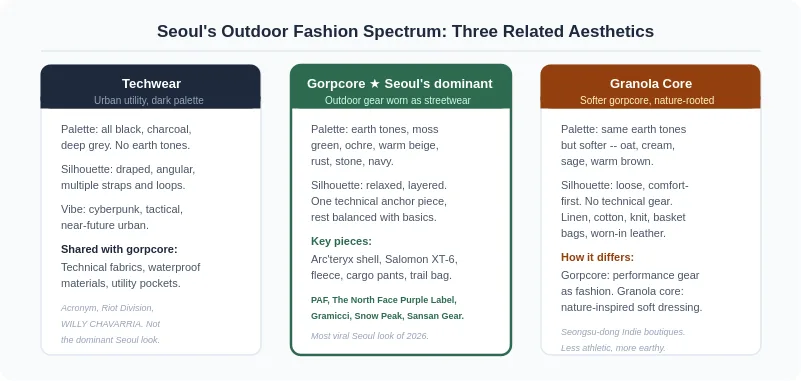
Three related but distinct aesthetics operate in Seoul's outdoor-influenced fashion space.
Gorpcore is the broadest and most active category. Its defining feature is the presence of at least one piece of genuine technical outdoor gear -- a Gore-Tex shell, a Salomon sneaker, a trail-rated fleece -- worn in a non-outdoor context alongside non-technical basics. Palette: earth tones and naturals. Mood: capable and grounded.
Granola core is gorpcore's softer 2026 evolution, described by Seoul fashion observers as an antidote to urban intensity. It shares the earth tone palette but removes the technical gear entirely. Linen, cotton, worn-in leather, basket bags, natural textures. It looks like someone who might go hiking but has not brought the equipment. Seongsu-dong's independent boutiques have leaned heavily into granola core alongside gorpcore. The practical distinction: gorpcore requires at least one technical-fabric piece; granola core does not.
Techwear shares technical fabrics and functional details with gorpcore but diverges completely on palette and mood. Where gorpcore is earth tones and relaxed, techwear is black, charcoal, dark grey, and angular. The silhouettes are deliberately near-future, with straps, loops, and draped panels. Seoul's Seongsu-dong has techwear stockists alongside gorpcore stores, but they serve a distinct customer.
The cultural reasons gorpcore took hold in Seoul
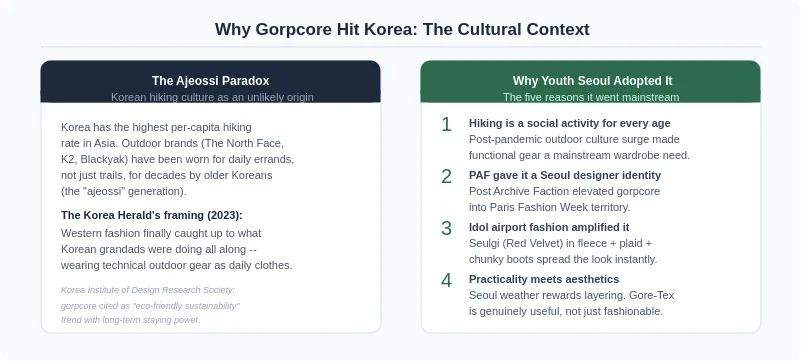
Korean hiking culture is the foundation. The outdoor apparel market in Korea has been disproportionately large for years. The post-pandemic period accelerated outdoor participation across all age groups. A generation that spent weekends hiking Bukhansan and Seoraksan already owned technical gear, already knew how to layer it, and already found it comfortable for daily wear. Gorpcore did not require Korean young adults to build a wardrobe from scratch. It asked them to re-contextualise what they already had.
Post Archive Faction gave gorpcore a Seoul designer identity. PAF, the Seoul-based label founded by Dongjoon Lim, is the most internationally significant Korean gorpcore brand. Its asymmetric tailoring, deconstructed technical outerwear, and futuristic silhouettes have appeared at Paris Fashion Week and in collaboration with the running brand On. PAF's presence in international fashion media positioned Seoul gorpcore as a design movement rather than a consumer trend.
Idol airport fashion provided mass amplification. When Red Velvet's Seulgi appeared in a grey high-neck fleece paired with plaid trousers and chunky boots, the look spread across Korean street style photography and social platforms within days -- a direct demonstration of how a single airport outfit can anchor a macro-trend.
Seoul's weather rewards layering. The Korean climate -- hot and humid summers, cold and dry winters, significant rainfall -- genuinely rewards functional outerwear. A Gore-Tex shell is not just a fashion statement in Seoul. It is a practical response to unpredictable weather, which gives Korean gorpcore a durability that purely trend-driven aesthetics do not have.
Sustainability aligned with Korean consumer values. The Korea Institute of Design Research Society cites gorpcore's use of recycled materials and eco-friendly sustainability as contributing factors to its long-term staying power. Outdoor brands' durable construction that resists replacement cycles aligns with the sustainability orientation of the twenty-five to thirty-five demographic that drives Seoul fashion.
The key pieces: how to build a gorpcore look
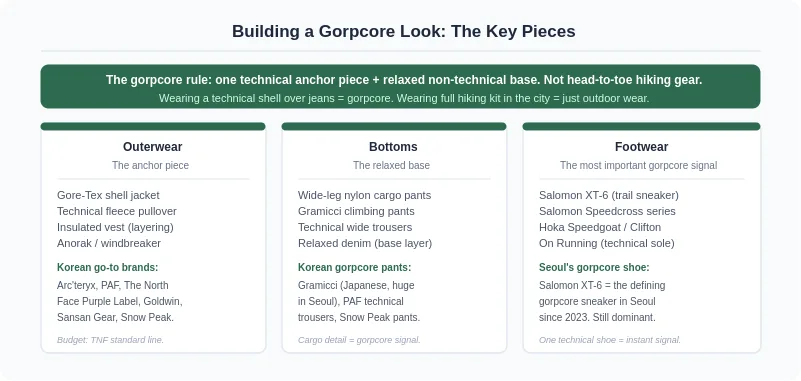
The foundational rule: gorpcore is not wearing full hiking kit in the city. It is wearing one or two technical pieces alongside non-technical basics in a way that reads as deliberate.
Outerwear (the anchor piece). The Gore-Tex shell jacket over a plain long-sleeve and wide-leg trousers is the most reliable formula. Arc'teryx is the aspirational reference. The North Face Purple Label (the Japanese-market premium sub-label, available in Seoul) offers a softer take closer to the fashion end of the spectrum. For Seoul-specific designer gorpcore: Post Archive Faction's outerwear, Sansan Gear's distorted-proportion shell jackets, Snow Peak's refined technical pieces. Gramicci (Japanese brand with strong Seoul retail presence) makes the most recommended gorpcore pants -- climbing-inspired nylon pieces with the distinctive gusset construction.
Footwear (the signal that travels farthest). The Salomon XT-6 trail running sneaker is the defining gorpcore shoe in Seoul. Its aggressive lugged sole and technical overlays produce an unmistakably outdoor reference even worn with tailored trousers and a clean top. Hoka's Speedgoat and Clifton models and the broader On Running catalogue occupy adjacent territory.
Palette. Moss green, warm beige, ochre, rust, stone, warm brown, deep olive. The combinations that have saturated Seongsu-dong street photography in 2026: Gore-Tex jackets in moss green over ochre linen, warm beige outerwear over structured knits. Avoiding high-visibility colours -- the neons and primary colours outdoor brands use for trail safety -- is the styling choice that moves a look from functional outdoor wear to gorpcore.
Where to find gorpcore in Seoul
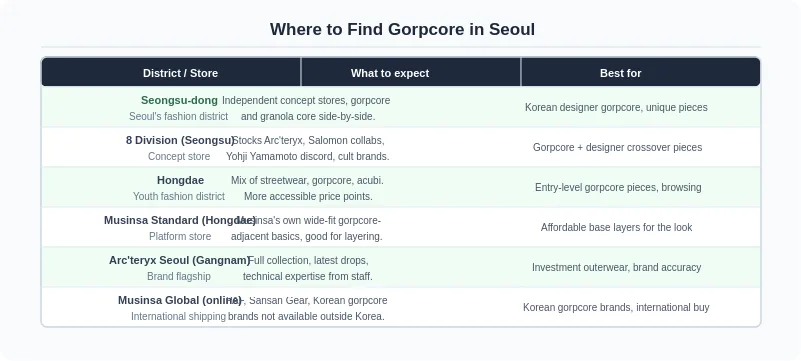
Seongsu-dong is the designer and concept store end. 8 Division (71 Seongsui-ro, Seongdong-gu) stocks Arc'teryx alongside discord Yohji Yamamoto, 032c, and Aries -- the kind of curatorial range that positions gorpcore within a broader international fashion conversation. Cueren, also in Seongsu, runs collaborations with Salomon and Merrell that transform the store into a conceptual space where art and fashion intersect.
Hongdae serves gorpcore at more accessible price points. Musinsa Standard's flagship on the main shopping strip offers wide-fit basics -- relaxed trousers, technical fleeces, and layering pieces that form the non-anchor component of a gorpcore look.
Brand flagships: Arc'teryx operates in Gangnam, full collection and technical expertise from staff. The North Face has flagship presence in multiple Seoul districts. Salomon's Seoul stockists include concept stores across Seongsu and Hongdae.
Musinsa Global ships internationally and carries Korean gorpcore brands not available through any other international channel -- PAF, Sansan Gear, and smaller Seoul gorpcore labels that have not established international distribution. The primary route to the Seoul designer end of the aesthetic for anyone building the wardrobe without a Seoul trip.
Gorpcore and the ajeossi question
The most interesting cultural layer of Korean gorpcore is the generational inversion the Korea Herald identified. The technical outdoor gear that global fashion media presented as a new aesthetic discovery in 2022 and 2023 had been worn as daily clothes by older Korean men for decades. The ajeossi hiking aesthetic -- brightly coloured technical jackets, waterproof trousers, trail boots, and technical caps worn to the local market and the Sunday morning park -- was functional rather than fashionable, which made it invisible to fashion coverage.
When international streetwear gave it a name, Korean young adults were not discovering something new. They were consciously claiming something that had existed in their parents' generation as an unconscious practice.
The twist Korean gorpcore adds: desaturation of the palette and deliberate mixing with non-technical basics. The ajeossi version was head-to-toe technical gear in whatever colours the brand offered, often bright and functional. The 2026 Seoul gorpcore version is one technical piece in an earth tone, balanced against relaxed basics, worn with the specific sneakers that signal membership in the aesthetic. The family resemblance is there, but the styling intent is completely different. One is function that happens to look like fashion; the other is fashion that borrows the visual language of function.
- Gorpcore = one or two technical outdoor pieces worn deliberately with non-technical basics. Not head-to-toe hiking kit.
- The Salomon XT-6 is the defining gorpcore sneaker in Seoul. One technical shoe is often the only signal a look needs.
- Palette: moss green, warm beige, ochre, rust, stone, deep olive. Avoid high-visibility colours.
- Post Archive Faction (PAF) is Seoul's most internationally significant gorpcore label. Available through select Seoul stockists and Musinsa Global.
- Granola core is gorpcore without the technical gear -- same earth tones, natural fabrics, no Gore-Tex.
- Seongsu-dong for designer gorpcore (8 Division, Cueren). Hongdae for accessible entry-level pieces (Musinsa Standard).
For Korean sizing guidance when shopping gorpcore brands on Musinsa, see the Korean Sizing Guide. For the Acubi aesthetic that sits adjacent to gorpcore on the Seoul fashion spectrum, see the Acubi Fashion guide.
Related: Korean Sizing Guide: How to Shop Musinsa Correctly | Acubi Fashion: Seoul's Quiet Cool Aesthetic | Seoul Street Style 2026: Seongsu-dong and Hongdae