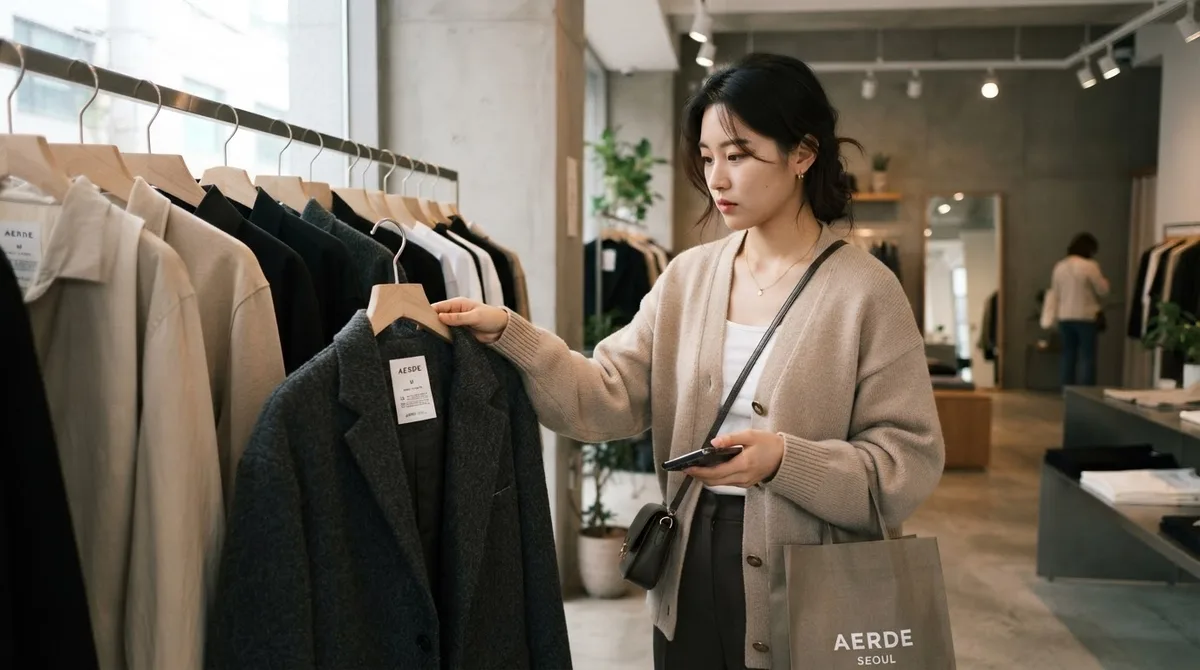
The most common Korean fashion ordering mistake has nothing to do with style or brand choice. It is a measurement unit problem. Korean size charts list flat half-widths, not circumferences. When a listing shows a chest width of 50cm, the actual garment circumference is 100cm. An international shopper reading the 50cm figure and comparing it to their own 92cm chest measurement concludes the item will not fit -- and either sizes up unnecessarily or avoids the purchase entirely. This is the danmyeon trap, and it is responsible for more wrong-size Musinsa orders than any other single factor.
Understanding why Korean sizing works the way it does removes most of the friction between wanting Korean fashion and successfully buying it. The method is specific and learnable.
Three systems running at once
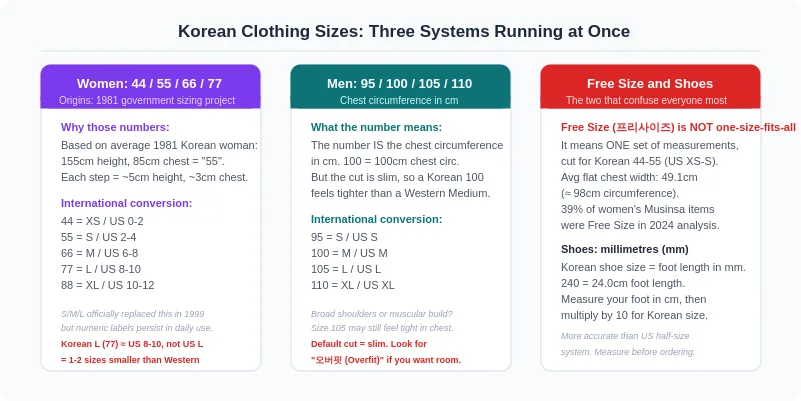
Korean clothing operates across three numbering systems simultaneously, and which applies depends on the garment category and the brand's age.
Women's sizing (44 / 55 / 66 / 77 / 88) is a legacy of a 1981 South Korean government standardisation project. The project categorised women's clothing based on the average Korean woman of that era: 155cm in height with an 85cm chest circumference. The last digits of those two measurements -- five and five -- combined to produce "55" as the base size. Each step up adds approximately 5cm in height and 3cm in chest circumference. South Korea officially transitioned to S/M/L labelling in 1999, but the numeric labels persisted because Korean shoppers were familiar with them. The critical conversion: Korean L (77) corresponds to approximately US 8 to 10, not US L. Korean clothing runs one to two sizes smaller than Western equivalents.
Men's sizing (95 / 100 / 105 / 110) is more directly logical: the number represents the chest circumference in centimetres. Size 100 means a 100cm chest. The complication is that the cut is slim by Western standards, so a Korean 100 feels tighter than a Western Medium even when the chest circumference figure matches. Korean menswear defaults to a slim silhouette. Brands labelled 오버핏 (overfit) or 루즈핏 (loose fit) deliberately depart from this default.
Free Size (프리사이즈) is neither free nor universal. The term means a garment produced in one single set of measurements -- inventory management freedom for the manufacturer, not the shopper. A Kyunghyang Shinmun analysis of 45,678 women's clothing items listed on Musinsa and 29CM in 2024 found that 39 percent were sold as Free Size. The average flat chest width of these items: 49.1cm (approximately 98cm circumference), average length 55.8cm. In international terms: US XS to S, UK 4 to 10. Free Size is designed to fit Korean women's sizes 44 to 55.
Shoe sizes use millimetres. Korean size 240 = 24.0cm foot length. Korean size 260 = 26.0cm foot. Measure your foot in centimetres and multiply by 10.
The danmyeon trap: the measurement problem that catches everyone
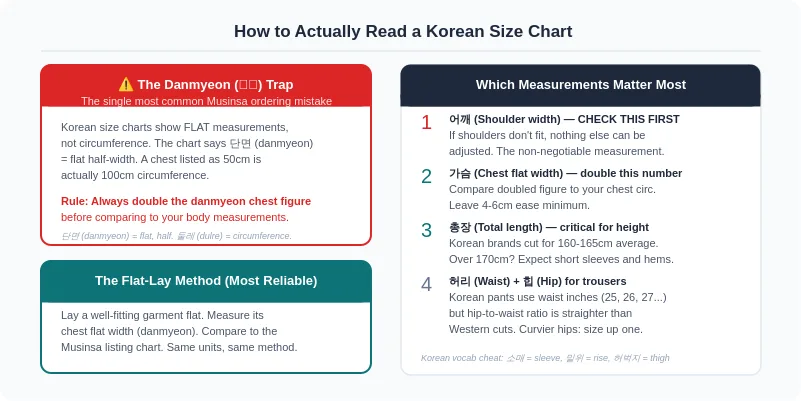
단면 (danmyeon) means flat half-width. When a Korean size chart shows a chest measurement of 50cm, it is showing the width of the garment laid flat -- half the total circumference. The actual garment circumference is 100cm.
A buyer accustomed to Western size charts, which typically show full circumference measurements, sees 50cm and concludes the item is far too small for their 92cm chest. The correct interpretation: 100cm chest circumference, 8cm of ease over their 92cm body measurement -- a workable fit. They size up unnecessarily, receive a garment too large, and blame Korean sizing for being inconsistent.
The vocabulary distinction: 단면 (danmyeon) = flat half measurement. 둘레 (dulre) = circumference. Most Musinsa charts use danmyeon. Always double the chest figure before comparing to body measurements.
The flat-lay method (most reliable): Take a garment you already own that fits the way you want the Korean item to fit. Lay it flat. Measure its chest width from seam to seam -- this is its danmyeon. Compare this figure directly to the danmyeon chest width on the Musinsa size chart. Same units, same method, direct comparison. If the chart shows 50cm danmyeon and your reference garment measures 48cm danmyeon, the Korean item is 4cm wider in total circumference and will be slightly looser. This works regardless of what you know about your body measurements.
Which measurements to check and in what order:
어깨 (Shoulder width) -- first. If shoulders don't fit, nothing can be adjusted. A chest can be slightly loose or fitted and remain wearable. Shoulders cannot. Compare the Musinsa shoulder danmyeon directly to the same measurement on your reference garment. Within one centimetre: the shoulder will fit. More than two centimetres smaller than your reference: do not order.
가슴 (Chest) -- double it. Double the danmyeon figure, then compare to your reference garment's doubled flat measurement. Leave 4-6cm ease minimum.
총장 (Total length) -- critical for height. Korean brands cut for 160-165cm average height. Buyers over 170cm (5'7") will regularly find sleeve lengths short and hems higher than expected. Check this against a reference garment before ordering.
허리 (Waist) and 힙 (Hip) for trousers. Korean pants use waist sizes in inches (25, 26, 27), similar to Western brands. But the hip-to-waist ratio is cut straighter. If your hip-to-waist ratio is larger than Korean fashion norms, size up one waist size and adjust the waist if needed.
Brand-by-brand fit character on Musinsa
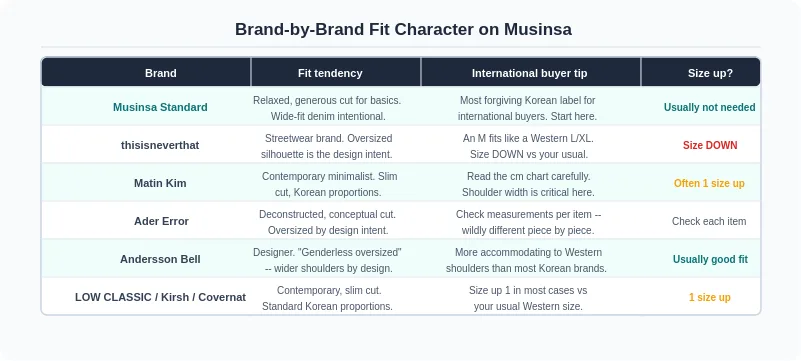
The most important sizing truth about Musinsa: a Korean M from thisisneverthat fits completely differently from a Korean M from Matin Kim, and both fit differently from Musinsa Standard. The size chart on the specific product page is the only reliable reference.
Musinsa Standard is the most forgiving Korean label for international buyers. Built around wider proportions than most Korean fashion brands. Foreign visitors increased 49 percent year-on-year in late 2025 -- international buyers have identified it as the entry point that fits most reliably. Start here.
thisisneverthat and intentionally oversized brands: Sizing down is the rule. An M fits like a Western L or XL because oversized is the design intent. Size one to two sizes down from your usual Western label.
Matin Kim and contemporary minimalist brands: Slim cut, Korean proportions. Read the cm chart carefully. Shoulder width is especially critical. Usually size up one from your Western label.
Ader Error: Deconstructed, conceptual cuts that vary wildly piece by piece. Check measurements per item -- there is no consistent house size logic.
Andersson Bell: "Genderless oversized" design -- wider shoulders than most Korean brands. More accommodating to Western builds than most labels at this price point.
LOW CLASSIC, Kirsh, Covernat: Contemporary slim cut, standard Korean proportions. Size up one from your usual Western label in most cases.
The six-step Musinsa ordering method
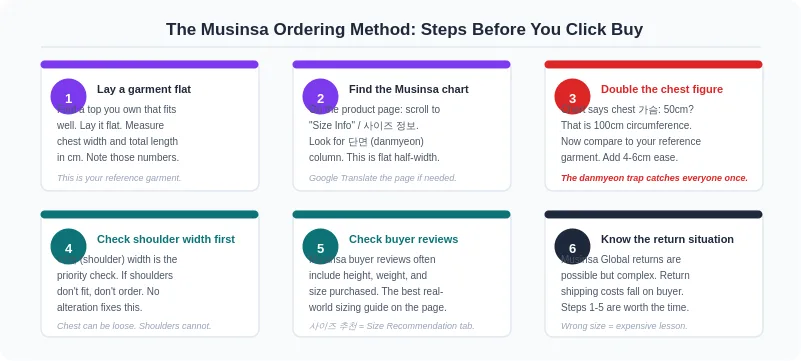
These steps take about four minutes per item. They are worth the time because Musinsa Global returns require the buyer to pay international return shipping -- typically $15 to $25 -- making a wrong-size order expensive to correct.
- Lay a garment flat. Find a well-fitting top from your wardrobe. Measure flat chest width, shoulder width, and total length in cm. These are your reference measurements.
- Find the size chart. On the Musinsa product page, scroll to 사이즈 정보 (Size Info). Google Translate handles the Korean adequately. Locate the 단면 (danmyeon) column.
- Double the chest figure. The listed chest danmyeon doubled = actual circumference. Compare to your reference garment's doubled chest measurement.
- Check shoulder width first. 어깨 (shoulder) figure vs your reference garment's shoulder measurement. Within 1cm: good fit. More than 2cm smaller: do not order.
- Read buyer reviews. Musinsa buyers include height, weight, and size purchased. Find reviewers close to your height and read their fit notes. This is the most accurate real-world sizing guide on the page.
- Know the return situation. Musinsa Global returns are possible within seven days, but international return shipping costs fall on the buyer. Steps 1-5 are worth the time.
Shopping in Seoul: what changes in person
In a Seoul physical store the sizing problem largely disappears because you can try items on. Try two sizes of anything -- the size that matches your measurements, and one size larger. Korean shop staff are accustomed to international visitors requesting a larger size.
Musinsa Standard's Myeongdong location (opened January 2026, three basement floors covering 992 square metres) and the Hongdae store carry the full range with English-speaking staff and on-site instant tax refunds for international visitors. Andersson Bell's Dosan flagship in Gangnam and the Ader Error Seongsu space both carry their full current collections for trying before purchasing.
For items only available online -- smaller Musinsa brands, limited drops, archived season stock -- the measurement method above applies. The Musinsa Try-On Hall in the Hongdae location allows visitors to try specific online-catalog items in-store before purchasing through the app, a service designed specifically for international visitors planning large online orders.
- Korean L ≈ Western XS to S. Size up one to two sizes from your usual Western label before checking measurements.
- Free Size = cut for Korean XS-S (US 0-6). Check cm measurements regardless of what the label says.
- The danmyeon chest figure on Musinsa is half the circumference. Always double it.
- Shoulder width is the priority check. If shoulders don't fit, nothing else can be corrected.
- For intentionally oversized streetwear (thisisneverthat, parts of Ader Error): size DOWN from your Western label.
- Buyer reviews include height and size purchased. Most reliable fit guide on the page.
- Korean trousers: if your hip-to-waist ratio is larger than Korean fashion norms, size up one waist size.
- Korean shoe size = foot length in mm. Measure your foot and multiply by 10.
For the Korean fashion brands this guide applies to in practice, see the Korean Fashion Brands guide. For the Acubi aesthetic and its sizing specifics, see the Acubi Fashion guide.
Related: Korean Fashion Brands Worth Buying in 2026 | Acubi Fashion: Seoul's Quiet Cool Aesthetic, Explained | Seoul Street Style 2026: Seongsu-dong and Hongdae