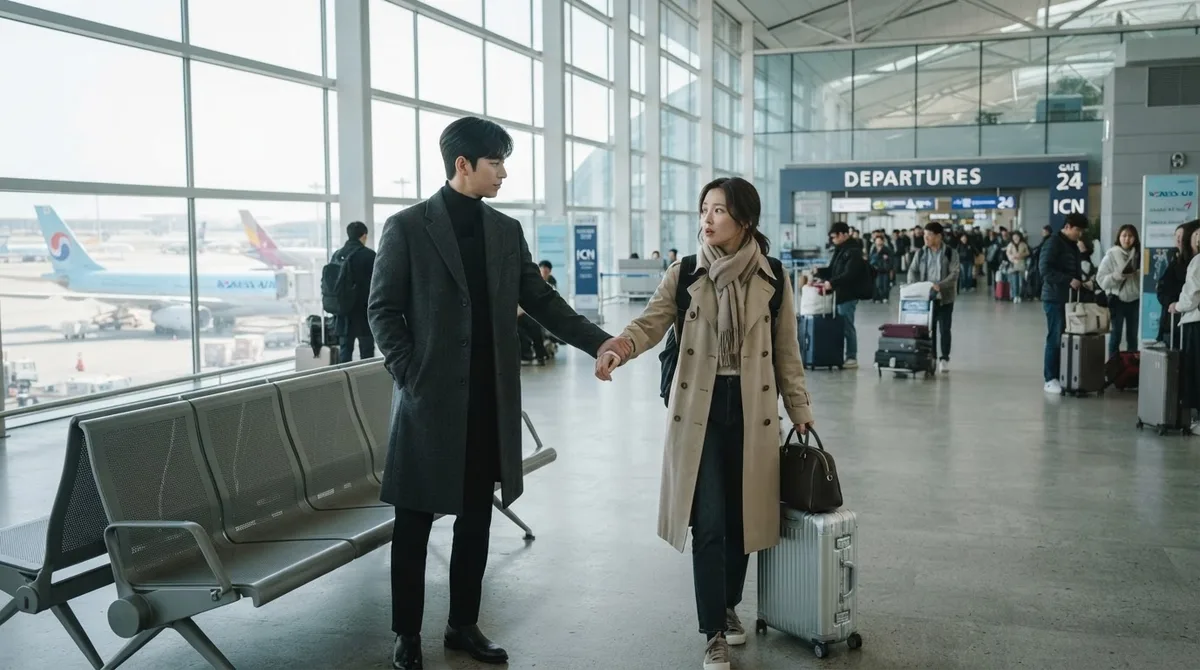
A K-drama trope is not a writing failure. It is a convention that carries meaning precisely because the audience already knows what it signals. When a K-drama male lead grabs a departing woman's wrist, a viewer who has seen three dramas already knows they are watching a moment of emotional crisis for a character who cannot say what he feels. When the slow burn reaches episode ten and everything suddenly falls apart, the experienced viewer knows this is the low point before the payoff, not the end. The tropes are a shared language between the production and the audience.
That shared language is what makes K-drama globally accessible. A first-time viewer in Brazil or Poland or Indonesia does not need cultural background to understand what the airport scene means. The emotional logic is legible from context even without prior exposure. The tropes are the scaffolding that allows K-drama writers working on fast production schedules -- often filming and airing simultaneously across a sixteen-episode run -- to build complex emotional worlds efficiently. Understanding what each trope is doing structurally makes the genre more enjoyable to watch, because you can see the craft behind the convention.
The trope map: what each one is actually doing
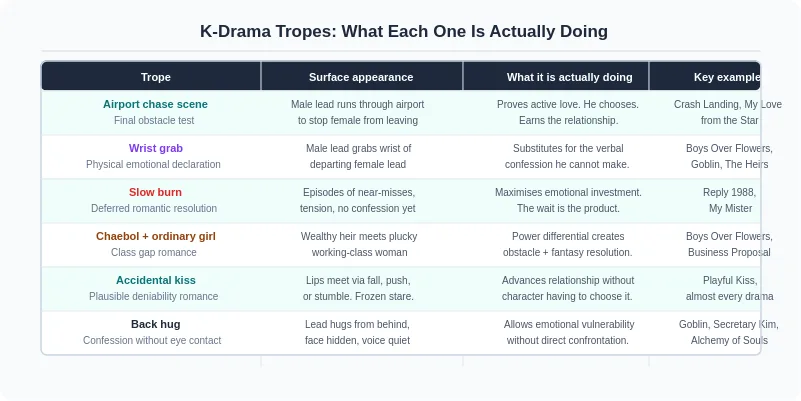
The most important thing to understand about K-drama tropes is that they are almost never random. Each one is performing a specific narrative function at a specific moment in the story's emotional arc -- usually something the story cannot do efficiently with dialogue.
The airport scene appears at the end of a drama when one lead is about to leave -- for another country, for another life, as a consequence of the crisis the middle of the drama has produced. The male lead runs through the airport to stop her. This is not a convenient plot device. It is the story's mechanism for proving that love is active rather than passive. In the slow burn architecture of K-drama, both leads spend most of the drama not choosing each other fully. The airport run is the moment one of them chooses, explicitly, under conditions that make the choice costly. It is the price that makes the payoff feel earned.
The airport also functions as a deadline. K-drama romance requires time pressure to generate tension, and the departure gate is one of the few situations where time pressure is absolute and legible without explanation. The plane leaves or it does not. The character chooses or they do not.
The wrist grab: what it is substituting for
The wrist grab appears almost always at the moment the female lead is walking away after an argument, a revelation, or a decision that would end their contact. He cannot let her go. He is not able to say so in words. His hand reaches out and closes around her wrist.
The functional explanation is that the wrist grab substitutes for a verbal declaration the character is not yet capable of making. Korean drama male leads -- particularly in older dramas -- are frequently constructed as emotionally constrained. The stoic, closed-off male lead who expresses feeling through action rather than speech is one of the genre's foundational character archetypes. The wrist grab is the physical manifestation of a confession that exists in the body before it can be articulated in language. He cannot say "I cannot let you go." His hand says it.
The gesture functions differently across drama generations. In the Boys Over Flowers era -- 2009 -- the wrist grab was coded as dominance made romantic. Jun-pyo grabbing Jan-di in the rain was part of a specific fantasy about the powerful, difficult man who cannot resist the right woman. That fantasy has aged unevenly. Modern K-drama engages with this more critically: female leads now grab wrists too, the gesture is increasingly shown as desperation rather than dominance, and some dramas use the expectation of the wrist grab and then subvert it by having the character say the words instead. The trope persists because the emotional need it serves -- communicating what language cannot -- persists. The power dynamic encoding around it is actively evolving.
The logic of the slow burn
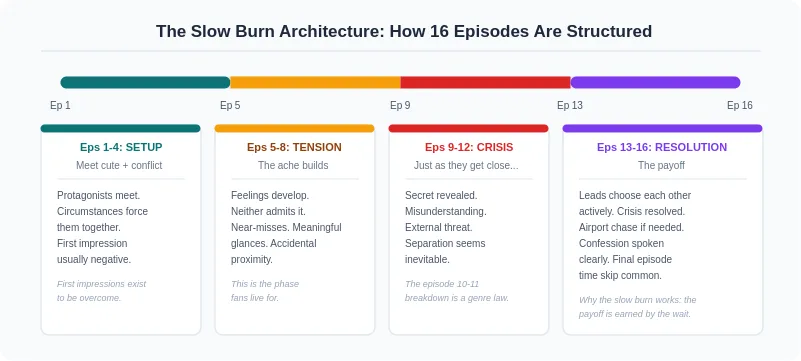
The slow burn is not a flaw in K-drama pacing. It is the entire product. The sixteen-episode standard runtime is architecturally built around the deferral of romantic resolution. Episodes one through four establish the leads and force them into proximity. Episodes five through eight develop feeling without declaration. Episodes nine through twelve introduce the crisis that makes resolution seem impossible. Episodes thirteen through sixteen pay off everything that preceded them.
The slow burn works because of a specific principle: anticipated pleasure is more intense than delivered pleasure. When a drama keeps its leads apart for twelve episodes while making their mutual feeling increasingly undeniable to the audience, it is building an emotional debt that the final episodes collect on. The confession and the resolution, when they finally arrive, carry the weight of everything that was deferred. A romance that resolves in episode four does not produce the same emotional response as one that resolves in episode fourteen, even if the scene itself is identical, because the fourteen-episode version has twelve more episodes of investment behind it.
The deferred confession is the specific device the slow burn relies on most heavily. K-drama leads rarely say "I love you" directly. They say it through the back hug, through the umbrella offered in the rain, through the food left outside someone's door, through a hundred small actions that accumulate into a confession the viewer can read before the characters can speak it.
Reply 1988 is the definitive slow burn drama. The question of which male lead the female lead will end up with is the central mystery across twenty episodes and multiple timeline layers, and the answer is withheld until the very end. The viewer's investment is total because the deferred resolution has kept it alive across the full runtime.
The chaebol trope: why the class gap keeps returning
The chaebol is the Korean term for a family-owned business conglomerate -- Samsung, Hyundai, LG, Lotte. In K-drama, the chaebol heir is drawn to an ordinary woman whose lack of wealth is precisely what attracts him. She is not performing. She is not calculating. She is the first genuinely real thing he has encountered.
The chaebol romance trope persists because it addresses a specific fantasy that is not particular to Korean culture: that genuine feeling can cut through the structures that ordinarily determine who gets access to whom. The romance is proof that the hierarchy of wealth does not determine the hierarchy of value.
What is most interesting in 2026 is how consistently this trope is being inverted. Business Proposal plays the premise for comedy. Hometown Cha-Cha-Cha inverts the formula: the female lead is the educated urban professional and the male lead is a small-town handyman rich in competence and care rather than money. My Mister removes the wealth differential entirely. The trope survives because the underlying fantasy is durable, but the K-drama writing community is thinking critically about what the fantasy contains.
The doom tropes: white truck, noble idiocy, second lead syndrome
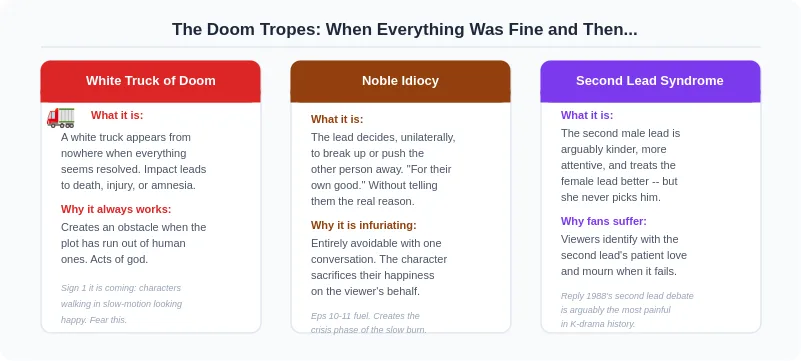
K-drama has a category of trope whose specific function is to introduce catastrophe when the plot needs a reset. These appear at the point where the couple has resolved their differences and the main obstacle has been overcome. A happy couple in episodes eleven and twelve is a structural problem in a sixteen-episode drama -- the crisis that drives the story has been removed too early.
The White Truck of Doom is the most identified. A white truck appears from nowhere when all seems well. The impact leads to injury, death, or amnesia. The drama community identified this pattern so specifically that the vehicle colour became shorthand for the entire genre of external catastrophe. Any slow-motion shot of a character walking happily while upbeat music plays is now universally read by experienced K-drama viewers as a setup for disaster. Some dramas now include the slow-motion happy walk and then withhold the truck precisely because the viewer expects it.
Noble idiocy is the doom trope that generates the most viewer frustration because it is self-inflicted. The male lead decides, without consultation, to push the female lead away for her own good -- without explanation, without asking her. The viewer can see that one direct conversation would resolve everything. The character refuses to have it. Noble idiocy is the crisis that keeps the leads apart through episodes ten and eleven, and it works because the underlying emotional logic -- someone who loves another person choosing to sacrifice their own happiness rather than burden them -- is recognisable even when the execution is maddening.
Second lead syndrome is the specific pain of watching a character who loves the female lead steadily, treats her well, and supports her without condition -- and is never chosen. The female lead's heart belongs to the first lead, whose difficult personality creates the drama that the kind second lead cannot generate. Reply 1988's second lead debate, in which fans argued for years about whether Choi Taek or Jung Hwan deserved the female lead, is the most sustained and painful example of the syndrome in K-drama history.
The physical gesture vocabulary
K-drama communicates significant emotional content through specific physical gestures that function as shorthand for states characters cannot articulate directly.
The back hug: one character approaches from behind and wraps their arms around the other, face hidden, voice near-whispered. This is the confession without eye contact -- it allows the declaration of feeling without the exposure of direct confrontation. It appears in Goblin, in What's Wrong with Secretary Kim, in Alchemy of Souls, because the emotional need it serves is constant across genres.
The accidental kiss: he trips, she stumbles, their lips meet. The freeze-frame follows -- wide eyes, held breath. The accidental kiss advances the romantic plot without either character having to make a choice. Neither chose it, so neither has to defend it. The drama gets the romance beat it needs while preserving the plausible deniability the characters require to keep denying their feelings for at least two more episodes.
The piggyback ride: one character carries the other on their back -- usually because one is drunk, injured, or exhausted. The position forces physical closeness and quiet that the drama otherwise keeps denying them. Drunk confessions happen on piggybacks. Small truths are spoken that will be denied in the morning. The piggyback is the drama's way of creating intimacy between characters who are not yet in the position where intimacy is sanctioned.
Why tropes are not a weakness
The consistent criticism of K-drama tropes from new viewers is that they are predictable. The consistent response from experienced viewers is that predictability is part of the function. A genre that deploys familiar conventions gives its audience a form of comfort -- you know that this type of moment signals that particular emotional beat, and there is genuine pleasure in recognition. The craft question is not whether a drama uses the slow burn or the wrist grab. It is how well it executes them.
Kim Eun-sook -- with Secret Garden, Goblin, Descendants of the Sun, and The Glory on her record -- uses almost every classic trope across her work. Her reputation rests not on avoiding conventions but on executing them with emotional intelligence that makes the familiar feel new.
My Mister, the 2018 drama consistently cited as one of the finest the genre has produced, takes a different approach: it subverts almost every standard romance trope, building its central relationship without the chaebol, without the airport, without the conventional confession. But My Mister is as dependent on K-drama's trope vocabulary as any more conventional drama. You need to know what a wrist grab usually means to understand what it means for My Mister to not have one.
- The slow burn is the product, not the delay. The sixteen-episode runtime is built around the deferral.
- Airport scenes function as proof of active love -- the lead chooses explicitly under conditions that make the choice costly.
- The wrist grab substitutes for the verbal confession a character cannot yet make.
- Episode ten or eleven crisis is almost universal. When everything falls apart near the middle, the drama is on schedule.
- Second lead syndrome is intentional. The second lead's goodness is designed to make his loss feel unjust.
- Fear the slow-motion happy walk with upbeat music. The White Truck of Doom may be near.
For the K-drama filming locations where these tropes play out on Seoul streets, see the K-Drama Filming Locations guide. For the beauty aesthetic of K-drama actors, see The Skin and Beauty Secrets Behind K-Drama Actors' Flawless Complexions.
Related: K-Drama Filming Locations in Seoul You Can Actually Visit | Bukchon, Ikseon-dong and Beyond: Seoul K-Drama Photo Guide | The Skin and Beauty Secrets Behind K-Drama Actors