
Every K-beauty glow trend has a name. Glass skin is the reflective, almost transparent finish that dominated Korean beauty from around 2017 onward. Cloud glow is the soft-focus, barrier-first luminosity that has replaced it in 2025 and 2026. Jello skin is the bouncy, elastic quality that collagen-focused routines aim for. These are all distinct finishes, and they are all built on the same foundation. That foundation is honey skin.
In Korean, the compliment "skin like honey" (꿀피부, gul-pi-bu) is one of the highest things you can say about someone's complexion. It does not mean shiny. It does not mean reflective. It means skin that looks deeply nourished, plump, and golden-toned -- the way honey looks when you hold it up to light. Opaque, warm, and full. The comparison is to the substance of honey rather than its surface, which is exactly the distinction that separates honey skin from every other glow trend: it describes skin condition rather than skin finish.
Why honey skin comes first
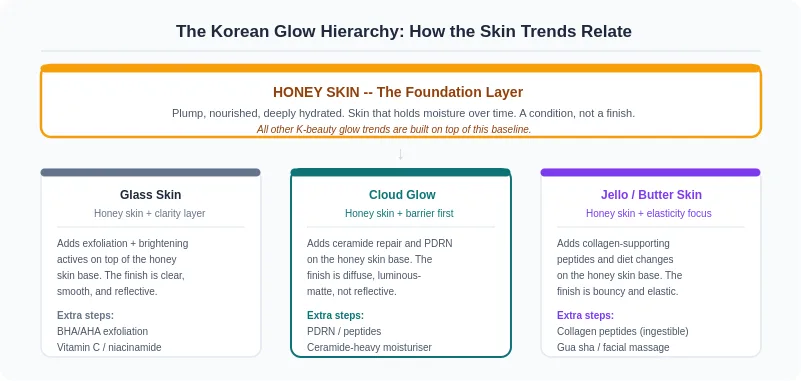
Glass skin, cloud glow, jello skin, and butter skin are all finish-level descriptions. They describe what the skin looks like at the end of a well-designed routine. Honey skin is the condition underneath all of them -- the baseline of deep hydration, intact barrier function, and genuine nourishment that makes any of those finishes achievable.
The distinction matters practically. You cannot achieve glass skin on a dehydrated, barrier-compromised complexion regardless of how many brightening actives you apply. The exfoliating and clarifying steps that glass skin requires will only cause irritation and reactive oiliness if the skin is not already in a plump, healthy state. Similarly, cloud glow's diffuse luminosity is the optical property of an intact stratum corneum lipid matrix -- it cannot be manufactured on top of damaged or undernourished skin. Both of these finish-level trends require honey skin as their prerequisite.
This is also why Korean beauty's historical approach has always prioritised hydration and barrier health before actives. Modern Korean dermatology consistently advises repairing the barrier before introducing any active ingredient. The honey skin ideal has always been the starting point rather than the destination.
What honey skin actually looks like
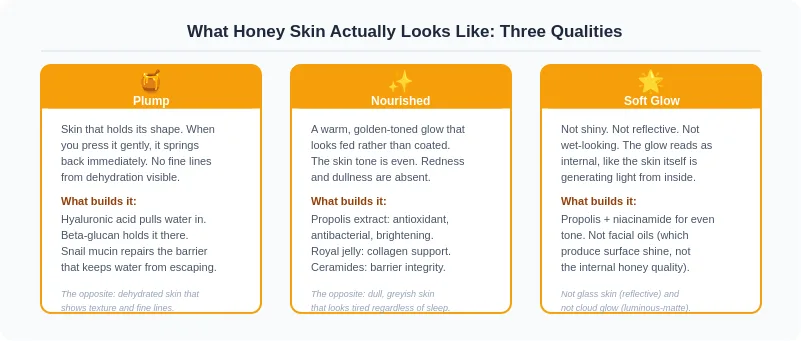
Honey skin has three qualities specific enough to check against your own complexion.
Plumpness is the first. Skin that is genuinely plump holds its shape, springs back immediately when pressed, and does not show dehydration lines -- the fine criss-cross texture that appears on the cheeks and around the eyes when skin lacks water. Plumpness is a structural quality produced by water content in the dermis and epidermis, maintained by an intact skin barrier that prevents transepidermal water loss. It is distinct from puffiness, which is inflammation. The specific look honey skin is after is springy and full, like the bounce of a fresh grape.
Nourishment is the second quality -- the warm, even-toned, golden glow that reads as internal rather than applied. Nourished skin has no greyish dullness, no visible redness or patchiness, and no flat texture that makes the face look tired regardless of sleep. In ingredient terms, nourishment comes from propolis extract, royal jelly, and ceramides -- the ingredients that feed and protect the structure rather than temporarily filling or coating it.
Soft glow is the third, and the one most commonly confused with other finish descriptions. Honey skin's glow is not reflective like glass skin -- it does not bounce light off a smooth surface in a way that reads as shiny or wet. It is not the diffuse luminosity of cloud glow, which has a specifically luminous-matte quality. Honey skin's glow is warmer and rounder. The best practical description: skin that looks healthy in a way that reads as slightly lit from inside, rather than skin that looks like it has product on it.
How honey skin differs from glass skin and cloud glow
Glass skin adds brightening actives and surface-clearing steps to the honey skin base: gentle exfoliation with BHA or AHA, and brightening serums with vitamin C or niacinamide. The finish is clearer and more reflective -- a smooth, almost transparent surface that reflects light uniformly. Glass skin is best suited to normal to combination skin that can tolerate exfoliation and active ingredients without reactivity. It is not the starting point for damaged or sensitised skin.
Cloud glow adds ceramide-heavy repair and PDRN to the honey skin base. The additions are barrier-focused rather than clarifying: the ceramide moisturiser becomes the centrepiece, PDRN or peptide serums drive cellular repair rather than surface brightness, and the routine avoids the exfoliating steps that glass skin requires. The finish is luminous-matte -- diffuse and dimensional rather than reflective. Cloud glow is the 2026 direction Korean beauty has moved from glass skin's maximalist approach, and honey skin is the condition it requires before it can work.
Honey skin itself, without glass skin or cloud glow additions, is the appropriate routine for anyone repairing barrier damage, dealing with sensitivity, or wanting a sustainable everyday baseline that does not require daily exfoliation or advanced actives. It is the mildest of the three approaches, the most forgiving for all skin types, and the most useful as a reset.
The five key ingredients
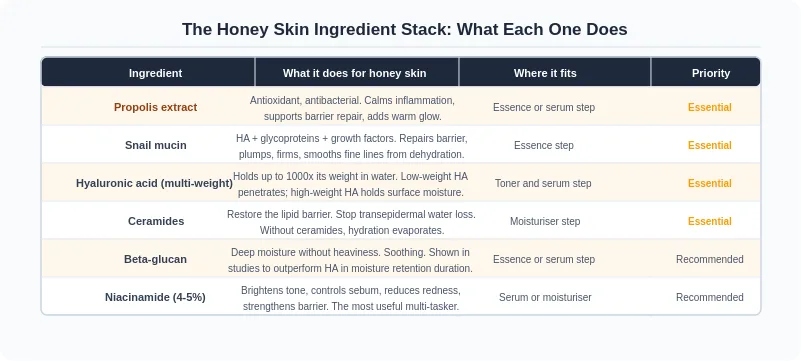
Propolis extract is the defining ingredient of honey skin and the one most directly responsible for its name. Propolis is the resinous substance that honeybees produce to seal and protect the hive -- antibacterial, antifungal, and rich in bioflavonoids and phenolic compounds. In skincare, it functions as an antioxidant that protects skin from environmental damage, as an anti-inflammatory that reduces redness and calms irritation, and as a barrier-supporting ingredient that helps repair the lipid matrix of the stratum corneum. The Beauty of Joseon Glow Serum -- 60% propolis extract with 2% niacinamide -- is consistently cited as one of the most effective single-product entry points to honey skin because it addresses nourishment, barrier support, and gentle brightening simultaneously.
Snail mucin is the second essential ingredient. COSRX's Advanced Snail 96 Mucin Power Essence is the single most-sold K-beauty product globally -- over twenty million bottles. Snail mucin contains hyaluronic acid, glycoproteins, and growth factors that work together to repair the skin barrier, promote moisture retention, and support skin firmness. The texture is specifically described as slightly sticky in the way that honey is slightly sticky -- a quality that Korean beauty enthusiasts associate with the chok-chok (촉촉) sensation that indicates skin is genuinely hydrated rather than just coated with silicone. The COSRX Snail 96 layered under the Beauty of Joseon propolis serum is the most commonly recommended two-product honey skin foundation.
Hyaluronic acid in multiple molecular weights is the third ingredient. Honey skin requires depth of hydration, not just surface moisturisation. Low-molecular-weight HA penetrates into the skin; high-molecular-weight HA holds moisture at the surface. Single-molecular-weight HA products primarily work at the surface level and produce temporary plumping that does not persist. The Korean approach consistently uses multiple weights -- Torriden's DIVE-IN Hyaluronic Acid Serum uses five types of HA at different molecular sizes.
Ceramides at the moisturiser step are the fourth essential. Without adequate ceramides, water evaporates from the skin surface regardless of how much hydration is applied. COSRX Balancium Comfort Ceramide Cream, Dr. Jart+ Ceramidin Cream, and Aestura AtoBarrier 365 Cream are the most consistently recommended Korean ceramide moisturisers in the honey skin context.
Beta-glucan is the fifth ingredient, less discussed but worth prioritising. Typically derived from oats or yeast, beta-glucan has been shown in comparative studies to outperform hyaluronic acid in moisture retention duration -- it holds water in the skin for longer. It is also deeply soothing, making it particularly valuable for redness-prone or sensitive skin.
The honey skin routine
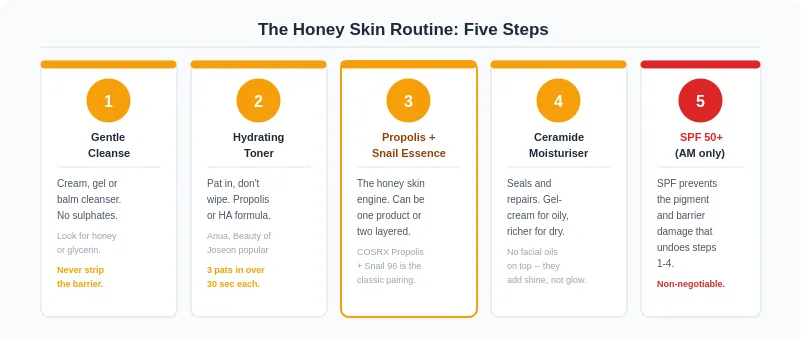
The honey skin routine avoids the exfoliation and advanced actives that glass skin or cloud glow would add. Five steps: cleanse without stripping, hydrate in layers, nourish at depth, seal with ceramides, protect with SPF.
Step 1: Gentle cleanser. Cream, gel, or balm textures with glycerin, honey extract, or amino acids. No sulphates. Evening: double cleanse with oil cleanser first. Morning: a single gentle wash is sufficient.
Step 2: Hydrating toner. Applied by patting rather than wiping. Propolis-containing toners or HA-rich essences both work here. The patting technique drives absorption rather than spreading product for evaporation. Three to five thin layers of the same toner builds hydration depth more effectively than a single large application.
Step 3: Propolis + snail mucin essence. This can be a single product containing both, or two products in sequence -- snail mucin first, propolis serum on top. This step is the functional heart of the routine: where the nourishment, barrier repair, and inner glow are built rather than temporarily delivered to the surface.
Step 4: Ceramide moisturiser. Seals everything placed below it by slowing transepidermal water loss. Gel-cream for oily and combination skin. Richer cream for dry and mature skin.
Step 5: SPF 50+ (morning). Sun damage undermines honey skin in two specific ways: it degrades the ceramide barrier and causes the pigmentation and redness that interrupt the even, warm tone honey skin describes. Korean sunscreen in 2026 is lightweight enough to not disrupt the finish below. PA++++ indicates broad-spectrum UVA protection.
Honey skin for different skin types
The honey skin approach is notably more inclusive across skin types than glass skin or cloud glow. The exfoliation that glass skin requires can cause purging for sensitive skin. The ceramide-heavy moisturiser that cloud glow emphasises can feel too rich for oily skin. Honey skin's moderate approach adapts well across the skin type spectrum by adjusting textures rather than ingredients.
Oily and combination skin: gel-format essences, gel-cream moisturisers, lightweight oil-free sunscreens. Propolis and snail mucin are both non-comedogenic and appropriate for oily skin. Niacinamide at 4-5% specifically regulates sebum production.
Dry and mature skin: honey skin is close to ideal as a base, with a richer ceramide cream at step four and an optional hydrating sleeping mask two to three nights per week. The LANEIGE Water Sleeping Mask is the most widely recommended Korean sleeping mask for this purpose.
Sensitive and barrier-compromised skin: honey skin without any additional actives is the appropriate starting point. COSRX Snail 96 plus a fragrance-free ceramide cream alone is sufficient to begin rebuilding a compromised barrier. Centella asiatica (cica) is worth adding for its specifically anti-inflammatory properties when sensitivity is the primary concern.
Korean products and where to find them
The honey skin ingredient list maps to a short set of Korean product categories available through Musinsa Global, YesStyle, Olive Young Global, and Korean beauty platforms.
- Propolis serums: Beauty of Joseon Glow Serum (benchmark), COSRX Propolis Light Ampoule (lighter, for oily skin), Skinfood Royal Honey Propolis Enhance Essence (richer, for dry skin)
- Snail mucin essences: COSRX Advanced Snail 96 Mucin Power Essence (most recommended globally), TONYMOLY Intense Care Snail Hydro Gel Cream (creamier version)
- Ceramide moisturisers: COSRX Balancium Comfort Ceramide Cream (accessible entry), Dr. Jart+ Ceramidin Cream (richer), Aestura AtoBarrier 365 Cream (sensitive skin)
All three categories are available at Olive Young stores in Seoul for in-person purchase during a Korea trip, and all ship internationally through the Olive Young Global website at prices thirty to sixty percent below equivalent-quality Western skincare.
- Honey skin describes a skin condition -- plump, nourished, warm-glowing -- not a finish. It is the baseline that glass skin and cloud glow are both built on top of.
- The five essential ingredients: propolis extract, snail mucin, multi-weight hyaluronic acid, ceramides, and beta-glucan.
- The routine: gentle cleanser, hydrating toner (pat in), propolis + snail mucin essence, ceramide moisturiser, SPF 50+.
- No facial oils on top of the moisturiser -- they add surface shine, not the internal honey glow.
- Honey skin suits all skin types better than glass skin or cloud glow because it avoids exfoliation and heavy occlusives.
- The COSRX Snail 96 + Beauty of Joseon Glow Serum pairing is the most recommended two-product honey skin foundation in Korean beauty communities.
- If visiting Seoul: Olive Young stocks all of these categories at prices significantly below international retail. The Myeongdong flagship is the most convenient single-stop for the full honey skin product set.
For the cloud glow finish that honey skin enables, see the Cloud Glow Skin 2026 guide. For the glass skin facial treatment context in Seoul, see the Korean Glass Skin Facial guide when published.
Related: Cloud Glow Skin: The 2026 Korean Trend That Replaced Glass Skin | How K-Pop Idols Actually Take Care of Their Skin | Rejuran vs Juvelook vs Exosome