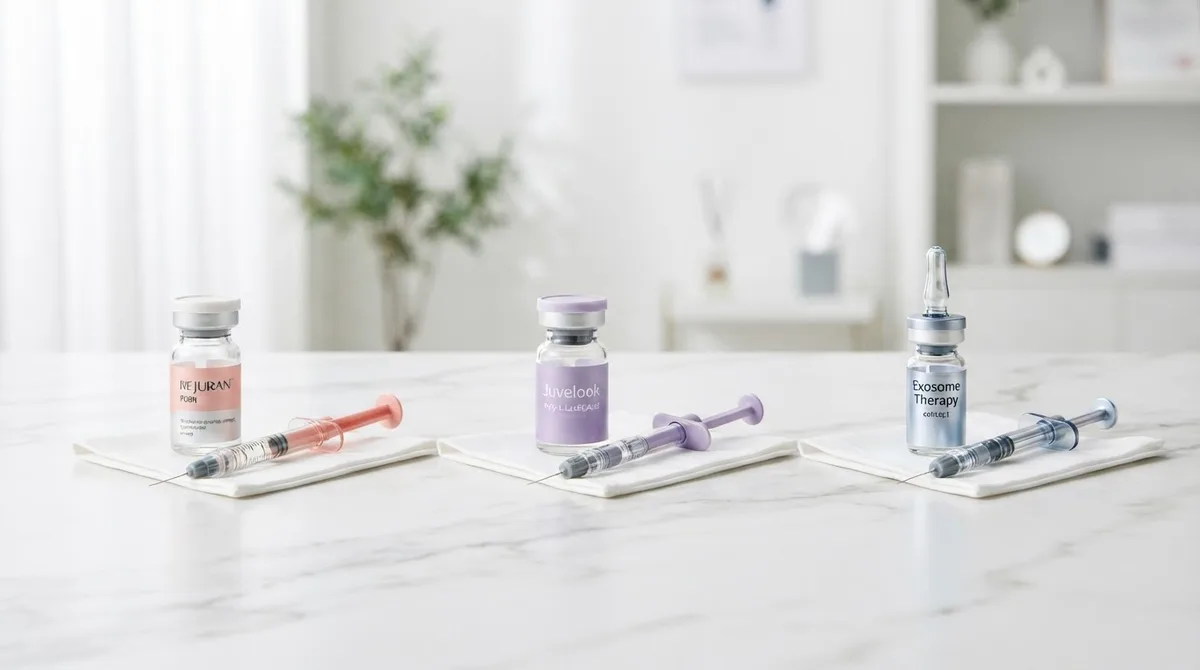
Walk into any dermatology clinic in Gangnam or Myeongdong and the menu will list Rejuran, Juvelook, and some variant of exosome therapy at similar price points with overlapping descriptions. The staff at most clinics will describe all three as good for glass skin, good for anti-aging, good for glow. That framing is not wrong, but it is not useful for making a choice.
These three treatments operate through distinct biological mechanisms on different timelines with different optimal skin conditions. Choosing between them based on budget or availability misses the point. Choosing based on your specific skin concern and the outcome you are trying to achieve is what produces the result the descriptions promise.
Three mechanisms: what each actually does
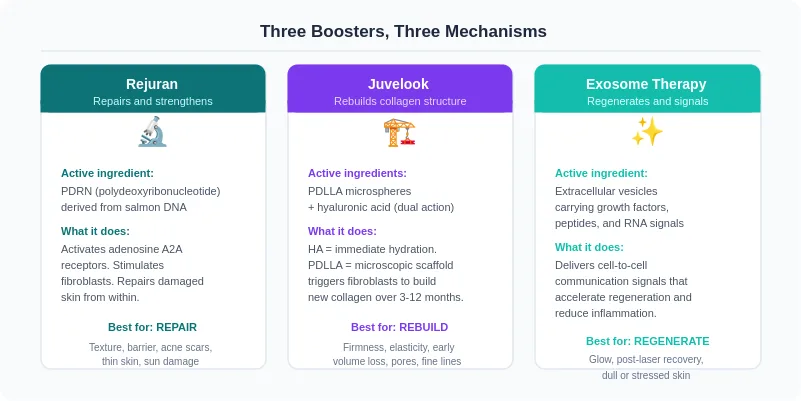
Rejuran is a polynucleotide (PDRN) injectable derived from purified salmon DNA. The DNA fragments activate adenosine A2A receptors in the dermis, which stimulate fibroblasts — the cells responsible for producing collagen, elastin, and the components of the extracellular matrix. The result is internal repair. Rejuran does not add volume. It does not produce immediate glow. It works by improving the quality and function of the skin's own repair systems, which means its results are gradual and cumulative. A session at four weeks shows change. A session at three months shows significantly more.
Rejuran's primary value is in damaged, thinned, or compromised skin: post-acne scarring, skin thinned by excessive sun exposure, enlarged pores with rough texture, and barrier-damaged skin that reacts sensitively to products. It is the most established of the three treatments, in Korean dermatology clinics since 2014, with the most published clinical data. The product line includes specific formulations: Rejuran Healer (original), Rejuran I (periorbital under-eye), Rejuran S (acne-scarred skin), and Rejuran HB (PDRN plus hyaluronic acid for hydration-focused results).
Juvelook is a dual-action hybrid biostimulator combining two active ingredients that work in sequence. Non-crosslinked hyaluronic acid provides immediate hydration visible within 24 to 48 hours, plumping skin and producing early glow. PDLLA microspheres (poly-D,L-lactic acid) are the longer-acting component: ultrafine biodegradable particles that function as a microscopic scaffold in the dermis, physically triggering fibroblasts to build new collagen around each particle as the particles gradually degrade. This collagen-building process begins at four to six weeks and continues developing through month twelve.
The significance of Juvelook's ultrafine PDLLA particle size matters practically. Earlier collagen-stimulating injectables like Sculptra used poly-L-lactic acid at larger particle sizes, which carried a meaningful risk of lump and nodule formation. Juvelook's significantly smaller spherical particles reduce this risk substantially. For skin that has lost elasticity and firmness, where the concern is structural rather than surface-level, Juvelook addresses the problem that Rejuran does not.
Exosome therapy is the most recent of the three and the one with the smallest body of published long-term clinical data. Exosomes are extracellular vesicles — structures produced by cells as a communication mechanism, containing growth factors, peptides, microRNA, and other signalling molecules. In skin applications, these vesicles deliver regenerative signals to recipient cells, accelerating healing, reducing inflammation, and promoting collagen synthesis through biological messaging. Results appear more quickly than Rejuran and with less downtime than either of the other two treatments, making exosome therapy particularly well-suited as a post-laser recovery accelerant or as a standalone glow treatment for skin that needs renewal rather than structural repair.
Which booster for which skin concern
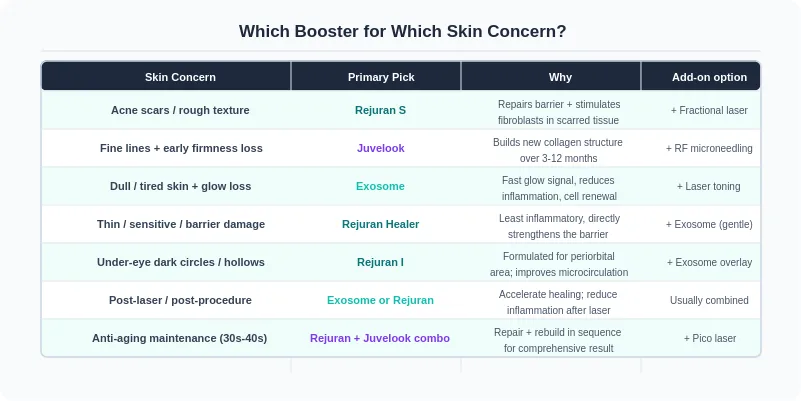
Choose Rejuran if your primary concern is damaged, rough, or sensitised skin — post-acne texture and scarring, enlarged pores, skin thinned by sun damage, and under-eye fragility. The barrier-strengthening and fibroblast-activating mechanism addresses the root of these problems. Rejuran I for the under-eye area is the only Korean skin booster specifically developed for periorbital injection.
Choose Juvelook if your primary concern is firmness, elasticity, and the early structural changes of aging: skin that has lost density, shows early sagging around the jawline or cheeks, or has fine lines driven by collagen loss rather than surface texture issues. The important distinction: someone with rough, damaged skin and a thin barrier does not primarily need more collagen stimulation — they need repair first. Juvelook on a compromised barrier addresses the wrong problem. Rejuran on lax, structurally sound skin addresses the wrong problem in the other direction. The starting point determines the choice: is the skin damaged, or is it aging without significant damage?
Choose exosome therapy if your primary concern is dullness, rapid visible improvement, or post-procedure recovery. Exosome results appear faster than either Rejuran or Juvelook with the least downtime. For visitors with limited time in Seoul who want visible glow improvement within their trip window, exosome therapy produces results more quickly than PDRN's four-to-six-week timeline. For anyone who has just had a laser session during their Seoul visit, exosome therapy applied in the immediate post-treatment period accelerates healing and reduces the inflammatory period. The tradeoff is duration: three to six months, shorter than Rejuran's six to nine months and significantly shorter than Juvelook's twelve to eighteen months.
The combination protocols Korean dermatologists use in practice are often more instructive than individual treatment descriptions. Rejuran followed by Juvelook in staggered sessions is the most common combination: Rejuran addresses repair first, building a healthier skin foundation, and Juvelook then stimulates collagen in prepared tissue. Exosome therapy added to a laser session is the standard post-procedure enhancement.
The Rejuran product line
The multiple Rejuran variants cause confusion because they share a parent name but serve different purposes.
Rejuran Healer is the original formulation and most widely studied. Full face application at multiple injection points across the treatment area. Standard choice for texture improvement, barrier strengthening, and general skin quality enhancement.
Rejuran I uses a different viscosity formulation specifically for the periorbital area, which has different tissue characteristics from the rest of the face. Placed more precisely around the orbital rim and under-eye area to address the microcirculation and thinning that produces dark circles and hollowing.
Rejuran S has a modified formulation targeting acne-scarred skin, with an application protocol designed for areas of thickened scar tissue. Works alongside fractional laser for scar revision protocols rather than as a standalone treatment.
Rejuran HB adds hyaluronic acid to the PDRN base, providing more immediate hydration alongside the repair mechanism. For patients whose primary concern is dullness with underlying texture issues, Rejuran HB addresses both the surface and the structural without requiring a separate hyaluronic acid session.
Regulatory note for international patients
Rejuran is KFDA-approved (Korea Ministry of Food and Drug Safety) and has been in use in Korea since 2014 with extensive published clinical evidence. It is not FDA-approved in the United States — a regulatory timeline matter rather than a safety concern, as no US approval has been sought for injectable PDRN. The same applies to Juvelook: KFDA-approved in Korea, no current US FDA approval for injectable use. Patients traveling to Seoul access legally approved, clinically validated procedures in a regulated medical environment staffed by board-certified Korean dermatologists.
Exosome therapy regulatory status varies by product and formulation. Request information on the specific exosome product being used and its regulatory status at consultation.
Timeline and what to expect
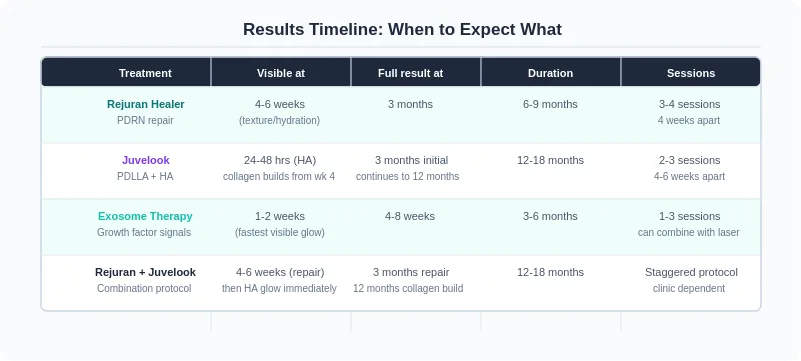
Rejuran Healer: Three to four sessions, four weeks apart. Visible texture and hydration improvement begins at four to six weeks after the first session. Full repair results at approximately three months. Effects last six to nine months; maintenance session recommended every six months.
Juvelook: Two to three sessions, four to six weeks apart. Immediate hydration visible within 24 to 48 hours. Collagen remodelling begins at four to six weeks, produces significant structural improvement at three months, and continues developing through month twelve. Results last twelve to eighteen months.
Exosome therapy: One to three sessions; can be administered as a single session for post-procedure recovery. Visible glow improvement typically within one to two weeks. Results last three to six months.
At the appointment: consultation and skin analysis run first, treatment plan presented and priced before anything proceeds. Numbing cream applied for twenty to forty minutes before injection. Injection procedure runs thirty to sixty minutes. A soothing mask and sometimes LED recovery light applied after injection. Return to normal activities same day. Avoid exercise, saunas, and steam rooms for 24 to 48 hours. SPF50+ is non-negotiable for the weeks following any of these treatments.
What it costs and the VAT situation
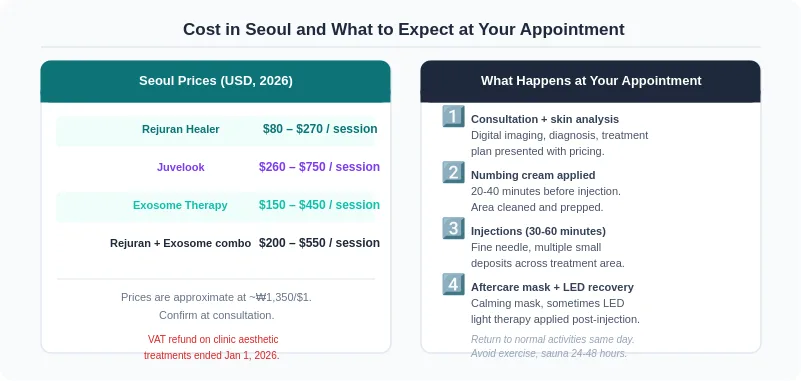
Rejuran sessions run approximately $80 to $270 USD per session depending on the formulation, clinic, and treatment area. A full initial course of three to four sessions runs $240 to $1,080.
Juvelook runs approximately $260 to $750 USD per session in Gangnam and Myeongdong clinics. The initial two to three session course runs $520 to $2,250.
Exosome therapy runs approximately $150 to $450 USD per session as a standalone treatment, varying by specific product and whether applied alongside another treatment.
The VAT refund on aesthetic medical clinic treatments that previously offered international visitors a ten percent return ended as of January 1, 2026. Any guide still citing the tax refund is using pre-2026 information.
For context on where these treatments sit within the full range of Seoul clinic options, see our Korea skin treatment cost guide and the Korean acne treatment clinic guide for companion coverage of laser and device treatments frequently combined with skin booster protocols.
Related: Clinic-in-a-Bottle: At-Home Versions of Korea's Pro Treatments | Korean Acne Treatment in Seoul: Clinics vs Products | Medical Tourism in Korea: The Complete First-Timer's Guide