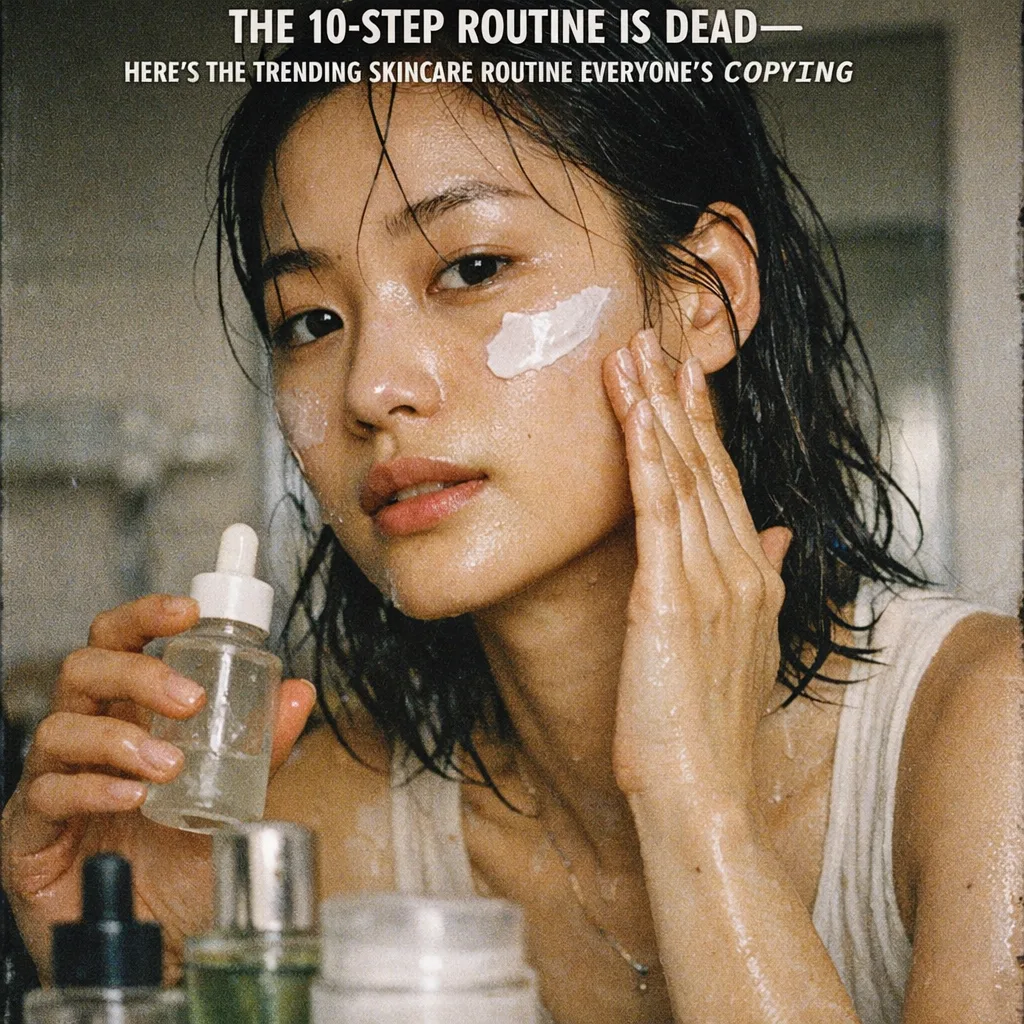
If you've ever stood in front of your bathroom mirror at 11pm, bleary-eyed, trying to remember whether the essence goes before or after the ampoule, I have good news for you.
Koreans aren't doing that. And honestly? They never really were.
The famous 10-step routine, the one that spawned a thousand YouTube tutorials and filled up the shelves at Sephora between 2016 and 2022, was largely a Western invention. It was a slick marketing package built around the sheer variety of Korean beauty products, not a description of how people in Seoul actually wash their faces. Walk into any Olive Young in Gangnam today and watch the 25-year-olds shopping. They're not buying ten things. They're buying two or three, and they're reading the ingredient lists like they're cross-examining a witness.
Welcome to the world of Korean skincare 2026. It's quieter. It's smarter. And the trending skincare routine from South Korea that you're about to learn looks almost nothing like the one that went viral five years ago. Here's what's actually happening in Seoul's bathrooms right now, and what you should steal from it.
Why the 10-Step Routine Quietly Fell Out of Favor
Let's start with the uncomfortable truth. Layering ten products on your face, morning and night, is not good for most people's skin. Korean dermatologists have been saying this for a while, and the message finally landed.
The problem is barrier damage. When you pile on a hydrating toner, then an essence, then a first treatment essence, then a serum, then an ampoule, then a sheet mask twice a week, plus actives like vitamin C and retinol and AHAs, your skin's barrier starts waving a white flag. Redness. Tightness. Breakouts that don't quite look like normal breakouts. Skin that stings when you apply sunscreen. Those are barrier SOS signals, and clinics in Seoul have been seeing more of them, not fewer, as the 10-step gospel spread.
Recent industry data tells the story pretty clearly. A 2025 Korean beauty survey found that 67% of Korean women aged 20 to 35 use five or fewer products in their daily routine. Not ten. Five or fewer. The elaborate routines you see demoed on TikTok were always more about aspiration (and, frankly, product-selling) than about what real people were doing on a Tuesday morning before work.
There's also a practical angle. Korean skincare got really good in the last five years. A serum on the shelf today might pack niacinamide, tranexamic acid, peptides, and hyaluronic acid into one stable formula. When one product is doing the work of three, why keep buying three? This ingredient consolidation is one of the biggest forces shaping Korean skincare 2026 as a whole.
Rising prices play a role too. Premium K-beauty used to mean spending a lot on a serum or ampoule. Now, mid-range brands are delivering clinical-level formulas at reasonable prices, and Korean consumers have gotten pickier. They'd rather own three products they trust than ten they're unsure about.
What Skip-Care Actually Means (It's Not Just "Use Less Stuff")
Skip-care is easy to misread. It's not "abandon skincare" or "just use a cleanser and moisturizer and call it a day." It's a shift in philosophy.
The word comes from the Korean use of "skip" — as in, skipping the steps that aren't earning their place on your face. Every product in your routine has to do a job. If it's not doing one, it's out. The approach has also picked up the nickname "skin intelligence" in the industry, which sounds like marketing fluff but actually captures the idea: you're making smarter decisions about what goes on your skin, not just more decisions.
In practice, this looks like:
- Choosing one multi-tasking serum instead of three single-ingredient ones
- Using a cream-skin hybrid that works as both toner and moisturizer
- Cutting exfoliation way back (most Korean dermatologists now recommend once a week, tops, for healthy skin)
- Treating sheet masks as an occasional treat, not a nightly obligation
- Building the routine around your skin's actual behavior this week, not a generic template
The goal is still the same goal K-beauty always had. Healthy, hydrated, resilient skin. The path just got a lot shorter.
It's worth pointing out what skip-care is not, too. It's not the same as the American "clean girl" minimalism, which often means using whatever's trendy on Amazon. And it's not J-beauty, which has always leaned minimalist but tends to favor single-ingredient simplicity. Korean skincare 2026 sits in its own lane: minimalist in step count, but ingredient-dense and highly strategic.
The Actual Trending Skincare Routine from South Korea in 2026
Here's what a typical pared-back routine looks like in Seoul right now. I'm going to give you the structure, and then talk about the products that tend to show up in people's bathrooms.
Morning (3 Steps)
1. Gentle cleanse or water rinse. A lot of Korean dermatologists have gone on record recommending just water in the morning, especially for dry or sensitive skin. If you want a cleanser, a low-pH gel like the COSRX Low pH Good Morning Gel Cleanser does the job without stripping anything. You're not washing off dirt at 7am. You're just removing whatever settled on your face overnight.
2. One hydrating product with a mild active. This is where skip-care really shows up. Instead of toner + essence + serum + ampoule, people are using one well-formulated essence or serum. Numbuzin No. 3 Skin Softening Serum (niacinamide plus galactomyces) is a current favorite. So is Beauty of Joseon's Glow Deep Serum with rice and alpha-arbutin. Pick one based on your main concern. Apply. Move on.
3. Sunscreen. This is the one step nobody skips. Korean sunscreens remain the best in the world, and SPF 50+ PA++++ is the standard. If you take nothing else from this article, take this. Every single day. Even when it's cloudy. Even when you're "just going to the office."
Evening (3 to 4 Steps)
1. Double cleanse. This one stays. An oil or balm cleanser to dissolve sunscreen and the day's residue, followed by a gentle water-based cleanser. Skipping this is where the barrier damage starts, because modern sunscreens don't come off with just a foam cleanser. Anua's Heartleaf Pore Control Cleansing Oil and Beauty of Joseon's Radiance Cleansing Balm are both workhorses here.
2. One targeted active. Evening is when you treat. One active ingredient, chosen based on what your skin actually needs. Retinal or retinol for aging concerns. Tranexamic acid or vitamin C for hyperpigmentation. Centella or madecassoside if you're dealing with inflammation. One. Not three stacked on top of each other.
3. Moisturizer. A good barrier-supporting night cream. Illiyoon's Ceramide Ato Concentrate Cream is a quiet Olive Young bestseller for a reason. For reactive skin, Etude's Soon Jung Hydro Barrier Cream is the one people reach for.
4. (Optional) Occlusive or sleeping mask, 2–3 nights a week. Skip this unless you actually need it. If your skin feels dry overnight or you're in winter, a thin layer of a sleeping mask on top helps lock everything in. If it doesn't, don't bother.
That's six steps total, split across two times of day. For some people, it's even less.
The Ingredients Doing the Heavy Lifting in Korean Skincare 2026
The other reason skip-care works is that the ingredients themselves have gotten smarter. A few names you'll see dominating labels right now:
PDRN (polydeoxyribonucleotide). Derived from salmon DNA, this one migrated from dermatology clinics into drugstore products over the last couple of years. It's a legitimate repair ingredient, not a gimmick, and it shows up in essences and ampoules aimed at skin recovery. If you've been reading anything about the trending skincare routine from South Korea lately, you've seen PDRN mentioned. It's that big.
Centella asiatica (and madecassoside). The holy grail of Korean soothing ingredients. If you have reactive or acne-prone skin, this is the one to look for. Brands like SKIN1004 and Purito have built entire lines around it, and the ingredient has become shorthand for "gentle but effective."
Peptides, especially multi-peptide blends. Single-peptide serums are out. The trend is formulas that combine five or six peptides to address multiple concerns at once. You'll see numbers in the name a lot ("17 peptides," "6 peptides") because it's become a selling point.
Ceramides, plus cholesterol and fatty acids. Barrier support is the dominant conversation in Korean skincare right now. Look for products that list several ceramide subtypes (NP, AP, EOP) rather than just "ceramide." The science has caught up to the marketing here, and formulators know a single ceramide isn't enough.
Exosomes and growth factor mimetics. These are the high-end, clinic-adjacent ingredients making their way into premium home-care lines. Not necessary for most people, but worth knowing about if you're shopping in that price range. Expect them to get cheaper over the next year or two.
Plant-based PDRN and fermented actives. For the vegan-leaning crowd, Korean brands have started extracting PDRN-like compounds from wild ginseng and other plants. Fermentation technology (think galactomyces and bifida ferment) also continues to define what makes a Korean formula feel distinctly Korean.
What you won't see as much of anymore: heavy layering of acids. Daily AHA/BHA use is genuinely going out of style in Korea, replaced by gentler, less frequent exfoliation. The idea that exfoliating more gets you better skin has been pretty thoroughly debunked in Korean dermatology circles.
What This Routine Looks Like in Real Life
Let me sketch this out with an example, because the step list on its own doesn't quite capture it.
A 28-year-old graphic designer in Seongsu-dong gets up at 7am. She splashes water on her face. She applies a niacinamide-and-tranexamic-acid serum. She pats on a light moisturizer. She finishes with Beauty of Joseon's rice sunscreen. Total time: about 90 seconds.
At night, she takes off her makeup with a cleansing oil, washes her face with a gentle foam cleanser, applies a retinol serum two nights a week (centella essence on the other nights), and finishes with a ceramide cream. Total time: about three minutes.
That's it. That's the whole routine. Her skin is great.
Compare that to the routine a Western beauty blogger was telling you to copy in 2019 and you'll see why the shift happened. The old routine wasn't just longer. It was actively working against the skin barrier for a lot of people who were earnestly trying to follow it.
The Role of Clinics in Korean Skincare 2026
One thing worth mentioning: the reason Koreans can get away with simpler home routines is that professional skincare is genuinely accessible in Korea. A basic clinic visit for LED therapy, a chemical peel, or a skin booster injection costs a fraction of what it does in the US or Europe. Gangnam alone has hundreds of dermatology clinics, and most Koreans in their 20s and 30s visit one occasionally.
This matters because it means the at-home routine doesn't have to do everything. Heavy-duty exfoliation, brightening treatments, and anti-aging interventions can happen at the clinic, leaving the home routine to do what it's best at: maintenance, hydration, and barrier support.
If you don't have access to affordable clinic care, you'll want to be a bit more strategic about your home actives. But the core philosophy — fewer products, smarter formulas, real barrier respect — still applies.
Should You Actually Try This Routine?
If your current routine is working and you love it, keep doing it. Truly. There's no prize for minimalism.
But if any of the following are true, the trending skincare routine from South Korea is probably worth trying:
- You have more products than you can finish before they expire
- Your skin has gotten more reactive since you started your "good" routine
- You skip steps half the time anyway because you're tired
- You can't actually tell which of your products is doing what
- You're spending more on skincare than you're comfortable with
The easiest way to transition is to pick one concern — hydration, barrier repair, hyperpigmentation, whatever it is — and find one well-formulated product that addresses it. Then cut everything that's redundant to that goal. Give your skin two or three weeks to settle. See how it looks.
You'll probably be surprised. I know I was. My own shelf went from eleven products to five over the course of a few months, and my skin is calmer now than it's been in years.
Common Mistakes When Switching to Skip-Care
A few things people get wrong when they try to simplify:
Cutting the wrong products. People tend to keep the fun stuff (sheet masks, fancy ampoules) and cut the boring stuff (sunscreen, moisturizer). Do the opposite. The trending skincare routine from South Korea keeps the basics and cuts the extras.
Going too minimal too fast. Dropping from ten products to two overnight can shock the skin, especially if it's gotten dependent on heavy layering for hydration. Ease into it over a few weeks.
Ignoring the actives question. Skip-care still includes treatment. Just one thing at a time. If you drop all your actives, you'll lose some of the results you were getting.
Buying "minimalist" products that aren't really minimalist. A product claiming to replace five steps should actually contain ingredients that justify it. Read the label. If the first five ingredients are water and slip agents, it's not doing five things.
The Bottom Line on Korean Skincare 2026
The 10-step routine isn't coming back. That era of K-beauty is over in Korea itself, and what's replacing it is honestly more interesting: a thoughtful, ingredient-literate approach where fewer products do more work. It's cheaper. It's easier. And based on what Korean dermatologists are seeing in their clinics, it's better for your skin.
The glass skin goal hasn't changed. The path to it just got a lot shorter, and a lot smarter.
If you've been paying attention to the trending skincare routine from South Korea on TikTok or in beauty magazines lately, this is what's really going on behind the hype. Not a new set of ten steps. Not a fancier routine. Just better choices, repeated consistently, with products that earn their spot on your face.
So if you were planning to buy another toner this week? Maybe don't. Your skin — and your bathroom shelf — will thank you.
Have questions about building your own version of this routine, or which multi-tasking products are worth the hype? Drop them in the comments below.