An in-depth sourcing and comparison guide for clinics, distributors, and licensed aesthetic professionals — brought to you by MyGuide Korea.
Important: Botulinum toxin is a prescription-only medical product almost everywhere in the world. It should only be purchased, handled, and administered by licensed medical professionals and registered clinics, and imported in line with your country's regulations. This guide is written for that professional audience. It is educational and not medical, legal, or regulatory advice.
Introduction: Why This Guide Matters
Few categories in medical aesthetics have changed as fast as botulinum toxin. For decades the conversation was dominated by a handful of Western brands at premium prices. Today, a clinic owner or distributor sourcing neurotoxin has more genuinely good options than ever — and a large share of them come from South Korea.
South Korea has quietly become one of the world's most sophisticated manufacturing hubs for botulinum toxin type A. Korean producers didn't just copy the established formulas; they innovated on purity, delivery format, and price, and several have now earned approval from the strictest regulators on earth, including the US FDA and the European Medicines Agency (EMA).
The result is a market where a clinic can buy a clinically comparable product at a fraction of the European price — provided they know the brands, understand the real differences, and source responsibly. This guide walks through all of that: what Korean botox is, the leading brands and how they differ, a direct comparison against European toxins, the economics, and how to buy safely online.
Throughout, we reference botoxkorea.com as a professional sourcing resource, since it consolidates 20+ Korean-made neurotoxin brands with treatment guides and distributor support in one place.
What Is "Korean Botox," Exactly?
First, a clarification that trips up a lot of buyers: "Botox" is technically a single brand name owned by Allergan (now AbbVie). What everyone means when they say "botox" is botulinum toxin type A, a purified protein that temporarily blocks the release of acetylcholine at the neuromuscular junction. In plain terms, it stops the nerve from telling the muscle to contract. Relax the muscle, and the dynamic wrinkle it creates softens.
"Korean Botox," then, is shorthand for the family of botulinum toxin type A injectables developed and manufactured in South Korea. Functionally they do the same job as the original: they treat glabellar (frown) lines, forehead lines, crow's feet, and are widely used for masseter (jaw) slimming, neck bands, lip flips, and hyperhidrosis (excessive sweating), among other indications.
What distinguishes the Korean category as a whole is a combination of three things:
- High-purity manufacturing. Korean labs lean heavily on advanced biotech processes under GMP-based quality systems, often emphasizing reduced complexing-protein content to lower the theoretical risk of antibody resistance over time.
- Formulation innovation. Korea gave the world the first ready-to-use liquid toxin (more on Innotox below) and several protein-reduced formulations.
- A "natural result" philosophy. Korean aesthetic culture prizes a refreshed, expression-preserving outcome over the over-frozen look of early heavy-handed dosing — which happens to be exactly what most patients now ask for globally.
The Top Korean Botox Brands on the Market
Here are the leading brands a professional buyer should know, what makes each distinct, and where each stands on regulatory approval.
Nabota (Daewoong) — the FDA-approved flagship
Developed by Daewoong Pharmaceutical, Nabota holds a special place in the category: it was the first Asian botulinum toxin to win US FDA approval (February 2019), and it also carries approvals from the European Medicines Agency and Health Canada. In the United States it is marketed as Jeuveau (by Evolus); in parts of Europe it appears as Nuceiva.
Nabota is a freeze-dried 100U formulation containing botulinum toxin type A, human serum albumin, and sodium chloride, reconstituted with sterile saline before injection. Korean practitioners favor it for its fast onset (often visible in 2–3 days), high purity, and natural-looking results that preserve expression. Domestically it consistently ranks as one of the top two brands by market share, behind only Botulax. If a buyer wants the Korean product with the strongest Western regulatory pedigree, Nabota is the headline choice.
Botulax (Hugel) — the most widely distributed
Botulax, made by Hugel Inc. — one of Korea's largest aesthetics manufacturers — is arguably the most globally distributed Korean toxin. Internationally it is sold as Letybo, which secured US FDA approval in February 2024. That milestone made Hugel one of the very few manufacturers (Korean or otherwise) approved across the US, EU, and China simultaneously.
Botulax is a 1:1 unit-equivalent product to Botox-standard dosing, which makes switching to it straightforward for practitioners already trained on Western brands. It's a well-rounded clinical workhorse with completed clinical studies, used across the full range of facial indications. Its onset is typically a touch slower than Nabota's (roughly 5–7 days), which some injectors actually prefer for controllability.
Innotox (Medytox) — the world's first ready-to-use liquid toxin
Innotox from Medytox is the genuine innovator of the group: it is the world's first pre-mixed, ready-to-use liquid botulinum toxin. Unlike every powder formulation that must be reconstituted with saline before use, Innotox arrives ready to inject. That brings several practical advantages:
- No dilution errors — dosing is consistent because the concentration is fixed at the factory.
- Greater stability in storage and transport, with less room for reconstitution mistakes.
- Faster prep in the treatment room, increasing appointment throughput.
- It is also formulated without animal-derived components.
Innotox comes in 50U and 100U presentations; the 100U vial (2.5 mL) offers strong value for larger treatment areas or full-face work. For clinics prioritizing convenience, consistency, and speed, Innotox is often the standout.
Neuronox / Meditoxin (Medytox) — the long-standing original
Neuronox (sold domestically as Meditoxin) was one of Korea's earliest botulinum toxin products and remains a trusted, widely used standard with a long clinical track record. For buyers who want an established, proven Korean toxin at a competitive price, it remains a dependable staple.
Liztox (Huons Biopharma) — high purity, strong value
Liztox, manufactured by Huons Biopharma, is marketed around an exceptionally high purity level and a competitive price point. It treats fine to deep wrinkles, works for glabellar lines, and is also used for hyperhidrosis. With visible results typically in 3–7 days and a 36-month shelf life when stored correctly (2–8°C), it has become a popular value-tier choice for clinics watching margins without wanting to compromise on purity.
Coretox (Medytox) — complexing-protein-free
Coretox is notable for removing complexing proteins from the formulation, which is designed to reduce immunogenicity. For patients treated frequently, at high doses, or over many years — the group most associated with neutralizing-antibody formation — a protein-reduced toxin is an appealing option. It positions Coretox as a premium, resistance-conscious choice within the Korean lineup.
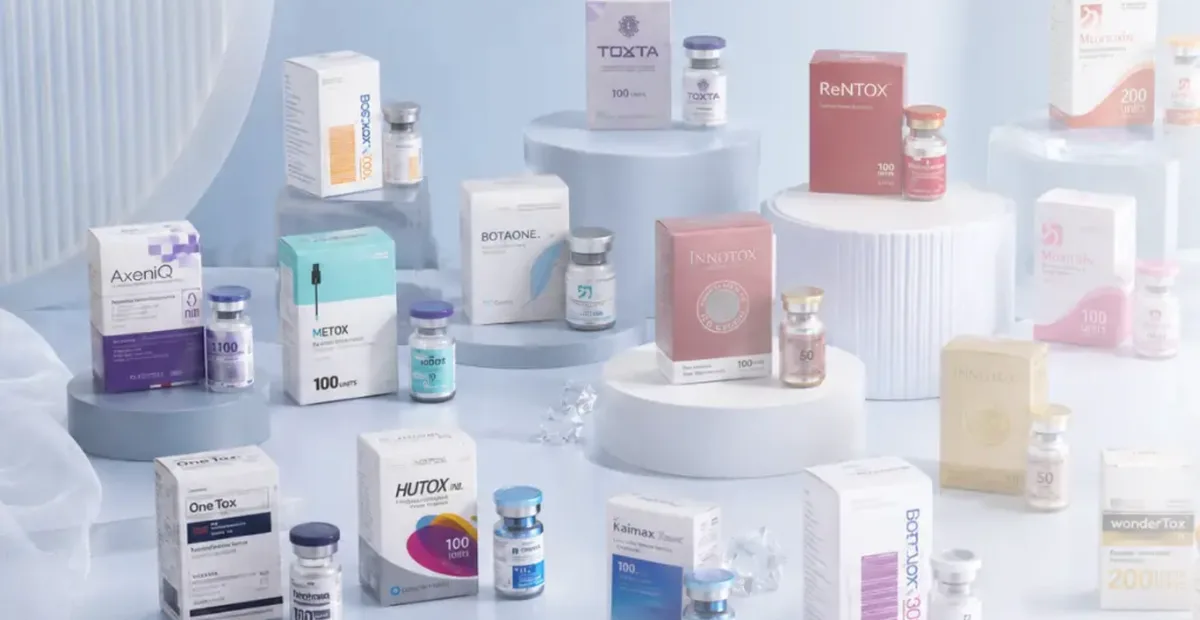
Neotox, Wondertox, Hutox, ReNTox, Toxta and the newer generation
The Korean market continues to expand rapidly. Brands such as Neotox, Wondertox, Hutox, ReNTox, and Toxta round out a deep and fast-growing field, often competing aggressively on price while maintaining KFDA approval and KGMP-standard manufacturing. For distributors building a broad catalogue, these fill out the value and specialty tiers.
Comparison Table: Korean Botox Brands at a Glance
| Brand | Manufacturer | Form | Typical onset | Standout trait | Highest-tier approval |
|---|---|---|---|---|---|
| Nabota | Daewoong | Powder (freeze-dried) | ~2–3 days | Fast onset, high purity | US FDA (as Jeuveau, 2019), EMA, Health Canada |
| Botulax | Hugel | Powder | ~5–7 days | Most widely distributed; 1:1 dosing | US FDA (as Letybo, 2024), EU, China |
| Innotox | Medytox | Liquid (ready-to-use) | ~3–5 days | World's first liquid toxin; no reconstitution | KFDA |
| Neuronox / Meditoxin | Medytox | Powder | ~3–5 days | Long-standing original, proven track record | KFDA |
| Liztox | Huons Biopharma | Powder | ~3–7 days | Very high purity, value pricing | KFDA |
| Coretox | Medytox | Powder | ~3–5 days | Complexing-protein-free (low immunogenicity) | KFDA |
| Neotox / Wondertox / Hutox | Various (Korean) | Powder | ~3–7 days | Aggressive value pricing | KFDA |
Onset times are general industry references and vary by patient, dose, and injection technique. Always follow each product's official prescribing information.
Korean Botox vs. European Botox: The Full Comparison
This is the comparison most buyers actually care about. "European botox" generally refers to the premium Western-manufactured toxins: Botox (Allergan/AbbVie — US-origin but the global benchmark), Dysport / Azzalure (Ipsen, France), and Xeomin / Bocouture (Merz, Germany). Here is how the Korean category stacks up against them across the dimensions that matter.
1. The Active Ingredient Is the Same
The most important point: all of these products — Korean and European alike — are botulinum toxin type A. The mechanism of action is essentially identical. Botox and Nabota, for instance, share the same 900 kDa molecular structure and produce comparable cosmetic results. The differences between brands are real, but they live in purity, formulation, onset speed, diffusion, dosing units, and price — not in whether the product works.
2. Price: The Decisive Difference
This is where the gap is dramatic. European/Western toxins carry a steep premium driven largely by brand strength and established market positioning. Industry references put Western per-unit pricing in ranges like roughly $12–$20 per unit for Botox and $10–$17 for Xeomin, with Dysport priced lower per unit but requiring more units per treatment (because its units are not equivalent — see below).
Korean toxins, by contrast, are sourced at professional wholesale levels often in the range of roughly $100–180 per 100U vial for products carrying international registration — and lower for value-tier brands. The practical effect: Korean botox frequently lands at half, a third, or in some cases around a quarter of the cost of an equivalent European product, with no corresponding drop in the quality of the active ingredient. For a clinic running any meaningful volume, that margin difference is transformational.
3. The Critical "Units Are Not Equivalent" Warning
One technical point every buyer must understand: botulinum toxin units are NOT interchangeable between brands. This is a safety issue, not a marketing detail.
- Botox, Nabota, Botulax, Bocouture, and Xeomin all use roughly 1:1 unit conversion with Botox-standard dosing — so switching among them is relatively straightforward.
- Dysport (Azzalure) is the major exception: approximately 2.5 to 3 units of Dysport are needed to equal 1 unit of Botox. Dysport vials come in 500-unit presentations precisely because of this.
This means part of the Korean cost advantage over Dysport specifically must be read carefully — you compare total treatment cost, not headline per-unit price. But against Botox, Xeomin, and Bocouture (all 1:1), the Korean savings are direct and unambiguous.
4. Regulatory Standing
European toxins benefit from decades of long-term clinical data and deep regulatory entrenchment. But the regulatory gap has narrowed sharply: Nabota (Jeuveau) cleared the US FDA in 2019, and Botulax (Letybo) cleared it in 2024 and is also approved in the EU and China. So the two flagship Korean brands now meet the same top-tier regulatory bar as the Western incumbents. The remaining Korean brands carry KFDA approval and KGMP-standard manufacturing, and are widely used across Asia, the Middle East, and Europe.
5. Purity and Immunogenicity
Both regions field high-purity options. On the European side, Xeomin/Bocouture (Merz) is famous as a "naked" toxin — it contains the smallest complexing-protein load (around 0.6 ng per 100U vial), which is associated with low immunogenicity, and it doesn't require cold storage. The Korean answer is Coretox, which similarly removes complexing proteins. For the resistance-conscious buyer, both categories offer a protein-reduced choice.
6. The Aesthetic Result
European and Western brands have historically been associated with strong, reliable correction. Korean brands built their reputation on the natural, subtle, expression-preserving result that has become the dominant patient preference worldwide. In practice, a skilled injector achieves excellent natural results with either — but the Korean aesthetic philosophy aligns neatly with current demand.
European vs. Korean Botox — Side-by-Side Table
| Factor | European / Western Toxins | Korean Toxins |
|---|---|---|
| Representative brands | Botox (Allergan/AbbVie), Dysport/Azzalure (Ipsen), Xeomin/Bocouture (Merz) | Nabota, Botulax, Innotox, Liztox, Coretox, Neuronox |
| Active ingredient | Botulinum toxin type A | Botulinum toxin type A (same) |
| Typical cost | High — e.g. ~$12–$20/unit (Botox); premium positioning | ~$100–180 per 100U vial wholesale; often ½, ⅓, or ~¼ of European cost |
| Top regulatory approvals | FDA, EMA, decades of data | FDA (Nabota/Jeuveau, Botulax/Letybo), EMA; KFDA for others |
| Innovation highlight | Xeomin "naked" protein-free toxin | Innotox (first ready-to-use liquid); Coretox (protein-free) |
| Unit equivalence | Botox/Xeomin/Bocouture 1:1; Dysport ~2.5–3:1 | Nabota/Botulax 1:1 with Botox standard |
| Aesthetic philosophy | Strong, reliable correction | Natural, expression-preserving |
| Long-term data | Extensive, multi-decade | Growing; flagship brands now FDA-backed |
| Value proposition | Brand trust, longest track record | Comparable efficacy at dramatically lower cost |
Why Korean Botox Is Trending Globally
Pulling the threads together, a few forces explain the surge in demand:
Regulatory credibility has caught up. With both Nabota and Botulax clearing the US FDA — and Botulax also approved in the EU and China — the old "is it legit?" objection has been answered at the highest level. That single shift has unlocked buyer confidence worldwide.
The economics are simply better. In a competitive clinic environment, the cost per treatment directly affects profitability and pricing flexibility. Korean toxins let practices offer competitive patient pricing while protecting (or improving) margin. Industry data shows the Korean domestic toxin market alone was valued around $194 million in 2023 and is projected to grow at roughly 10% annually through 2030 — a sign of how fast the category is scaling.
Innovation solves real clinical problems. Innotox's ready-to-use liquid removes reconstitution error and prep time; Coretox's protein-free profile addresses long-term resistance concerns. These aren't gimmicks — they're features practitioners actually want.
The result matches modern taste. The natural, refreshed aesthetic that Korean brands are built around is precisely what today's patients request.
Where and How to Buy Korean Botox Online — Safely
Sourcing matters as much as the product itself. Because these are cold-chain biologic products, the how of buying is not optional. A responsible professional buyer should insist on:
- Licensed, verified distributors dealing in genuine, registered product — never grey-market or unverifiable stock.
- Temperature-controlled (cold-chain) shipping with proper documentation, since toxin potency degrades if the cold chain breaks.
- Customs-clearance support for international import, including correct paperwork and HS coding.
- Authenticity verification — batch numbers, manufacturer traceability, and tamper-evident packaging.
- Regulatory confirmation that the specific brand is approved or permitted for use in your market before you import it.
- Responsive expert support, ideally available around the clock for cross-time-zone ordering.
A strong starting point for professional buyers is botoxkorea.com. It carries a broad portfolio sourced directly from Korean manufacturers — including Innotox, Botulax, Nabota, Coretox, Meditoxin, and many more — alongside detailed treatment guides and 24/7 support for medical professionals. You can browse the full product range, review the treatment protocols for areas like glabellar lines, crow's feet, and masseter slimming, or request a quote from licensed distributors.
A Buyer's Quick Checklist
Before you place an order, confirm:
- Is the brand approved/permitted in my country? (FDA, EMA, COFEPRIS, ANVISA, MFDS, etc. — rules differ by market.)
- Is the seller a licensed, verifiable distributor?
- Is cold-chain shipping guaranteed and documented?
- Do I understand this brand's unit equivalence (especially if switching from Dysport)?
- Is my import/customs process compliant?
- Can I verify authenticity on arrival (batch, packaging, traceability)?
Common Treatment Areas (and Why Brand Choice Can Vary)
One reason experienced clinics stock more than one brand is that different products suit different jobs. While any quality toxin can treat any approved area, practitioners often develop preferences based on onset, diffusion, and precision:
- Glabellar (frown / "11") lines: The most common indication worldwide. A precise, controllable toxin is ideal here — many injectors like Nabota or Botulax for their predictable 1:1 dosing.
- Forehead lines: Requires careful dosing to avoid brow heaviness; the natural-result Korean profile is well suited.
- Crow's feet (lateral canthal lines): A delicate area where over-diffusion is undesirable — precision matters.
- Masseter / jaw slimming: One of the fastest-growing aesthetic procedures, especially in Asian markets, used to soften a square or bulky jawline. Larger doses make value-tier pricing especially attractive here.
- Lip flip and perioral lines: Small, precise dosing — a good fit for liquid formulations like Innotox where consistency reduces error.
- Neck bands (platysmal) and neck rejuvenation: The neck shows age early; toxin relaxes targeted bands for a smoother contour.
- Hyperhidrosis (excessive sweating): A therapeutic, non-cosmetic use — palms, underarms, soles — where high-purity brands like Liztox are frequently chosen.
Because larger areas like the masseter consume more units, the per-vial savings of Korean toxins compound quickly in high-volume contouring practices — another reason the category has taken off in markets where jaw slimming is in heavy demand.
Storage, Handling, and the Cold Chain
Botulinum toxin is a biologic, and its potency depends on correct handling from factory to injection. This is non-negotiable for any buyer:
- Cold-chain storage: Most powder formulations are stored refrigerated at 2–8°C; check each product's prescribing information. Liquid Innotox and "naked" toxins have their own requirements.
- Shelf life: Many Korean toxins carry up to a 36-month shelf life from manufacture when stored correctly — confirm batch dates on arrival.
- Reconstitution (powder products): Powder vials are reconstituted with 0.9% preservative-free sterile saline; dilution must be accurate, because incorrect dilution changes the effective dose. This is precisely the step Innotox's ready-to-use liquid eliminates.
- Transport documentation: Insist on cold-chain documentation with every shipment. A broken cold chain can quietly reduce potency without any visible sign, leading to underwhelming results that get wrongly blamed on the product.
- Authenticity on arrival: Inspect packaging integrity, tamper-evidence, batch numbers, and manufacturer traceability before accepting stock.
Handled properly, these products deliver consistent, reliable results. Handled poorly, even the best toxin underperforms — which is why a reputable supplier's logistics are as important as its catalogue.
Frequently Asked Questions
Is Korean botox as effective as European botox?
The active ingredient — botulinum toxin type A — is the same, and when used correctly by a trained injector, quality brands perform very similarly. Differences are mainly in onset speed, formulation (powder vs. liquid), purity, and price.
Which Korean brands are FDA-approved?
Two: Nabota (sold as Jeuveau in the US, approved 2019) and Botulax (sold as Letybo, approved 2024). Botulax is also approved in the EU and China.
Why is Korean botox so much cheaper?
The savings come from manufacturing efficiency and the absence of the heavy brand premium attached to Western incumbents — not from lower-quality ingredients. The underlying molecule and mechanism are the same.
What makes Innotox special?
It's the world's first ready-to-use liquid botulinum toxin, so it needs no saline reconstitution — meaning no dilution error, better transport stability, and faster prep.
How long do results last?
Typically 3–6 months, depending on the area treated, dose, individual metabolism, and product. Initial results usually appear within 3–7 days, with full effect around 10–14 days.
Final Word
For clinics, distributors, and licensed aesthetic professionals, Korean botulinum toxin represents one of the clearest value opportunities in modern aesthetics: the same active ingredient as the premium European brands, FDA-level credibility on the flagship products, genuine formulation innovation, and pricing that can run a half, a third, or even a quarter of the European cost.
The key is buying smart — sourcing genuine, registered product from licensed distributors, respecting the cold chain, understanding unit equivalence, and confirming approval in your own market. Get those fundamentals right, and Korean botox isn't just a cheaper option — it's a smarter one.
Looking for more on sourcing Korean skincare, aesthetics, and beauty products? Explore additional guides on MyGuide Korea.
This article is for educational purposes for licensed professionals and is not medical, legal, or regulatory advice. Always verify current regulatory status and import requirements in your jurisdiction.