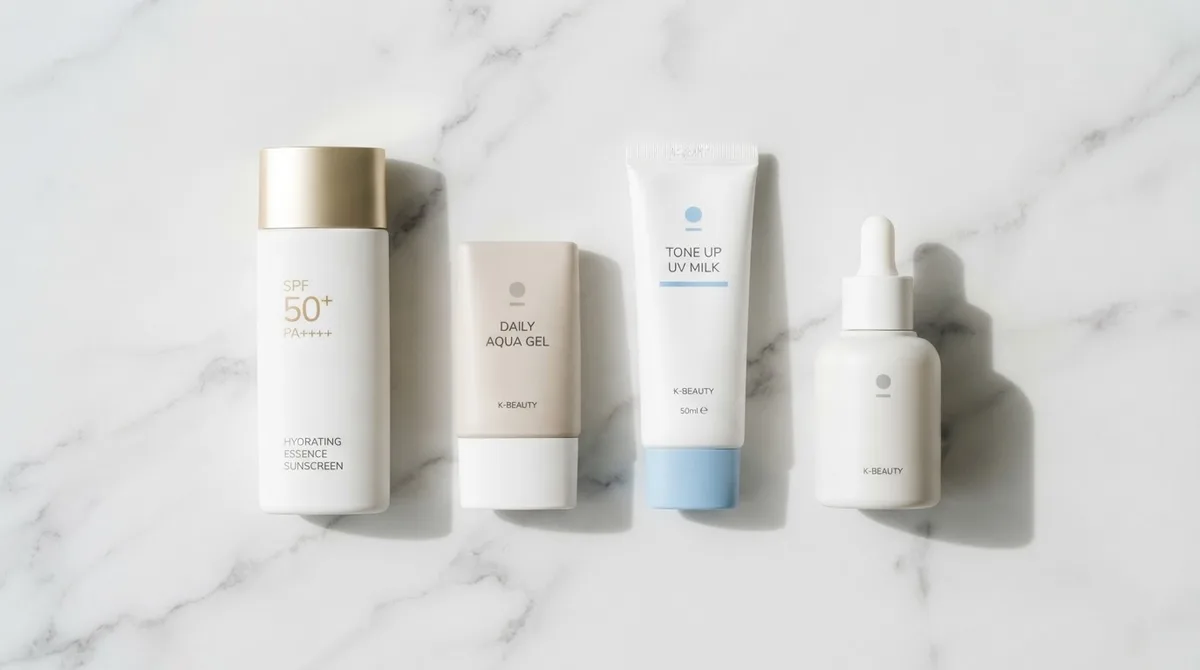
Pick up an American sunscreen and a Korean sunscreen and apply each. The texture difference is immediate and significant. The American version is likely thick, slow-absorbing, and leaves a visible film or white cast. The Korean version absorbs in seconds, leaves no residue, and feels like moisturiser. Both have SPF 50 on the label. The difference is not marketing -- it is chemistry.
Korean sunscreen formulators have had access to UV filter technology that the US FDA only approved in June 2026. On June 9, 2026, the FDA finalised approval of bemotrizinol -- also known as Tinosorb S -- as a permitted sunscreen active ingredient in the United States, its first new sunscreen filter approval in over 25 years. That regulatory event marks the start of a shift that Korean and European consumers experienced decades ago: access to photostable, broad-spectrum filters that work at lower concentrations, produce no white cast, and formulate into the lightweight textures that actually get worn every day.
The filter gap: why the textures are so different
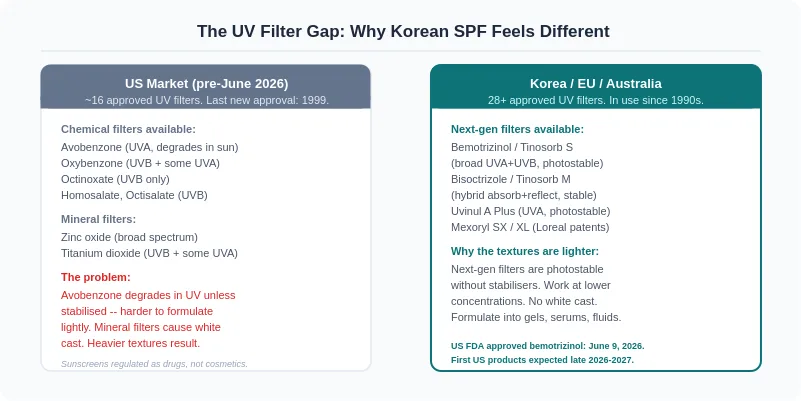
The US FDA regulates sunscreens as over-the-counter drugs, not cosmetics. That classification means every active ingredient in an American sunscreen must clear the FDA's OTC Monograph system -- a process that, until the CARES Act of 2020 created a faster pathway, had not approved a new UV filter since 1999. Korea and the EU regulate sunscreens as cosmetics, so new filters enter the market faster. The result is a 25-year gap in available filter technology between the two markets.
The US filter set relies primarily on avobenzone for UVA protection. Avobenzone is effective but inherently photounstable -- it degrades when exposed to UV light. To keep it stable, US manufacturers add photostabilisers, which add complexity and weight to the formula. The alternative -- mineral filters (zinc oxide and titanium dioxide) -- provide stable broad-spectrum protection but leave a white cast that makes them impractical for daily cosmetic use, particularly on medium and deep skin tones.
Korea and the EU have access to bemotrizinol (Tinosorb S), bisoctrizole (Tinosorb M), uvinul A plus, and mexoryl SX and XL. These next-generation filters are photostable -- they do not degrade in sunlight -- and deliver broad-spectrum coverage at lower concentrations. Lower concentration means less filter mass in the formula, which means the remaining formulation space fills with elegant cosmetic ingredients: lightweight silicones, water-based gels, serum-texture actives. The result is a filter that protects at least as well as older filters while sitting invisibly on the skin.
The June 9, 2026 FDA approval of bemotrizinol is significant but gradual in its practical impact. The final order takes effect on August 9, 2026. Brands still need to reformulate, conduct stability testing, run SPF performance testing, and meet OTC labelling requirements. Dr. Jane Yoo, a board-certified dermatologist who has advocated for sunscreen filter reform, estimates the first US products with bemotrizinol listed as an active ingredient will appear late 2026 to early 2027. In the interim, Korean and European sunscreens formulated with bemotrizinol for decades remain the most direct access to this filter technology.
Reading the PA rating system
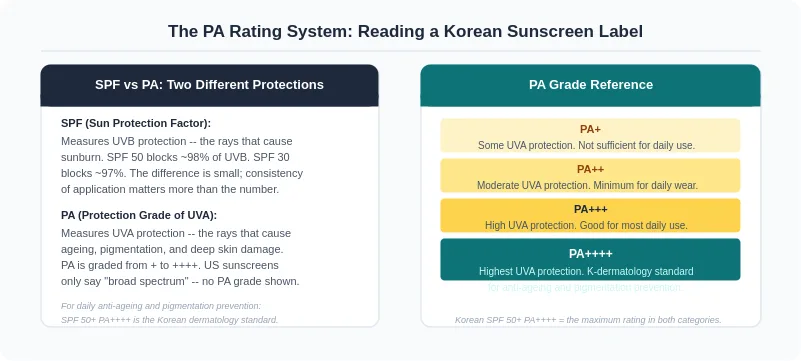
Korean sunscreen labels show two ratings: SPF and PA. International buyers often understand SPF and ignore PA, which matters more for everyday skin ageing and pigmentation prevention.
SPF measures UVB protection -- the rays responsible for sunburn. SPF 30 blocks approximately 97 percent of UVB. SPF 50 blocks approximately 98 percent. The difference between SPF 30 and SPF 50 is smaller than the number gap implies, and both are rendered roughly equivalent by under-application. The label number assumes full application at the correct amount.
PA measures protection against UVA rays -- the longer-wavelength rays that penetrate more deeply into the skin, cause photoageing, trigger pigmentation and melasma, and suppress immune function. UVA rays reach the skin at consistent intensity year-round, on overcast days and through glass. The PA system was developed in Japan and adopted by Korea. PA+ indicates some protection; PA++ moderate; PA+++ high; PA++++ the highest available UVA protection.
American sunscreens do not show PA ratings. They are required to carry the label "broad spectrum" to indicate UVA protection is included, but the degree is not quantified. A Korean SPF 50+ PA++++ provides measurably more UVA protection than a US SPF 50 broad-spectrum product because the PA system specifies the level and Korean products are formulated to meet it.
Why Koreans actually wear sunscreen every day
The texture advantage of Korean sunscreen is not only an aesthetic preference. It is how better sun protection is achieved. A sunscreen that feels good to wear gets worn in the correct amount, every day, year-round.
In Korea, daily SPF is a morning routine step applied after moisturiser and before makeup, every day regardless of weather, season, or planned time outdoors. Korean dermatology's emphasis on UV protection as a daily habit -- rather than an occasional precaution -- has driven the industry to develop formulas that genuinely compete with skincare products for texture, finish, and wearability.
Mirai Skin researchers note that Korean sunscreen chemists developed their lightweight textures not as a luxury feature but as a compliance tool: Korean consumers would simply not use a sunscreen they found uncomfortable, regardless of its SPF number. Designing the product so that people apply the correct amount every day is the single most effective thing a sunscreen manufacturer can do for real-world protection. The texture innovation is the protection innovation.
The best Korean sunscreens in 2026 by skin type
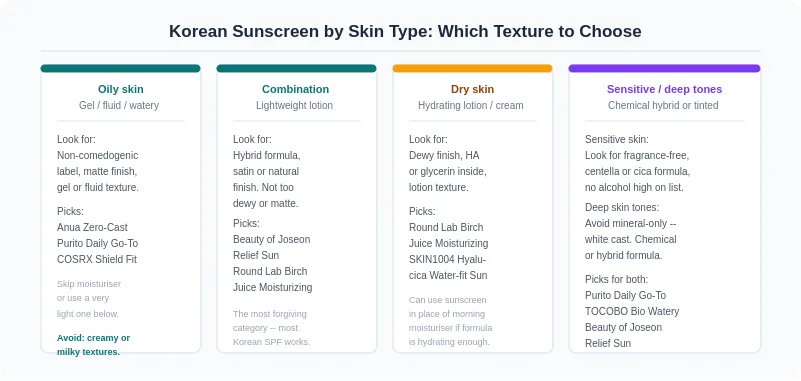
Oily and acne-prone skin: Anua Zero-Cast Moisturizing Finish Sunscreen -- the "zero cast" designation is accurate, absorbs immediately into a lightweight matte finish, non-comedogenic. Purito Daily Go-To Sunscreen for the fragrance-free, sensitive-skin-compatible alternative in the same texture category. COSRX Shield Fit All Green Comfort Sun for a microbiome-friendly formula that controls sebum and works well under makeup.
Combination skin: Beauty of Joseon Relief Sun: Rice and Probiotics is the most consistently recommended Korean sunscreen of 2026 in this category. Rice extract and probiotic formula, lightweight lotion texture, SPF 50+ PA++++ with a natural finish -- not matte, not dewy -- that makes it the most versatile formula across skin types.
Dry skin: Round Lab Birch Juice Moisturizing Sun Cream -- birch sap as the primary hydrating ingredient alongside hyaluronic acid, rich enough to replace a morning moisturiser for most dry skin types. SKIN1004 Madagascar Centella Hyalu-Cica Water-fit Sun Serum for the same hydration level in a serum texture, with centella asiatica for soothing and multiple HA molecular weights for depth.
Sensitive skin and medium to deep skin tones: Avoid mineral-only formulas -- the white cast issue is real. Purito Daily Go-To, Beauty of Joseon Relief Sun, and TOCOBO Bio Watery Sun Cream SPF 50+ PA++++ all deliver broad-spectrum chemical filter protection with confirmed zero white cast across the full skin tone spectrum. The TOCOBO uses a vitamin and cica complex for additional barrier support and a pore-blurring finish.
2025-2026 trend: tone-up / tinted hybrids. The "foundation-free" movement in Korean beauty has driven a generation of sunscreens that combine SPF 50+ PA++++ with subtle pink, peach, or purple pigments to neutralise dullness and create a lit-from-within effect without a separate foundation step. IOPE UV Shield Sun Essence Tone Up and Dr. G Brightening Up Sun are the most referenced examples.
Bemotrizinol and what it means if you buy Korean sunscreen now
The FDA approval creates a specific practical consideration for buyers purchasing Korean sunscreen internationally: the global formula of a Korean sunscreen and its US-market version may not be identical. Many Korean brands have historically maintained two separate formulas -- one using their full global filter set including bemotrizinol, and one reformulated for US compliance using only FDA-approved active ingredients.
If you are buying Korean sunscreen directly from Korea -- at Olive Young on a trip, through a Korean shipping service, or from a Korea-based retailer -- you receive the global formula with the full filter set. If you are buying through a US Amazon listing or a US-based Korean beauty retailer, confirm whether the product is the international version or the US-market reformulation. The active ingredients list on the box is the reliable indicator.
On an international Korean sunscreen label, bemotrizinol appears as bis-ethylhexyloxyphenol methoxyphenyl triazine (its INCI name), BEMT, or Tinosorb S. If any of these appear in the active ingredients, the formula contains the next-generation filter. As the August 9, 2026 effective date passes and brands begin reformulating their US-market products, the gap between the two versions will narrow -- but the transition will take time.
How much to apply and where most people go wrong
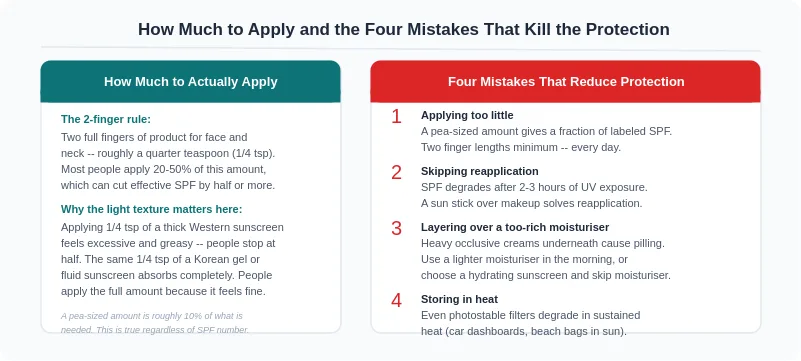
The SPF number assumes full application: approximately a quarter teaspoon for the face and neck combined -- about two full finger lengths of product. Most people apply twenty to fifty percent of this amount, which can cut effective SPF by more than half regardless of the label number. A pea-sized amount is approximately ten percent of the required dose.
The four mistakes that reduce real-world protection:
- Applying too little. A pea-sized amount is roughly 10% of what is needed. Two finger lengths, face and neck, every morning.
- Skipping reapplication. UV filters degrade after two to three hours of direct UV exposure. A Korean sun stick applied over makeup is the practical solution.
- Layering over a too-rich moisturiser. Heavy occlusive creams underneath cause pilling and uneven application. Use a lighter morning moisturiser, or pick a hydrating sunscreen that replaces the moisturiser entirely.
- Storing in heat. Car dashboards, beach bags in direct sunlight -- even photostable filters degrade in sustained heat. Keep the bottle in shade or a cool pouch.
Where to buy Korean sunscreen
In Seoul, Olive Young is the primary retail destination. The chain stocks the full range of the brands listed in this guide, allows side-by-side texture comparisons, and carries the international-formula versions rather than US-market reformulations. The Myeongdong flagship stores and Hongdae locations carry the most comprehensive sunscreen selection.
Online: Olive Young Global website ships internationally with the full Korean product range. YesStyle, Stylevana, and Jolse are alternative platforms with international shipping. For products on Amazon or at US-based Korean beauty retailers, confirm the formula version before purchasing if the filter list matters.
- Korean sunscreen uses UV filters the US FDA only approved in June 2026. The lighter texture is a direct result of better filter technology.
- PA++++ is the highest UVA protection rating -- the number that matters most for daily anti-ageing and pigmentation prevention. SPF 50+ PA++++ is the Korean dermatology standard.
- Apply two finger lengths for the face and neck (~quarter teaspoon). Most people apply 20-50% of the required amount, halving effective protection.
- Reapply every two to three hours of UV exposure. A Korean sun stick applied over makeup is the practical solution.
- The international formula of a Korean sunscreen may differ from its US-market version. At Olive Young in Seoul, you receive the global formula.
- Bemotrizinol = Tinosorb S = BEMT on a label. First US products with it as a listed active: expected late 2026 to early 2027.
- For white cast concerns on deep skin tones: choose chemical or hybrid Korean formulas. Beauty of Joseon Relief Sun and Anua Zero-Cast have confirmed zero white cast across all tones.
For the full Korean skincare routine context this sunscreen sits within, see the Cloud Glow Skin 2026 guide. For Seoul clinic treatments for sun damage, see the Medical Tourism in Korea guide.
Related: Honey Skin: The Korean Beauty Trend That Comes Before Glass Skin | Korean Skincare & Aesthetics for Men (2026) | How K-Pop Idols Actually Take Care of Their Skin