Reedle Shot & Spicules: Korea's Liquid Microneedling Explained
Walk into any Olive Young in Seoul and you will likely find a shelf gap where the VT Reedle Shot was standing. The product has sold out repeatedly across Korea, racked up hundreds of millions of TikTok views, and sparked a genuine scientific conversation: can a serum really deliver anything close to a clinic microneedling session?
It can do something meaningful, though not the same thing. Spicule technology and professional microneedling share a core principle, operate at very different depths, and serve genuinely different purposes. This guide explains exactly what spicules are, how reedle shots work, what the science supports, and how to get the most out of both at-home and clinic-grade versions, including what to expect from a spicule facial if you visit Korea.
What Are Spicules? Where They Come From
Spicules are microscopic, needle-shaped silica structures that form the internal skeleton of marine sponges. In nature, these rigid crystalline needles give sea sponges their structural support. In skincare, they are harvested, purified, and stabilised into topical serums, creams, and clinic-grade peels, where they function as biological micro-needles.
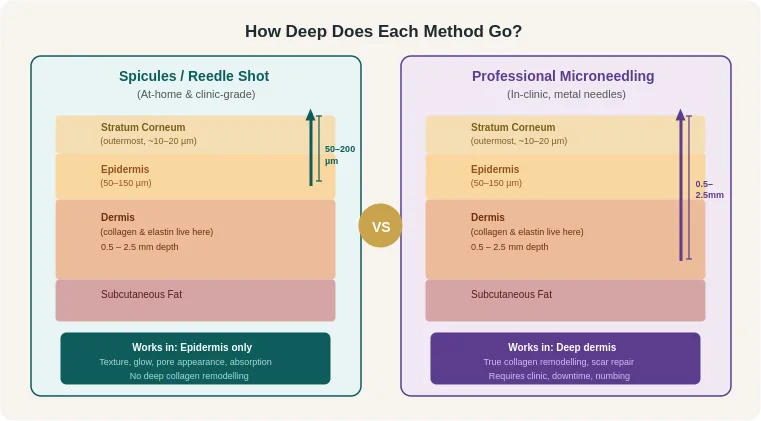
Each spicule is roughly 50 to 200 micrometres long, small enough to penetrate the outermost layer of the skin through mechanical massage, but short enough that they never reach the collagen-producing dermis below. That depth distinction is the single most important thing to understand about this technology, and it is the reason spicule products are genuinely useful but not a replacement for clinical microneedling.
You may also see spicules listed on ingredient labels as "hydrolysed sponge." Some newer formulations use plant-derived silica rather than marine sponge, functionally similar in mechanism, though marine sponge remains the most studied source.
How Spicules Work
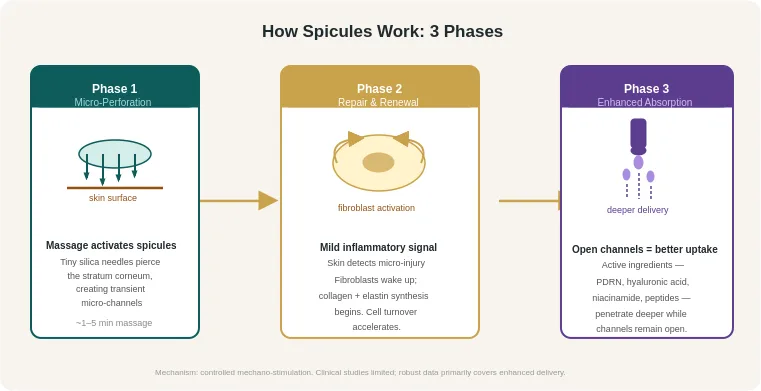
When you massage a spicule-containing product into your skin, and massage is key, as studies required 1 to 5 minutes of application for clinical benefit, the needle-like structures create thousands of tiny, temporary micro-channels through the stratum corneum, the skin's outermost barrier layer.
This triggers a three-phase response:
- Micro-perforation: spicules pierce the stratum corneum, creating transient openings without long-term damage. The skin's dead surface cells eventually shed, taking residual spicules with them. They do not remain lodged indefinitely.
- Mild inflammatory repair signal: the skin detects the micro-injury and activates fibroblast cells, which produce collagen and elastin. Cell turnover accelerates. This is the same basic mechanism that makes professional microneedling effective, just at a far shallower level.
- Enhanced absorption: while channels are temporarily open, active ingredients in the same product, and applied immediately after, penetrate deeper into the upper epidermis than they would otherwise. Studies show this significantly improves delivery of PDRN, hyaluronic acid, peptides, niacinamide, and other key actives.
What the evidence supports: The delivery-enhancement research is the strongest evidence base for spicules. A split-face study comparing a growth factor cream with and without spicules found measurable improvement on the spicule side over 8 weeks. A 12-week acne study using a 3% spicule cleanser showed surface improvement. Long-term safety data and large-scale human collagen trials remain limited, the honest position is: promising, not fully proven.
What "Reedle Shot" Is
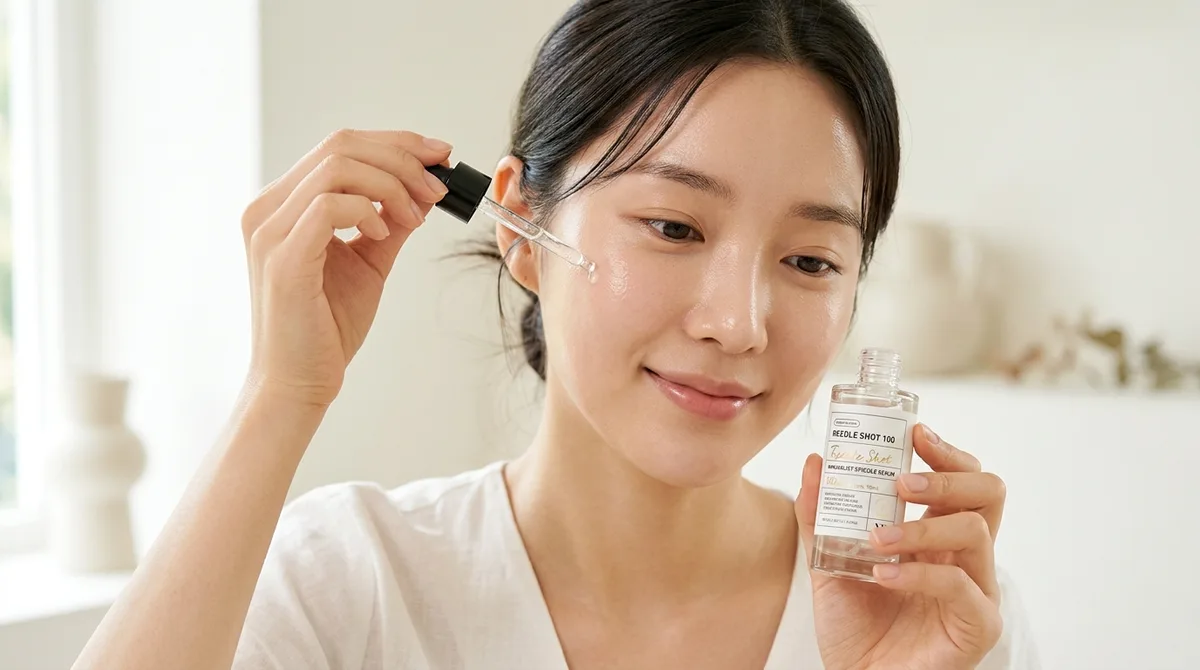
Reedle Shot is not a different technology. It is VT Cosmetics' branded name for a spicule serum. The "Cica Reedle" formulation combines marine spicules with Centella Asiatica (cica) for calming, alongside hyaluronic acid and green propolis for barrier support. The numbers in the product name (100, 300, 700, 1000) indicate relative spicule concentration, not needle length.
VT Cosmetics launched the line in Korea and it became a cult product almost immediately, selling out at Daiso and Olive Young repeatedly. The brand officially entered US retail at Ulta Beauty in July 2025, marking one of the first K-beauty spicule products to reach mass Western distribution. Many other Korean brands now offer similar spicule serums (Medicube's Zero Exosome Shot is another popular example), and the category is expanding rapidly.
Choosing Your Strength: A Practical Guide
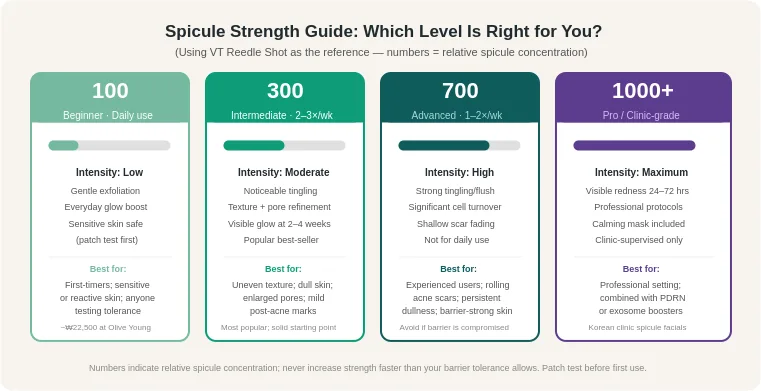
The numbered system (100 → 300 → 700 → 1000+) is a concentration gradient. Stronger is not automatically better, barrier health and tolerance matter more than the highest number you can apply.
| Strength | Intensity | Frequency | Good For | Avoid If |
|---|---|---|---|---|
| 100 | Low | Daily | First-timers, sensitive or reactive skin, general maintenance | Active eczema, open wounds, post-treatment skin |
| 300 | Moderate | 2–3× / week | Dull texture, enlarged pores, mild acne marks, glow | Compromised or actively inflamed skin |
| 700 | High | 1–2× / week | Persistent texture, rolling acne scars, experienced users | Weak barrier, recent laser or peel, pregnancy (no data) |
| 1000+ | Maximum | Clinic only | Professional spicule facial, combined with actives | At-home use; unsupervised application |
Application matters as much as concentration. Dispense a small amount onto clean, slightly damp skin and massage in circular motions for at least 60 to 90 seconds (clinic studies used up to 5 minutes). A mild tingling or temporary flush is normal and expected. It signals the spicules are working. Significant stinging that does not fade is a sign to rinse and reassess your frequency or strength level.
Follow immediately with a serum or moisturiser containing actives you want delivered deeper, hyaluronic acid, PDRN, niacinamide, or peptides all pair well. Avoid stacking aggressive exfoliants (AHAs, BHAs, retinol) on the same application to prevent barrier overload.
What Results to Realistically Expect
Spicules are an excellent tool for surface-level improvements. They are not a substitute for injectable skin boosters, professional microneedling, or laser resurfacing when those are what a concern needs.
| Concern | Spicule Performance | When to Upgrade to Clinic |
|---|---|---|
| Dull, rough texture | Strong, most noticeable early benefit | Rarely needed for this alone |
| Enlarged pore appearance | Good, visible refinement at 4–6 weeks | Deep structural issues need laser or RF |
| Glow / radiance | Strong, improved absorption of actives helps | Skin boosters (Rejuran, HA) for deeper hydration |
| Shallow post-acne marks | Moderate, gradual fading at 700 strength | Deep rolling scars: clinic microneedling |
| Ice-pick / deep scars | Weak, epidermis-only is insufficient | CO2 fractional laser or clinical needling |
| Fine lines | Mild improvement via collagen signal | Thermage, HIFU, or injectable boosters for lift |
| Active acne | Avoid, can spread bacteria into channels | Dermatologist consultation |
The Korean Clinic Version: Spicule Facials and Peels
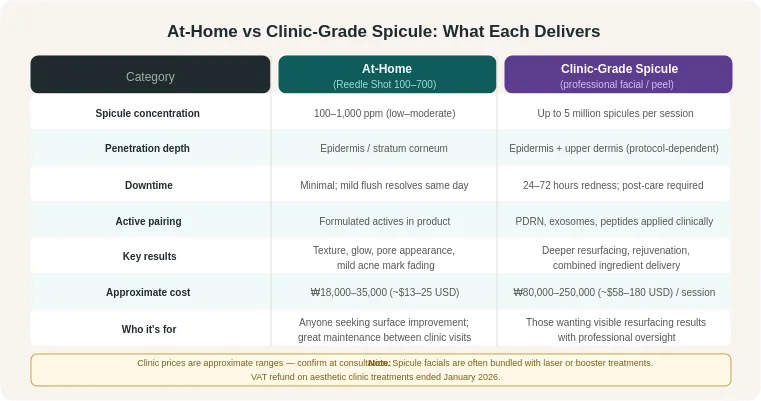
At clinic concentration, spicule treatments take on a different character. Professional spicule facials use formulations with significantly higher spicule counts, some protocols reaching millions of spicules per session, applied by trained practitioners with a structured protocol including pre-cleansing, targeted active ampoules, the spicule application itself, and a calming mask to manage the post-treatment inflammation window.
The result is more intensive resurfacing than any at-home product can produce, combined with high-potency actives (PDRN, exosomes, peptides) delivered while channels are open, a sequencing logic that Korean clinics have refined into a precise protocol. Visible redness typically lasts 24 to 72 hours after a professional session, and sun exposure and heat should be avoided during that window.
Korean dermatology clinics list spicule peels and facials under their brightening or resurfacing treatment menus, often pairing them with other treatments such as laser toning or skin booster injections on the same visit. Approximate costs in Seoul:
- Spicule facial / peel (standalone): approximately ₩80,000–200,000 ($58–145 USD), confirm at consultation
- Combined with laser toning or skin booster: often bundled, ask for package pricing
- VAT refund on clinic treatments ended January 2026, no longer applicable
Who Should Avoid Spicules (or Proceed with Care)
Spicule products are generally considered safe and appropriate for most skin types, but they are not for everyone. Avoid or consult a dermatologist first if you have:
- Active eczema flares, rosacea, or barrier dysfunction, mechanical stimulation risks worsening inflammation
- Recent professional treatments: post-laser, post-peel, or post-procedure skin needs to heal before any mechanical exfoliant is applied
- Open wounds, active acne, or sunburned skin, spicule channels can allow bacteria into compromised skin
- Shellfish allergies: some marine-derived spicule products may carry related proteins; check ingredient notes
- Pregnancy or nursing: there is limited data on spicule use during pregnancy; consult your doctor
Where to Find Spicule Products in Korea
Reedle Shot and competing spicule serums are widely available across Seoul without a prescription or clinic visit. Olive Young is the primary retailer, VT Cosmetics has ranked #1 on Olive Young's skincare charts multiple times. Daiso stocks select lower-price formats. Pharmacies and H&B stores throughout Gangnam, Myeongdong, and Hongdae also carry the category.
Prices in Korea are consistently lower than international retail, a ₩22,500 ($16) Reedle Shot 300 costs roughly $34–38 on Amazon US. If you are visiting Korea specifically for skin treatments, picking up spicule products at Olive Young to use at home is a practical and affordable extension of your trip. Most tourists with normal skin can safely start with the 100 or 300 at-home and step up to a clinic spicule facial if they want a stronger in-person result.
A note on the retail VAT refund: The shopping VAT refund (Olive Young, retail cosmetics) still applies for tourists. The refund abolished in January 2026 applies only to medical and aesthetic clinic treatments. Retail spicule products purchased at Olive Young or Daiso remain refund-eligible, check the tax-free counter at the store or airport.
Spicules, Delivery Technology, and the K-Beauty Ingredient Stack
What makes the spicule boom particularly interesting is where it sits in the broader K-beauty ingredient story. The most advanced Korean skincare is no longer about surface occlusives or simple hydration. It is about delivery. Getting the right actives deep enough to matter.
Spicules solve the delivery problem mechanically. Other technologies, including plant exosome encapsulation and PDRN complexes, solve it biochemically, by packaging fragile large molecules inside delivery vehicles that can survive the skin barrier. Products like EXO NAD+ from Cherry Medi combine PDRN 30,000ppm, plant exosomes, PN polynucleotides 10,000ppm, NAD+, and peptides into a formulation designed specifically for professional topical application, the exosome delivery system addressing the same fundamental challenge that spicules tackle mechanically.
These approaches are complementary rather than competing. In clinic settings, a spicule protocol followed by a professionally applied exosome or PDRN product represents a sequenced delivery strategy, the spicule channels open first, the high-potency ingredients follow while the pathway is active. This is the thinking behind many of the more sophisticated Korean clinic protocols being offered in Gangnam and Cheongdam in 2026.
Quick-Answer FAQ
Is Reedle Shot the same as microneedling?
No. It shares the same conceptual principle, controlled micro-injury to stimulate repair, but operates in the epidermis only. Professional microneedling with metal needles reaches the dermis, triggering genuine collagen remodelling. Reedle Shot is valuable for surface improvement and absorption enhancement, not dermal restructuring.
Will I see results immediately?
Most people notice a visible texture smoothness and glow effect after the first or second use. Meaningful pore refinement typically becomes visible at 4 to 6 weeks of consistent use. Fine line softening and shallow scar fading, if they occur, generally appear at 8 to 12 weeks.
Can spicules get stuck in my skin?
Animal studies have shown spicules can remain in the skin for up to 5 days before being shed with normal cell turnover. They are not absorbed into the body. VT Cosmetics states that any residue naturally sheds with dead skin cells. Dermatologists generally do not flag permanent lodging as a concern, though the research on very long-term use is still developing.
Should I do a patch test?
Yes, especially for the 300 and above. Apply a small amount to the inner forearm or behind the ear 24 hours before first facial use. Expect mild tingling, discontinue if you experience significant burning, hives, or a reaction that does not calm within a few hours.
Can I combine spicules with other actives?
Best actives to pair on the same application: PDRN serums, hyaluronic acid, niacinamide, peptides, all benefit from improved delivery. Avoid on the same night: retinol at high percentages, AHAs, BHAs, strong vitamin C. Alternate-night routines with these actives are fine.