Mul-gwang (물광) translates directly as water light. It is the Korean name for the dewy, deeply hydrated skin finish that has been at the centre of K-beauty for decades -- more intensely dewy than a natural healthy glow, less glossy than honey skin, and produced by layering multiple thin, water-based products rather than applying one heavy facial oil on top. The distinction between mul-gwang and a heavy facial oil finish matters enough in Korean beauty culture that the two have different names: mul-gwang is water light, while the heavy-gloss version is kkul-gwang, honey glow. They look related but are built differently and signal different things about the skin underneath.
Mul-gwang is also a clinic treatment. Mul-gwang ju-sa (물광주사), water light injection, describes a category of intradermal skin booster available at Korean aesthetic clinics that delivers hydrating actives directly into the dermis. The at-home routine and the clinic treatment share the same goal -- deeply hydrated, dewy-looking skin -- but arrive there by different routes. This guide covers both.
Gwang: the Korean beauty vocabulary for glow
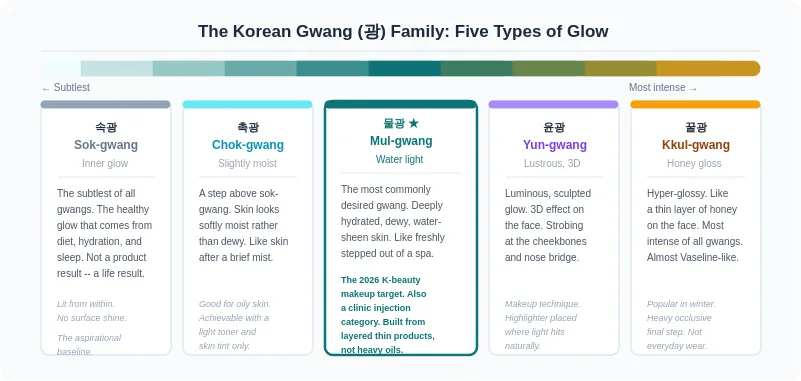
Gwang (광) is the Korean umbrella term for luminous, glowing skin. Its subcategories distinguish different qualities and intensities of glow precisely, and Korean beauty enthusiasts use these terms to specify which products and techniques are appropriate for each.
Sok-gwang (속광) is the subtlest. Sok means inside, so sok-gwang is the glow from within -- the healthy, lit-from-within luminosity produced by diet, sleep, hydration, and general skin health rather than any specific product. The aspirational baseline: skin that looks healthy without product assistance.
Chok-gwang (촉광) sits just above sok-gwang. Slightly moist, softly shining -- like skin that has been lightly misted. Achievable with a hydrating toner and a light essence. The appropriate gwang for oily skin types who want glow without the intensity of mul-gwang. Related to chok-chok (촉촉), the Korean onomatopoeia for skin that is satisfyingly moist and bouncy -- skin that bounces back when pressed lightly, has physical volume from water content, and fills in dehydration lines.
Mul-gwang (물광) is the most commonly desired gwang internationally. Mul means water, so mul-gwang is the water-light or water-sheen finish. The skin looks deeply hydrated, almost like it is still slightly wet from a fresh wash but in a controlled and luminous way. Like stepping out of a high-end spa. It is the gwang produced by layered, water-based hydration -- multiple thin products stacked, not a single heavy product applied. Palace Beauty's 2026 K-beauty trends report identifies mul-gwang as the elevated glass-skin finish for makeup in 2026.
Yun-gwang (윤광) is a more sculpted, three-dimensional glow achieved primarily through makeup. Strobing -- applying shimmer highlighter at points where light naturally strikes the face, primarily the cheekbones and nose bridge -- creates a faceted, dimensional effect. The most product-dependent gwang, closest to a professional makeup look.
Kkul-gwang (꿀광) is the most intense. Kkul means honey, so kkul-gwang is the honey-gloss finish -- hyper-glossy, almost like a thin layer of honey applied to the face. Produced by heavy occlusives, thick facial oils, and in extreme versions, petroleum jelly as a final sealing step. Popular in winter. Not everyday wear. The distinction between mul-gwang and kkul-gwang is the practical reason why Korean beauty experts consistently warn against finishing a mul-gwang routine with a heavy facial oil: the oil pushes the finish from water-light to honey-gloss, a different thing entirely.
Mul-gwang vs glass skin vs cloud glow
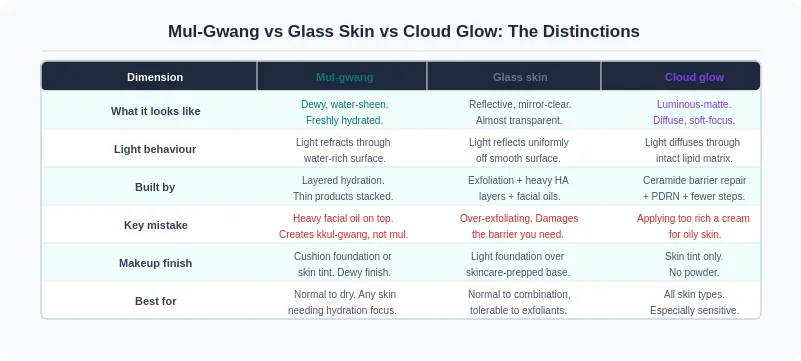
Glass skin is the term that broke internationally around 2017. It describes skin clear, smooth, and reflective enough to almost look like glass -- a mirror-like surface that bounces light uniformly. Glass skin requires exfoliation to remove dead skin cell buildup, maximum hyaluronic acid hydration layered across multiple steps, and a final sealing step that creates the reflective surface. The exfoliation makes it potentially irritating for sensitive or barrier-compromised skin. The finish is specifically reflective: light bounces off rather than transmits through.
Mul-gwang is adjacent to glass skin but differs in two key ways. First, it does not require exfoliation -- built from hydration alone by layering water-based products until the skin surface has enough water content to produce the dewy appearance naturally. Second, the finish is dewy rather than reflective: light refracts through the water-rich surface rather than bouncing off a smooth reflective layer. The effect is softer and more natural-looking than glass skin's mirror finish, and achievable on most skin types.
Cloud glow is the 2025-2026 evolution covered in a separate guide. Where mul-gwang is built from hydration and glass skin from clarity, cloud glow is built from barrier integrity -- the ceramide-rich, PDRN-supported approach that produces a luminous-matte quality as light diffuses through a healthy stratum corneum. Softer and less obviously dewy than mul-gwang. The practical relationship: honey skin is the condition all three build on; mul-gwang is the most achievable dewy finish without exfoliation; glass skin is the maximum reflective version; cloud glow is the matte-luminous 2026 direction.
How the layering method builds mul-gwang
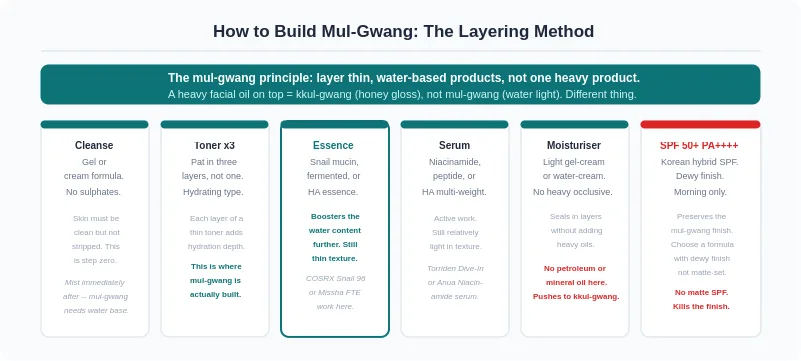
The operational principle of mul-gwang: layer thin, water-based products. Do not apply one heavy product on top. A heavy facial oil at the end creates kkul-gwang (honey gloss), not mul-gwang (water light). Different thing.
The mechanism is physical. Water fills the microscopic surface irregularities of the skin and creates a surface that refracts light in a way that reads as dewy. Multiple thin layers of a water-based toner, essence, or serum accumulate this water content progressively without adding the oily film that heavy products introduce. The skin genuinely has more water in it after proper mul-gwang layering -- the appearance is not a coating but a condition. This is why layered mul-gwang holds better across the day than a facial oil applied on top: the oil sits on the surface and moves or absorbs, while the water content is in the skin itself.
The toner step is where mul-gwang is actually built. Three applications of a lightweight hydrating toner -- patted in with the palm, allowed to absorb between each application -- accumulates more hydration depth than a single generous application of a richer product.
The cleansing step sets conditions. A gentle, non-stripping cleanser is essential. Immediately mist or apply toner to still-slightly-damp skin after cleansing -- layering on dry skin has lower absorption efficiency.
The essence step builds on the toner. COSRX Advanced Snail 96 Mucin Power Essence and Missha Time Revolution First Treatment Essence are the products most frequently cited for this step because both are thin enough to layer while delivering active ingredients that support barrier function alongside hydration.
The moisturiser step seals without adding heavy oils. A water-cream or gel-cream texture for normal to oily skin. No product that leaves a visible film -- that film pushes the finish toward kkul-gwang.
The SPF step is where mul-gwang is most commonly disrupted. A matte-finish sunscreen collapses the dewy finish built below. Choose a Korean hybrid SPF with a dewy or natural finish: essence-texture SPF, serum-SPF, or skin-tint SPF. The 2026 Korean sunscreen market has specific formulas designed to preserve mul-gwang.
The makeup approach over mul-gwang skin
Mul-gwang is a skincare finish that determines how makeup sits. Because the skin itself is providing luminosity and even appearance, the makeup approach is lighter than most Western applications.
Cushion foundation is the Korean makeup format most directly associated with mul-gwang. A liquid foundation formula held in a cushion compact, applied in thin buildable layers that maintain the dewy finish of the skincare below. Choose a cushion with dewy or natural finish rather than matte or porcelain.
Skin tint is the lighter alternative -- significantly less coverage than foundation, allows the mul-gwang texture to show through completely. The 2026 trend toward skin tints and away from full-coverage foundation reflects the skin-first, makeup-secondary philosophy that mul-gwang represents.
No mattifying setting powder. Any powder applied over mul-gwang skin reduces the dewy finish. If T-zone oil control is necessary, a pressed powder applied lightly to the forehead and nose only -- leaving cheeks and outer face untouched -- is the compromise. Setting mist replaces setting powder: it locks makeup without removing the moisture.
Mul-gwang at Korean clinics
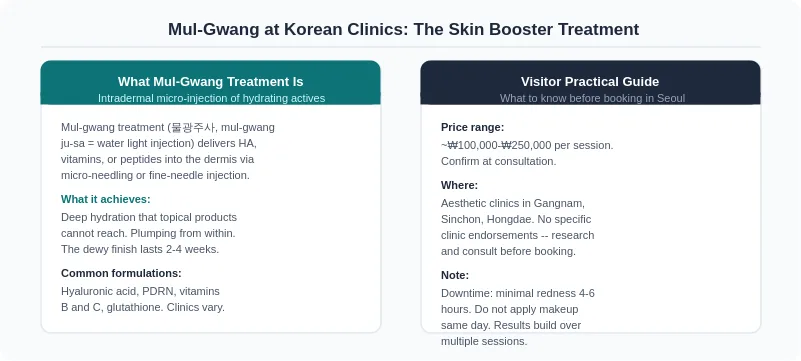
The clinic version -- mul-gwang ju-sa (물광주사), the water light injection -- is one of the most popular aesthetic treatments at Korean skin clinics and has been for over a decade.
The treatment delivers hydrating actives -- typically hyaluronic acid, vitamins, or peptide complexes -- directly into the dermis via micro-needling or fine-needle injection. The intradermal delivery bypasses the barrier limitations of topical products. The result is deep hydration that produces a plumping, dewy effect from within the skin rather than from surface products. Effect typically lasts two to four weeks, building across a course of treatments.
Formulations vary by clinic: non-crosslinked HA is the most common base. PDRN, vitamin B complexes, vitamin C, and glutathione are frequently added. PDRN adds regenerative support; vitamin C adds brightening; glutathione addresses pigmentation at a cellular level.
For visitors to Seoul: available at aesthetic clinics in Gangnam, Sinchon, and Hongdae. Pricing approximately ₩100,000-₩250,000 per session -- confirm at consultation. Minimal downtime: redness at injection points for four to six hours, no makeup same day. Multiple sessions separated by two to four weeks are typically recommended. Research clinics and consult before booking.
Building mul-gwang by skin type
Oily and combination skin: gel moisturiser, water-texture essence. The toner layering step is the same across all skin types -- three thin applications. A light setting mist reapplied at midday maintains the finish.
Dry skin: slightly richer water-cream at the moisturiser step. A hydrating sleeping mask two to three nights per week builds the hydration reserve that keeps mul-gwang consistent across days.
Sensitive and barrier-compromised skin: mul-gwang is gentler than glass skin -- no exfoliation required. But a compromised barrier will not hold mul-gwang well regardless of how many layers are applied. Repair the barrier first with ceramide-rich moisturiser and a low-ingredient routine for two to four weeks before attempting the full layering method.
- Mul-gwang (물광) = water light. Dewy, water-sheen finish built from layered thin, water-based products.
- The gwang family: sok-gwang (inner glow) → chok-gwang (slightly moist) → mul-gwang (water-sheen) → yun-gwang (3D lustrous) → kkul-gwang (honey gloss, most intense).
- The most common mul-gwang mistake: adding a heavy facial oil at the end. This creates kkul-gwang, not mul-gwang.
- The layering method: three applications of a thin toner, patted in. This is where mul-gwang is actually built.
- Mul-gwang vs glass skin: glass skin is reflective (light bounces off); mul-gwang is dewy (light refracts through water-rich surface).
- Mul-gwang ju-sa (물광주사) = the clinic water light injection. ~₩100,000-₩250,000 per session. Confirm at consultation.
- Cushion foundation or skin tint over mul-gwang skin. No mattifying setting powder.
For the skincare conditions that support mul-gwang, see the Honey Skin guide. For the cloud glow finish adjacent to mul-gwang in 2026 Korean beauty, see the Cloud Glow Skin guide.
Related: Honey Skin: The Korean Beauty Trend That Comes Before Glass Skin | Cloud Glow Skin: The 2026 Korean Trend That Replaced Glass Skin | Korean Sunscreen 2026: Why It Feels Nothing Like Western SPF