There is a specific alley in Bukchon Hanok Village that every Korean drama set designer knows about. It runs steeply down Bukchon-ro 11na-gil, tile rooftops cascading on both sides, and if you stand at the right position near the top you can see N Seoul Tower floating above the roofline in the background. This is Viewpoint 2 on the official Bukchon 8-gyeong route, and it is why the neighbourhood appears on so many drama posters and key art. The same shot shows up in Goblin, in The Heirs, in Boys Over Flowers. Cinematographers return to this alley because the geometry is consistent and the city skyline adds depth that no studio set can replicate.
The problem is that everyone else knows this too. On a weekend afternoon in high tourist season, Viewpoint 2 is a crowd of several hundred people, all waiting for the same three seconds of clear alley. The shot is not worth it under those conditions. But the same alley at 7 AM on a Tuesday in November, with mist still sitting on the rooftops and no one else present, is one of the better photographs you can take in Seoul.
Getting the most photogenic K-drama locations in Seoul right is almost entirely a question of timing and the right sub-spot within each neighbourhood.
Bukchon Hanok Village: the eight viewpoints
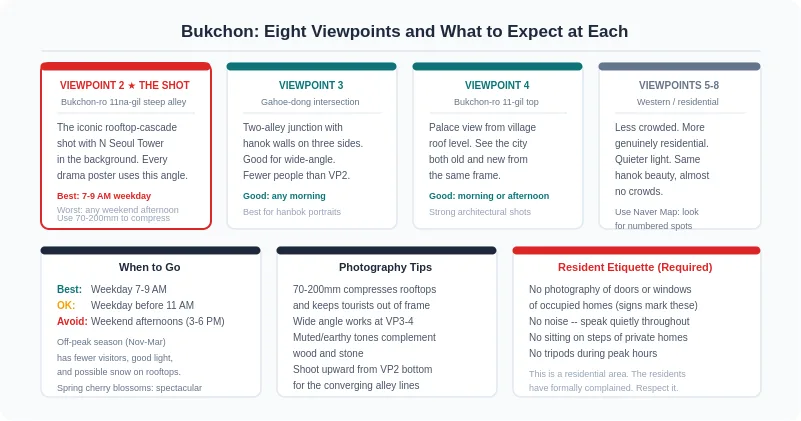
Bukchon's official tourist route is organised around eight numbered viewpoints, each offering a different perspective on the neighbourhood's 900-odd surviving hanok houses. The viewpoints are marked on Naver Map and signed within the village itself.
Viewpoint 2 is the photograph. The steep, narrow alley on Bukchon-ro 11na-gil with hanok walls on both sides and N Seoul Tower in the background -- this is the image that appears on travel magazine covers, drama promotional materials, and every Seoul photography roundup. The shot is real and the location is exactly as it appears on screen. The technique for getting it cleanly is a telephoto lens in the 70 to 200mm range, which compresses the rooftops and brings the tower forward, while also narrowing the frame enough to cut out the tourists who will inevitably be present on either side. Going very early on a weekday is the other variable. Before 9 AM on a weekday morning, the alley has manageable foot traffic. After 10 AM on a weekend, it is untenable.
Viewpoint 3 at the Gahoe-dong intersection offers the second-best architectural shot in the village: a T-junction where hanok walls run on three sides simultaneously. This is a wider-angle shot that conveys the scale and density of the neighbourhood rather than isolating the single rooftop cascade. It sees significantly less foot traffic than Viewpoint 2 and tends to work well at any point in the morning.
Viewpoints 4 through 8 on the western, more residential side of the village are where the experience of Bukchon that dramas use for background scenes actually lives. These alleys are quieter, more genuinely lived-in, and less overrun at any hour. The architecture is identical -- tile rooftops, wooden gates, stone walls -- without the crowd. The small alley connecting Viewpoints 4 and 5 is where experienced photographers go when they arrive and find Viewpoint 2 already crowded.
The photography logistics: 70-200mm compresses rooftops beautifully. Wide-angle (24-35mm) works at Viewpoints 3 and 4 where the alleys are wide enough. Muted or earthy clothing tones complement the wood and clay palette without competing with it. Shooting from the bottom of Viewpoint 2 upward, letting the converging alley lines meet at the top of the frame, is the compositional choice that most closely replicates the drama establishing shot.
The resident etiquette is not optional. The neighbourhood has submitted formal complaints about tourist behaviour. No photography of private home doors or windows (signs mark these). No noise in the alleys. No sitting on the steps of occupied properties. No tripods during peak hours. This is a residential neighbourhood of several hundred households living within a three-metre radius of the most photographed alley in South Korea. The respectful approach is also the approach that produces the conditions the photographs require: quiet, unhurried, unpopulated.
Ikseon-dong: what time of day determines what you get
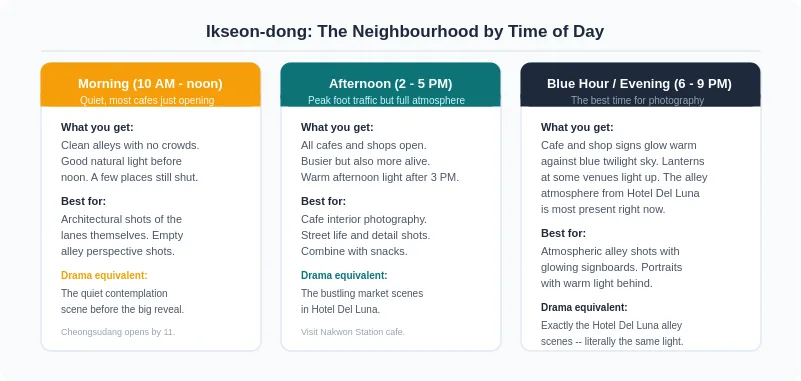
Ikseon-dong is Bukchon's opposite in almost every logistical way. Where Bukchon is residential and resists visitor presence, Ikseon-dong is built to serve it. The 1920s hanok neighbourhood was repurposed into one of Seoul's densest concentrations of specialty cafes, craft cocktail bars, and independent restaurants, all operating within original tile-roofed hanok shells. The businesses there want you. The atmosphere changes significantly by hour.
In the morning (10 AM to noon), Ikseon-dong offers clean, uncrowded alley shots with good natural light and almost no foot traffic. The moment for architectural photography -- perspective down a narrow lane with hanok rooflines on both sides, the wooden gate detail, old stone walls meeting new cafe signage. Cheongsudang, famous for its jiggly castella cakes and wood interior, opens by 11 AM and is considerably more approachable at this hour than in the afternoon queue it develops.
In the afternoon (2 PM to 5 PM), all businesses are operating and the neighbourhood has the bustling market energy that Hotel Del Luna used for its crowd scenes. This is the time for the interior photography, for the street life and detail shots, for the snack-in-hand street photography that makes Ikseon-dong's social media presence. The train-themed Nakwon Station cafe, with its retro announcement board and platform aesthetic, is worth a visit for the exterior even if the wait inside is long.
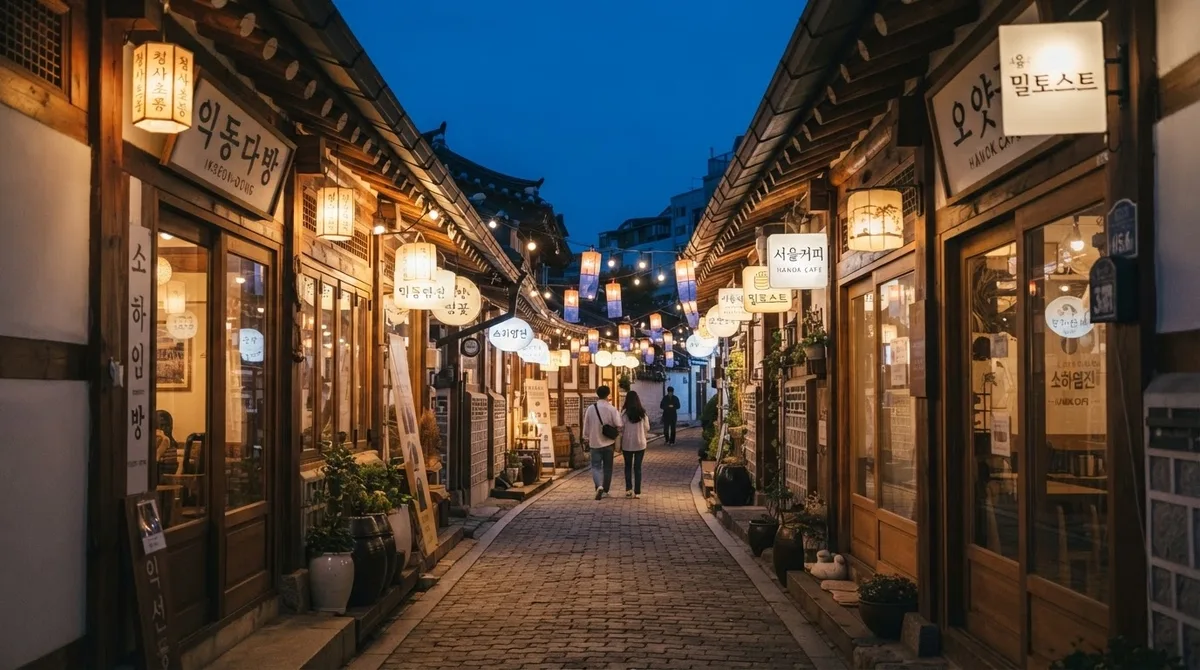
Blue hour (6 PM until dark) is when Ikseon-dong becomes the version of itself that Hotel Del Luna filmed. The cafe and restaurant signs glow warm against the darkening sky. Some venues hang lanterns. The 1920s hanok shells frame warmly lit interiors in a way that has almost no equivalent in Seoul -- the combination of traditional architectural silhouette and contemporary hospitality lighting is precisely the aesthetic the production chose this neighbourhood for. Return here if you visit in the morning and do not get the shot you want. The evening version is distinct enough to be a separate visit.
The Hotel Del Luna filming is specific: the production used Hotel SEINE (a cafe with rooftop lounge) and the Kyungsung Clothes rental shop, both in the central lane grid around Donhwamun-ro 11na-gil, as primary locations. Fans looking for exact scene spots can find them in this cluster.
Practical: Access via Jongno 3-ga Station, Lines 1, 3, or 5, Exit 4 or Exit 6. The neighbourhood covers in 90 minutes at a walk, or three to four hours eating and visiting cafes. Weekend afternoons after 3 PM are the peak crowd window. The alleys are narrow -- large backpacks and strollers are genuinely difficult.
Beyond: five more photogenic spots
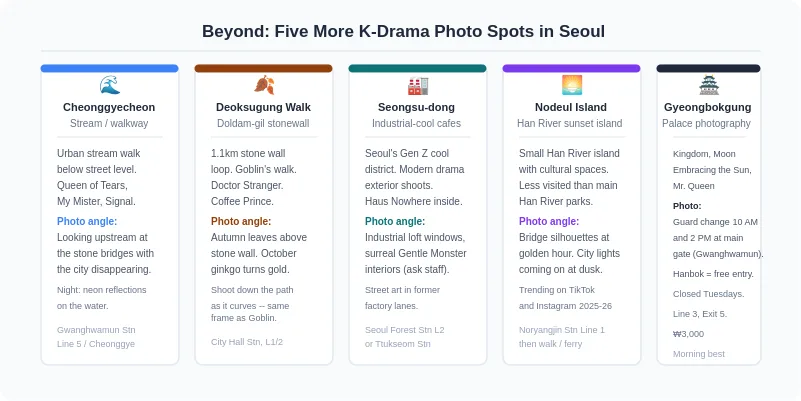
Cheonggyecheon Stream runs 10.9 kilometres below street level through central Seoul, accessible by descending stone steps at regular intervals along its length. Queen of Tears, My Mister, and Signal all use it for the visual that requires flowing water, linear perspective, and the tension of a natural corridor running below dense urban fabric. The photographic angle that most closely matches the drama use: looking upstream from a low bridge position, letting the stone arches recede into the distance with the city buildings rising on either side above the stream walls. At night, the neon signs of the surrounding streets reflect in the water in a way that no other Seoul location replicates.
The Deoksugung Stonewall Walkway (Doldam-gil) has its best photography window in October and November, when the ginkgo trees along the path turn yellow and the plane trees turn orange-red. This is the colour palette that Goblin used -- the drama filmed the Deoksugung walk scenes specifically during the autumn foliage window, because the warm colours against the grey stone wall produce the visual that reads as emotionally significant. Arriving in late October or November and walking the path in the afternoon gives the closest approximation of what the drama captured.
Seongsu-dong is Seoul's current Gen Z cool district, a former industrial zone repurposed into concept stores, flagship spaces, and cafes where the architecture is designed to be photographed. Gentle Monster's Haus Nowhere installation -- giant kinetic sculptures, surreal rooms -- is the most extreme example, but the entire district's language of industrial loft windows, concrete walls with neon signage, and street art in former factory lanes provides the backdrop for the modern drama aesthetic. Access via Seoul Forest Station, Line 2.
Nodeul Island is a small cultural island in the Han River, accessible by pedestrian bridge from Noryangjin, that has been quietly becoming one of Seoul's most visited sunset locations. The island's primary photographic value is positional: standing at the island's edge at golden hour with the Han River bridges on either side and the Seoul skyline visible in multiple directions gives a compositional freedom that the crowded riverbanks cannot provide. Stay for the city lights coming on at dusk.
Gyeongbokgung Palace's photographic peak is the changing of the royal guard ceremony at the Gwanghwamun main gate at 10 AM and 2 PM daily except Tuesday. The ceremony is free to watch, runs approximately twenty minutes, and involves uniformed guards in full Joseon-era military dress. This is the image Kingdom, The Moon Embracing the Sun, and Mr. Queen use as shorthand for royal court power. Arrive fifteen minutes early for a position at the railing. The 2 PM ceremony has better light in most seasons.
Two half-day routes
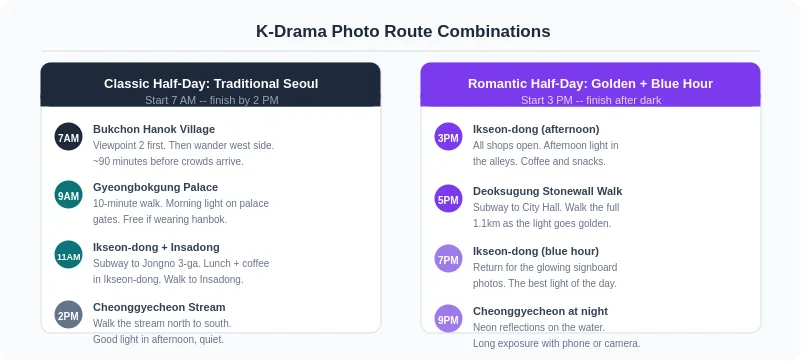
The Classic Half-Day starts at Bukchon before 8 AM, works Viewpoint 2 and the western residential alleys in the quiet window, then walks down to Gyeongbokgung for the palace grounds as the morning light opens up the main courtyard. Subway to Jongno 3-ga arrives at Ikseon-dong around 11 AM when cafes are opening and the morning light still holds. The route ends at Cheonggyecheon Stream for the afternoon walk.
The Romantic Half-Day starts at 3 PM at Ikseon-dong in its afternoon mode, then subway to City Hall for the Deoksugung Stonewall Walk at golden hour -- the path is at its best around 5 to 6 PM in most seasons. Return to Ikseon-dong for blue hour, the best photography window of the day. The route ends at Cheonggyecheon for the night reflection shots. This route runs entirely after 3 PM and is oriented toward the warm and blue-hour light conditions that dramas use for their most visually polished sequences.
- Naver Map is more useful than Google Maps inside Bukchon. Search 북촌 8경 (Bukchon 8-gyeong) for all viewpoints marked.
- Hanbok rental near Gyeongbokgung Station gives free palace entry and improves both palace and Bukchon shots. Rent before Bukchon, not after -- the hills are steep.
- Ikseon-dong's rose vines are in bloom from late April through May. The most specifically Ikseon-dong image.
- For the Hotel Del Luna shot specifically: Ikseon-dong at blue hour, in the central lane grid around Donhwamun-ro 11na-gil.
For more K-drama filming locations across Seoul, see the K-Drama Filming Locations guide. For the skin and beauty context behind K-drama actors' on-screen appearance, see The Skin and Beauty Secrets Behind K-Drama Actors' Flawless Complexions.
Related: K-Drama Filming Locations in Seoul You Can Actually Visit | The Skin and Beauty Secrets Behind K-Drama Actors | Seoul Street Style 2026: Seongsu-dong and Hongdae