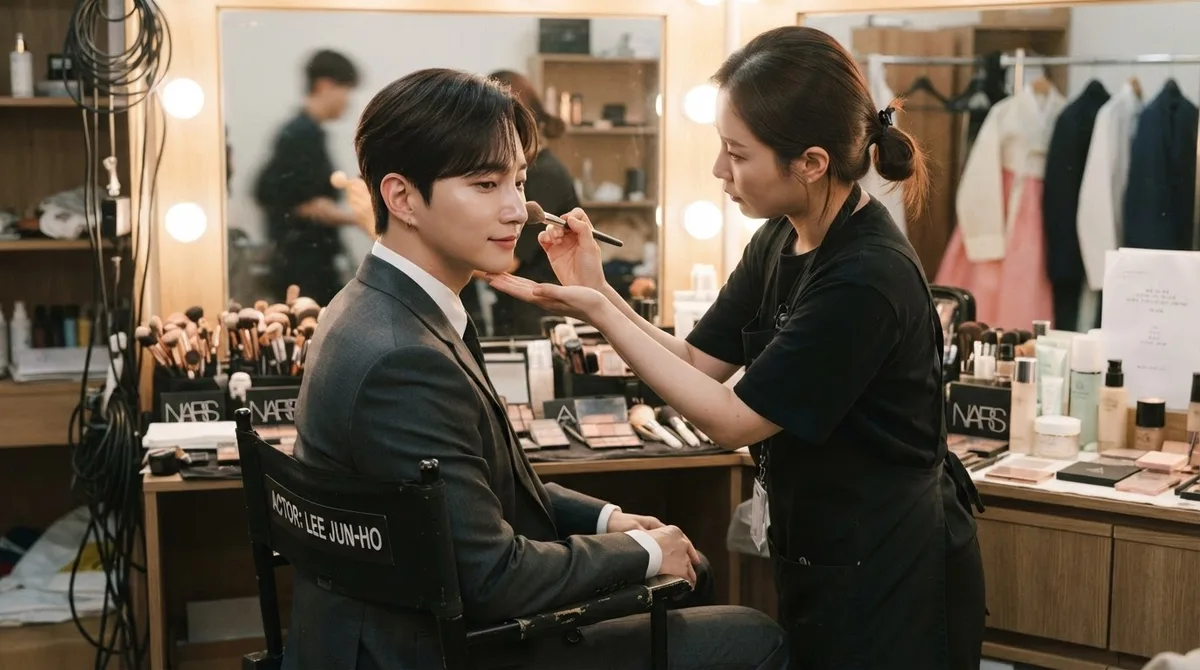
The first thing to understand about K-drama skin is that what appears on screen is a collaboration. The actor's actual skin contributes. So does the professional makeup artist applying and retouching through a sixteen-hour filming day. So does the cinematographer using soft boxes and diffusers. So does post-production. Korean drama production teams routinely retouch skin in close-up scenes, particularly during emotionally intense sequences where the camera lingers. This is standard practice, not concealment.
The second thing to understand is that filming conditions are genuinely hard on skin. Studio lights run hot and dry. The skin of an actor under set lighting for eight to sixteen hours is losing moisture at a meaningful rate. Heavy powder is applied and reapplied throughout the day to prevent shine, clogging pores across the duration of the shoot. Stress and sleep deprivation from early call times and late finishes produce cortisol spikes that break down collagen. The gap between what filmmaking does to skin and what the final footage shows is what the aftercare system is built to bridge.
The routines documented by K-drama actors reflect this reality. They are not elaborate or aspirational. They are repair protocols designed for people whose skin takes a sustained beating and needs to be camera-ready again the next morning.
What filming actually does to skin
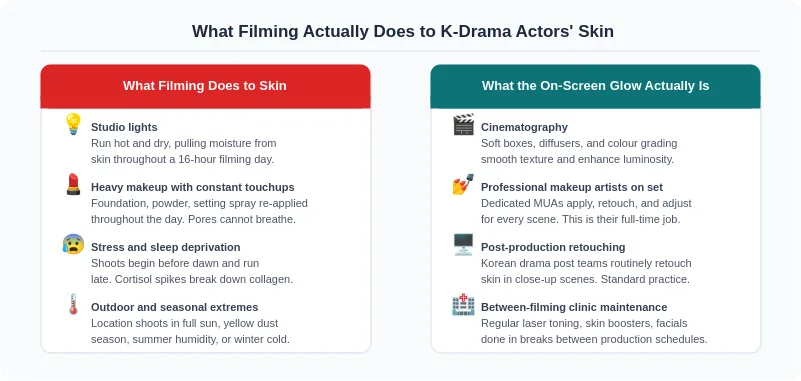
Studio lighting is the most consistently underestimated factor in K-drama skin maintenance. Stage and cinema lights run significantly hotter and drier than ambient conditions. Over a filming day measured in double digits of hours, the cumulative dehydration effect on skin is substantial. Actors who leave this unaddressed develop the kind of tight, dull, finely lined skin that reads poorly in close-up high-definition footage.
Heavy makeup for camera is not the same as regular street makeup. Foundation applied to withstand filming conditions is heavier, set more thoroughly, and reapplied repeatedly across the shooting day. By the end of a long shoot, the skin has been under occlusive product for many hours, pores have been blocked across that duration, and the barrier is typically compromised. Double cleansing after filming is not a preference. It is a clinical necessity for actors who want to avoid the breakouts, congestion, and sensitivity that the alternative produces.
Stress and irregular sleep are structural features of production schedules, not incidental. Early morning call times, late nights, physically demanding scenes, and performance pressure maintain elevated cortisol. The skin effects of sustained cortisol elevation are documented: collagen degradation, increased sebum production, impaired barrier function, and greater susceptibility to inflammatory responses.
The on-screen complexion is a production output, not purely a skincare output. A production team using soft-box lighting, diffusing filters, and colour grading in post has enormous capacity to enhance skin appearance regardless of what is underneath. The most honest framing of K-drama skin is that it represents exceptional skincare maintained under difficult conditions, filtered through exceptional production technique.
Five actors: documented routines
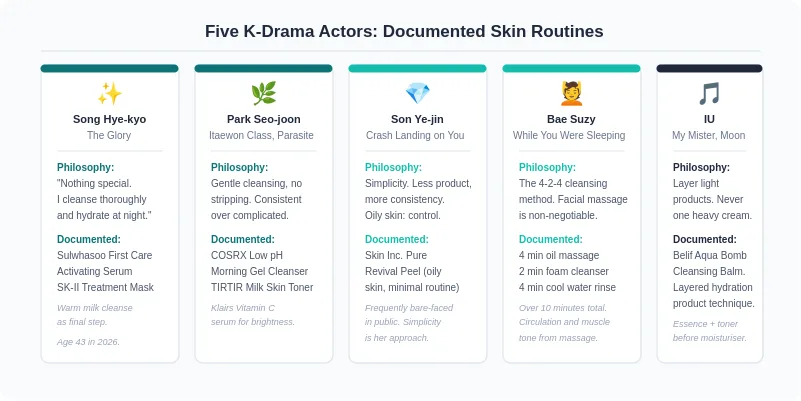
Song Hye-kyo, 43 in 2026, has become one of the most-referenced examples of Korean actress longevity in skincare discourse. In a YouTube channel appearance in late 2025, she said: "There's nothing special about my routine. But I think cleansing my face thoroughly is the most important thing. Before bed, I always make sure to hydrate my skin with enough night cream." Dermatologists responding to the Korea Times coverage noted that the principle she described — thorough removal followed by barrier repair — is exactly what evidence-based skincare recommends for skin under regular heavy-makeup exposure. Her documented products include the Sulwhasoo First Care Activating Serum, SK-II Facial Treatment Masks, and a warm milk rinse as a final cleansing step.
Park Seo-joon's product choices reflect the gentle consistency principle: the COSRX Low pH Good Morning Gel Cleanser chosen specifically because it does not strip the acid mantle, the TIRTIR Milk Skin Toner for hydration, and the Klairs Freshly Juiced Vitamin Drop for brightening. His approach consistently prioritises not breaking what is working over adding new products.
Son Ye-jin, known from Crash Landing on You, has been consistently described in Korean beauty media as the actress whose routine is most notable for its simplicity. She has oily skin and manages it with an edit-down rather than a stack-up approach. She is one of the Korean celebrities most frequently photographed bare-faced — itself evidence of consistent barrier maintenance rather than product minimalism.
Bae Suzy's 4-2-4 cleansing method is the most technically specific routine among the documented celebrity approaches and the one most consistently cited by Korean beauty editors as worth adapting: four minutes of oil cleanser massaged into dry skin, two minutes of foam cleanser over the oil emulsion, then a four-minute rinse with lukewarm then cool water. The total time exceeds ten minutes. The massage component serves a dual function — thorough removal and circulation stimulation that produces a genuine toning effect over consistent practice.
IU's approach is the most representative of the Korean layered hydration philosophy. Rather than a single rich moisturiser, she uses multiple thin layers applied in sequence, each absorbed before the next is applied. The rationale, confirmed by dermatologists commenting on Korean skincare methodology, is that thin layers penetrate and absorb more efficiently than a single heavy application.
The five principles that appear in every documented routine
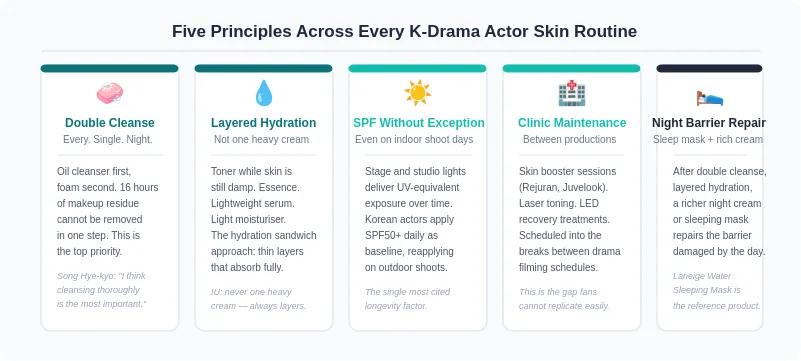
Double cleanse every night without exception. Not weekly. Not when they remember. Every night. Oil cleanser removes oil-based makeup, sunscreen, and sebum. Foam cleanser removes the oil emulsion and water-based residue. Skipping either step leaves something behind that, overnight, produces exactly the breakouts and congestion that read badly in close-up footage.
Layered hydration, not one heavy moisturiser. Toner while skin is still damp, essence, lightweight serum, then a final moisturiser — each layer absorbed before the next is applied. The 'hydration sandwich' described in Korean beauty discourse is a functional description. Thin layers with moisture present in the skin penetrate more effectively than thick products on dry skin.
SPF50+ daily. Location shoots in direct sunlight, studio lights that produce UV-adjacent exposure over extended periods, and the Korean cultural emphasis on sun protection from youth all converge on the same conclusion. Song Hye-kyo's maintained skin at 43 is attributed by Korean beauty editors primarily to this factor over any single product or clinic treatment.
Clinic maintenance between productions. Regular skin booster sessions with Rejuran PDRN injections, laser toning to manage pigmentation, and periodic facials during breaks between productions are the standard maintenance infrastructure. This is the element that separates K-drama skin from what most home routines can produce, and it is the part that fan-facing content rarely addresses directly.
Night barrier repair. After double cleansing and layered hydration, a richer night cream or sleeping mask applied before sleep provides the barrier reinforcement that compensates for what filming has taken during the day. The Laneige Water Sleeping Mask is the most consistently cited product in this category across Korean celebrity references, with Song Hye-kyo's decade as a Laneige ambassador being the longest-documented specific actor-product connection.
What the on-screen glow is made of
A close-up shot in a Korean drama is not a direct window into the actor's skin. It is a composite of the actor's skin under professional makeup, lit by a cinematography team, captured by a camera that processes the image, and then colour-graded and retouched in post-production before broadcast or streaming.
Production teams use soft-box lighting and diffusing filters as standard. These smooth texture and enhance luminosity in ways that are invisible as creative choices but significant in their effect on how skin appears. Korean drama post-production teams, working on content increasingly produced for global streaming at high definition, apply careful retouching to skin during intense close-up sequences.
This is not a cynical observation. It is the context that makes the skincare content useful. K-drama actors have genuinely good skin because they work at it consistently, repair it deliberately after filming damages it, and maintain it with professional clinic support. They also benefit from excellent professional support on set and in post. Both things are true, and understanding both makes the replicable parts more valuable rather than less.
What to take from the approach
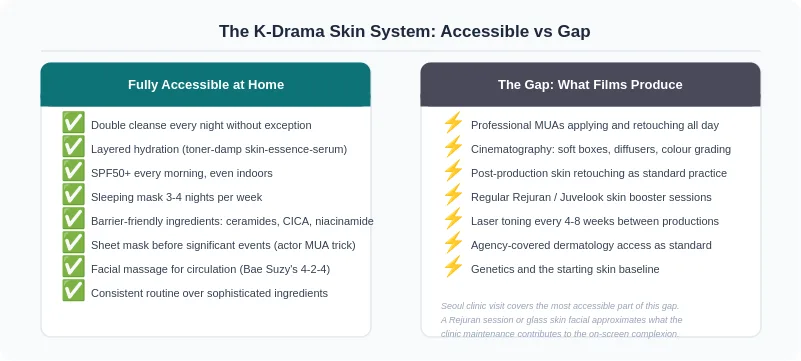
The fully accessible component of K-drama actor skincare is larger than it might appear after accounting for the production infrastructure. Double cleansing every night, layered hydration applied while skin is still damp, SPF50+ without exception, a sleeping mask three to four times per week, and consistent facial massage during cleansing are all practices that cost relatively little and are documented to produce measurable results in skin texture, moisture retention, and long-term appearance maintenance.
The products behind these practices are accessible internationally. Sulwhasoo First Care Activating Serum, Laneige Water Sleeping Mask, COSRX Low pH cleanser, TIRTIR Milk Skin Toner — all available on Korean beauty platforms with global shipping. The total cost of building a version of the documented actor routine runs between $80 and $150 for a full set of products.
For visitors to Seoul, a single clinic visit provides access to the most impactful element of the gap: the skin booster and laser toning combination that regular maintenance schedules in but a home routine cannot reach. A Rejuran session or glass skin facial at a Gangnam clinic during a Seoul trip gives skin the structural hydration and surface refinement that produces the luminosity visible in K-drama close-up footage, at a cost well below Western clinic equivalents. For what those sessions involve and cost, see our Rejuran vs Exosomes vs Skin Boosters guide and the medical tourism first-timer's guide.
Related: K-Drama Filming Locations in Seoul You Can Actually Visit | How K-Pop Idols Actually Take Care of Their Skin | Clinic-in-a-Bottle: At-Home Versions of Korea's Pro Treatments