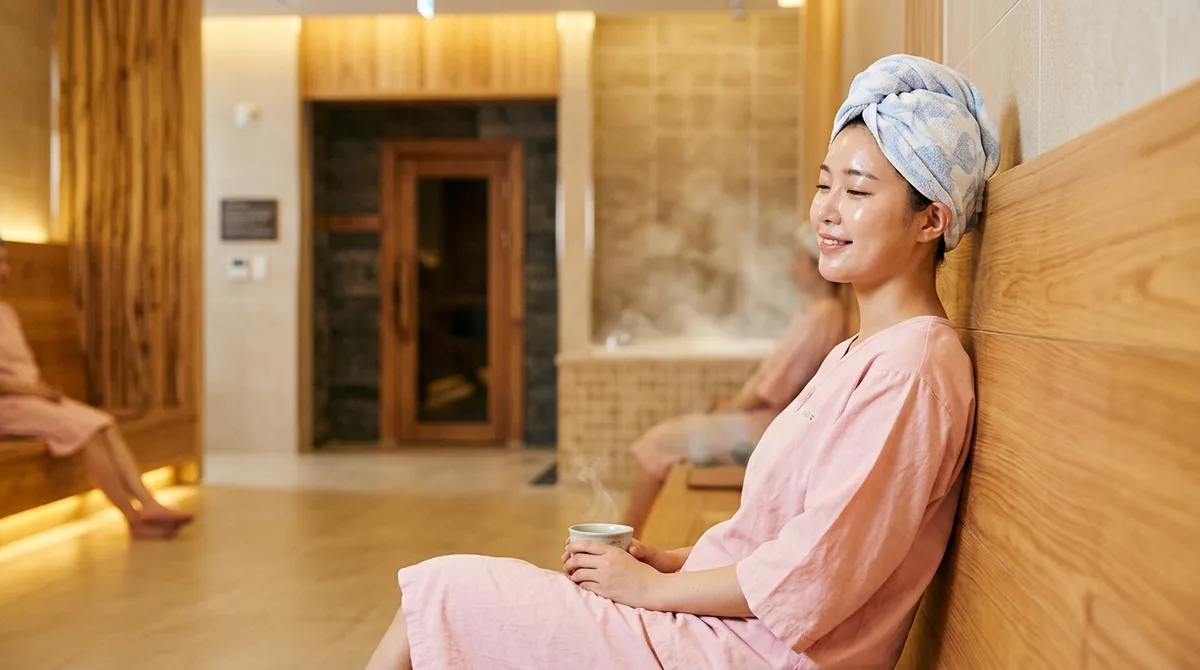
A jjimjilbang is not a spa in the Western sense. There are no treatment rooms with dim lighting and whale sounds. There is no reception staff handing you a robe and a glass of cucumber water. What there is: a sprawling multi-floor complex where Koreans of every age come to sweat, soak, sleep, eat, and do nothing in particular for hours at a time. Grandmothers share a sauna with office workers. Families eat ramyeon in the food hall at midnight. Solo travellers fall asleep on heated floors in cotton uniforms with towels folded into sheep heads. It is utterly Korean, completely accessible with about twenty minutes of preparation, and consistently rated by beauty tourists as one of their trip highlights.
The confusion that stops most first-timers is not the complexity. It is the nudity. The gender-separated bathing section of a jjimjilbang requires full nudity, with no exceptions, and this is the part that reads alarming in travel guides until you actually get there and discover that nobody is looking at you because everyone is too busy ignoring everyone else. Koreans have bathed communally their entire lives. The atmosphere is entirely non-sexual and surprisingly relaxed. Acting self-conscious draws more attention than simply going with the flow.
What a jjimjilbang actually is
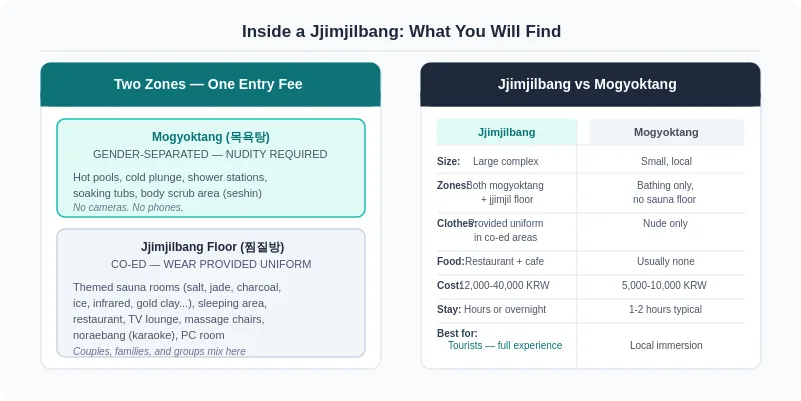
The word jjimjil (찜질) means fomentation, the application of heat to relieve pain and tension, and that is the core of what a jjimjilbang delivers. The facility splits into two distinct zones, both covered by the entry fee.
The mogyoktang (목욕탕) is the gender-separated bathing area, where nudity is required. Hot pools, cold plunge, shower stations, soaking tubs, and the body scrub service operate here. Phones and cameras are prohibited from the moment you enter this zone. The pools often use medicinal ingredients -- ginseng for circulation, mugwort for skin and muscle relief, hinoki cypress for stress -- with English-language signs in most tourist-accessible facilities.
The jjimjilbang floor is the co-ed communal area where everyone wears the cotton uniform provided at check-in. This is where the themed sauna rooms operate: salt rooms, charcoal rooms, jade rooms, ice rooms, infrared kilns, and in luxury facilities, cedar domes and Himalayan salt caves. The food hall, sleeping area, TV lounge, massage chairs, and in larger facilities the karaoke rooms, PC rooms, and nail salons are all here. Couples and groups who split for the mogyoktang reunite on the jjimjilbang floor.
The distinction between a jjimjilbang and a mogyoktang matters for planning. A mogyoktang is a smaller neighbourhood bathhouse with bathing only -- no sauna floor, no food, no entertainment, 5,000 to 10,000 won and an hour or two maximum. All jjimjilbangs contain a mogyoktang section, but not all mogyoktangs have a jjimjilbang floor. Tourists want the jjimjilbang.
Step by step: your first visit
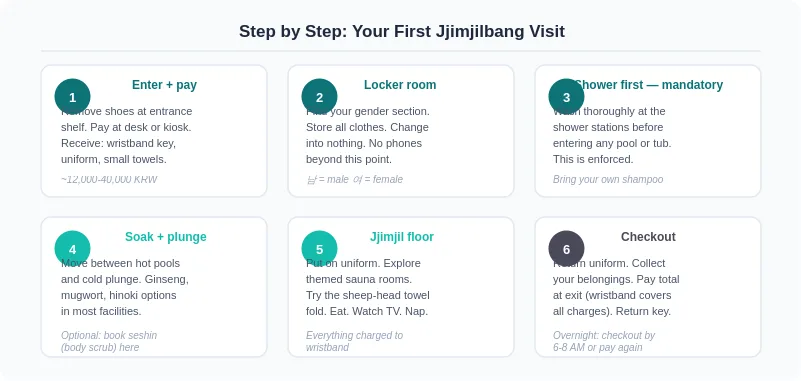
You arrive, remove your shoes at the entrance shelf before you even reach the counter, and pay at the desk or unmanned kiosk. Entry fees in 2026 run from around 12,000 to 18,000 won for standard facilities and 28,000 to 40,000 won for luxury options. You receive a wristband key, a cotton uniform set (shorts and T-shirt), and small towels. Everything you consume inside -- food, drinks, additional services -- is charged to the wristband chip and settled at exit.
You find the locker room for your gender (남 is male, 여 is female on the signs), store everything, and head to the shower stations in the bathing area. Showering before entering any pool is mandatory and enforced. Bring your own shampoo and conditioner -- most facilities provide basic soap but not hair products.
After the shower, the soaking pools are yours. Move between hot and cold at your own pace. Five to ten minutes in a hot pool, a cold plunge or cold shower, repeat -- that is the traditional cycle Koreans follow. The body scrub service (seshin, 세신) is available in most mogyoktang areas as an add-on, performed by experienced seshin masters using a red Italy towel mitt. Book or request it before entering -- pointing to the seshin area and the word is enough.
When you are ready, put on your uniform and head to the jjimjilbang floor. The kiln saunas (bulgama) are dome-shaped brick rooms reaching 80 to 90 degrees Celsius -- five minutes maximum for first visits. The lower-temperature hanjeungmak rooms are more accessible for longer stays. The sheep-head towel fold, where you twist the small towel into a makeshift turban while sitting in the sauna, is a real Korean tradition, not a tourist performance.
Eat something. Sikhye, a cold sweet rice drink, is the classic jjimjilbang order. Hard-boiled eggs cooked on the sauna floor taste significantly better than they have any right to. Full Korean meals -- ramyeon, bibimbap, fried chicken -- are available in the in-house restaurant at most larger facilities, all charged to the wristband.
Checkout at the exit, where the wristband total is settled. For overnight stays, checkout windows run between 6 and 8 AM -- staying beyond that incurs another entry charge.
The nudity question, answered directly
The nudity is limited to the gender-separated bathing zone. In the co-ed jjimjilbang floor, everyone wears the provided uniform. Couples, groups, and mixed parties spend the majority of their visit together in the uniform areas, splitting only for the bathing section.
In the bathing zone, the atmosphere is matter-of-fact. The ajummas who manage many mogyoktang areas move through the space doing their jobs, not looking at anyone. The other bathers are mostly ignoring each other completely. First-timers consistently report that the anxiety in anticipation is significantly larger than the reality once inside.
Swimwear is not permitted in the gender-separated zone. This is a Korean hygiene standard, not a modesty statement -- the bathing water is filtered and treated, the mandatory shower enforces cleanliness, and communal bathing standards require the same conditions for everyone.
Etiquette: what Koreans actually notice
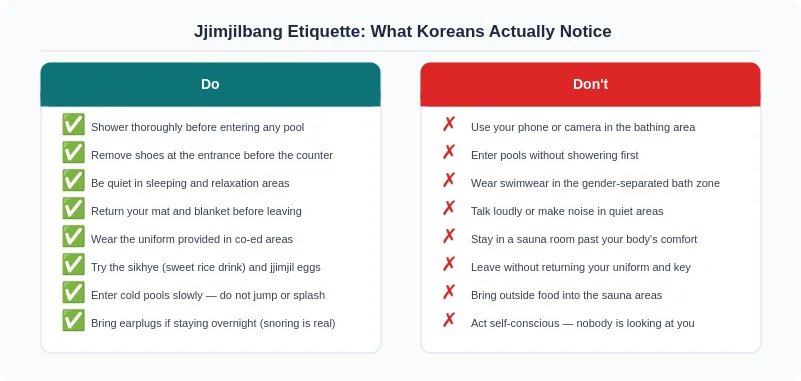
Koreans will not usually say anything if you get etiquette wrong -- they will simply notice. What matters: shower before any pool, remove shoes before the counter not after, be quiet in sleeping areas, return your mat and blanket before leaving, and do not use your phone or camera once you pass the locker room threshold. Everything else is fairly forgiving for first-time international visitors.
Tattoos are no longer the barrier they once were. Korea legalized tattooing for non-medical practitioners and the cultural stigma has faded in Seoul. Cimer, Aquafield, and the SPAREX locations are tattoo-friendly. Smaller traditional mogyoktangs may still produce stares, but refusals are rare at Seoul's main jjimjilbangs.
The seshin body scrub is worth a specific note. The seshin master uses a coarse exfoliation mitt to remove a visible quantity of dead skin -- the process produces results and a mild burning sensation that gives way to noticeably smoother skin. You do not need to do anything except lie still and rotate when asked. Standard rate is 15,000 to 25,000 won, sometimes combined with a massage add-on.
Where to go in Seoul
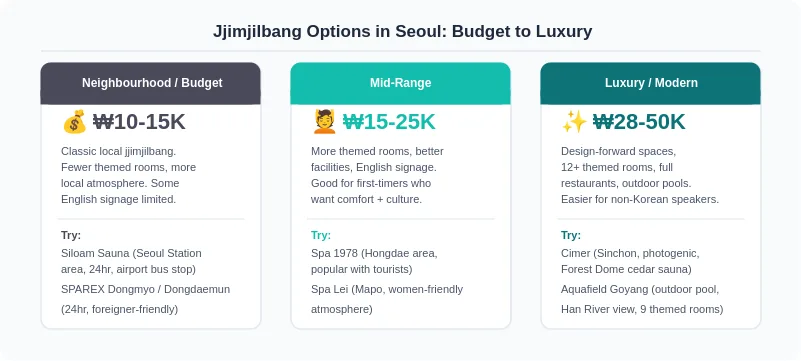
Siloam Sauna near Seoul Station is the practical first choice for many tourists arriving late on the airport bus or leaving early in the morning. It is 24 hours, budget-priced, and well-maintained. The airport bus from Incheon stops directly nearby.
SPAREX Dongmyo and SPAREX Dongdaemun are 24-hour facilities near the Dongdaemun shopping district with high volumes of international visitors. One minute from Dongdaemun History and Culture Park Station. Straightforward for first-timers.
Cimer in Sinchon is Seoul's most design-conscious jjimjilbang in 2026 -- a repurposed industrial building with twelve themed rooms including a Forest Dome cedar sauna, a Himalayan salt cave with real salt blocks, and a subterranean cold plunge at 14 degrees Celsius. Weekend price around 35,000 won for an eight-hour pass. The easiest recommendation for beauty tourists who want the full premium version on a first visit.
Aquafield Goyang in Starfield Goyang shopping complex offers 4,600 square metres including an outdoor heated pool and nine themed indoor rooms. About 33,000 won weekday, 40,000 won weekend for a six-hour pass. A full-day destination when combined with shopping and dining.
A note: Dragon Hill Spa, which still appears in some guides, permanently closed. Cimer and Aquafield represent where the category has moved.
Using the jjimjilbang as a budget overnight stay
Sleeping in a jjimjilbang works, with calibrated expectations. The sleeping area is a communal room with mats on a heated ondol floor, small hard pillows, and blankets. People snore. The lights do not fully turn off. For a late Incheon Airport arrival when the hotel check-in is the following afternoon, 12,000 won in a jjimjilbang is practically and economically sensible. It is not a hotel substitute for multiple nights.
Bring earplugs. Checkout by 6 to 8 AM or pay for another entry. Your valuables stay locked and are safe. The ondol floor heating is maintained through the night, which makes sleeping on the floor genuinely comfortable in a way that sounds improbable until you try it.
What to bring
- Toiletries: shampoo, conditioner, body wash. Facilities provide soap and basic supplies but most visitors prefer their own.
- A larger towel if you prefer one -- the provided small towels are functional but compact.
- Earplugs if staying overnight or napping.
- Skincare products: the post-bath window on freshly exfoliated, steam-opened skin is one of the best possible moments to apply serums or sheet masks.
- Cash for smaller snack shops, though most facilities accept cards.
The beauty tourist angle: why it fits the trip
The jjimjilbang earns its place on a beauty tourist itinerary for reasons beyond novelty. The seshin body scrub is genuine exfoliation at a depth most at-home methods cannot match. The alternating hot-cold cycle drives circulation and supports lymphatic movement that complements skin treatments done earlier in the trip. The sauna heat opens pores and supports the absorption of skincare applied in the post-session window. And the forced rest -- hours without a phone, in a heated room, with nowhere to be -- produces a quality of decompression that is harder to manufacture than most Seoul activities.
Schedule it toward the end of a treatment-heavy trip, not immediately after a laser session or anything requiring skin sensitivity management. The heat and steam are not appropriate in the 48 to 72 hours after procedures that leave the skin in a vulnerable state. After that window, or as a standalone wellness experience on a lighter treatment day, it sits naturally in the same itinerary as a glass skin facial or scalp treatment.
For context on how jjimjilbang fits within the broader beauty tourist schedule, see our 3-Day Seoul Skin-Treatment Trip itinerary and the best time of year guide.
Related: Korean Scalp Care: What Tourists Are Adding to Their Trips | Medical Tourism in Korea: The Complete First-Timer's Guide | Best Time to Visit Korea for Skin Treatments