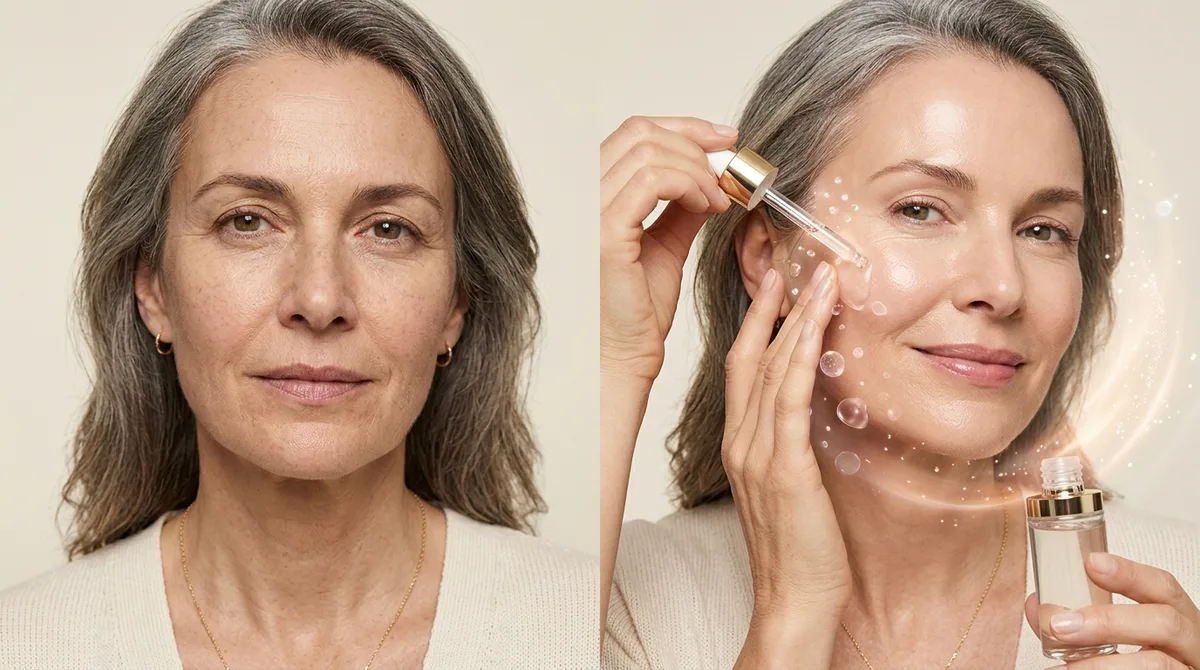
If you follow skincare science at all, NAD⁺ has been hard to miss in 2026. It is showing up in serums, boosters, and clinic treatments from Seoul to Singapore, heralded as a cellular anti-aging breakthrough. And the biology behind it is genuinely compelling. But like every ingredient that goes viral, the hype has outpaced the evidence in some corners, and not everything on the label matches what the science supports yet. Here is the honest version: what NAD⁺ is, what it really does, where the evidence is solid and where it is still catching up, and why the Korean approach to formulating with it is the most interesting development in this space.
What NAD⁺ is
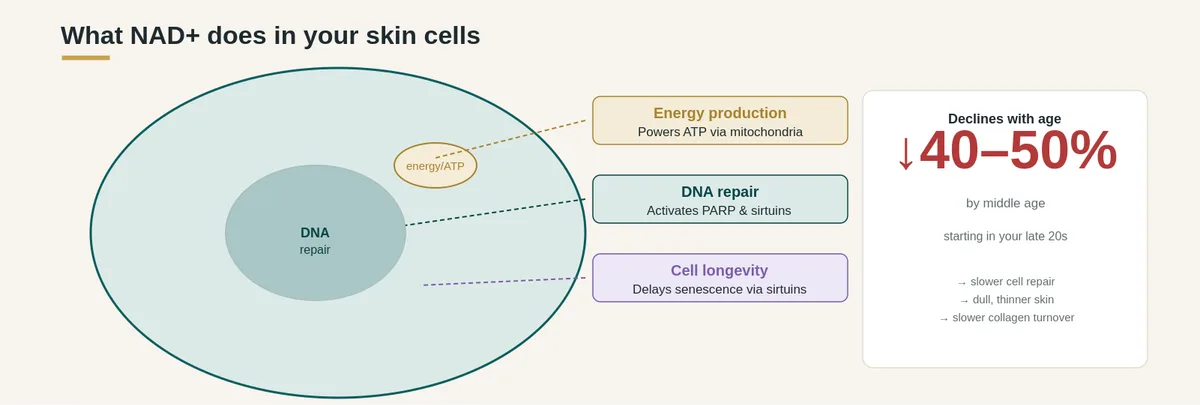
NAD⁺ stands for nicotinamide adenine dinucleotide. It is a coenzyme found in every living cell, and it is one of the most fundamental molecules in biology, described as the cellular battery that powers nearly every energy-producing reaction in the body. In the skin specifically it does three things that matter most for aging: it fuels the ATP energy that keeps cells active and functioning, it activates the DNA repair enzymes, PARP proteins and sirtuins, that fix daily UV and oxidative damage, and it supports the cell longevity pathways that slow the accumulation of old, senescent cells that make skin look dull and thin.
The key fact is what happens to it with age. NAD⁺ levels decline by roughly 40 to 50% by middle age, with the drop beginning as early as the late twenties. That progressive decline is now understood to be a genuine driver of many visible aging changes in the skin: slower cell repair, thinner and less bouncy texture, slower collagen turnover, and reduced ability to recover from UV and environmental stress. The biology is rock-solid and published across decades of research.
The precursor family
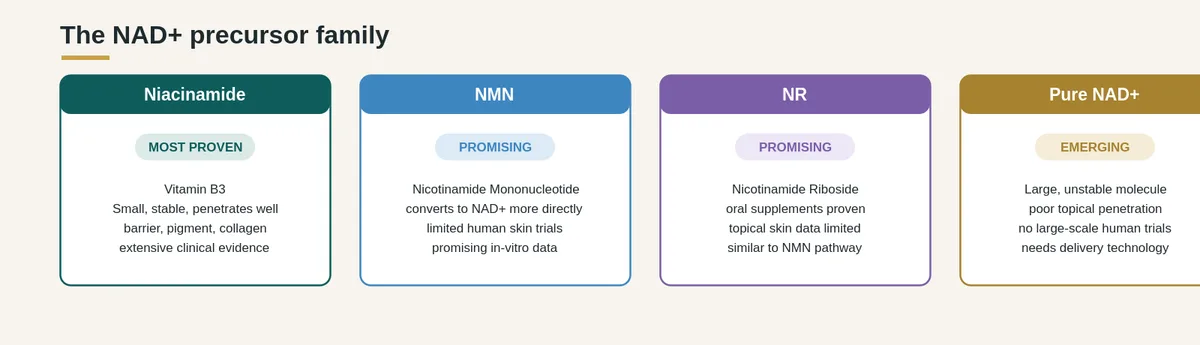
Here is where it gets more nuanced, and where the marketing often muddles what the science says. NAD⁺ itself is a large, unstable molecule with a penetration problem: applied topically to skin, it struggles to get through the outer barrier in meaningful amounts, and it degrades quickly in a jar or a serum without encapsulation. So the products you will find mostly do not contain pure NAD⁺ at all, they contain precursors, smaller molecules the skin can convert into NAD⁺ internally.
The most proven precursor is niacinamide, also known as vitamin B3. It is small, stable, and one of the most extensively studied ingredients in all of dermatology, with clear clinical evidence for improving skin barrier function, reducing hyperpigmentation, supporting collagen synthesis, and calming inflammation. It is the bedrock of the NAD⁺ pathway in skincare, and it has been in your moisturiser for years. NMN, nicotinamide mononucleotide, and NR, nicotinamide riboside, are newer, more direct NAD⁺ precursors with a more efficient conversion pathway, and they have strong evidence from oral supplement research. For topical skin use, the human trial data is currently limited but genuinely promising. Pure NAD⁺ itself in topical form remains the frontier: some premium formulations now use encapsulated or stabilised NAD⁺, but large-scale human skin trials are still in progress.
The honest evidence ladder
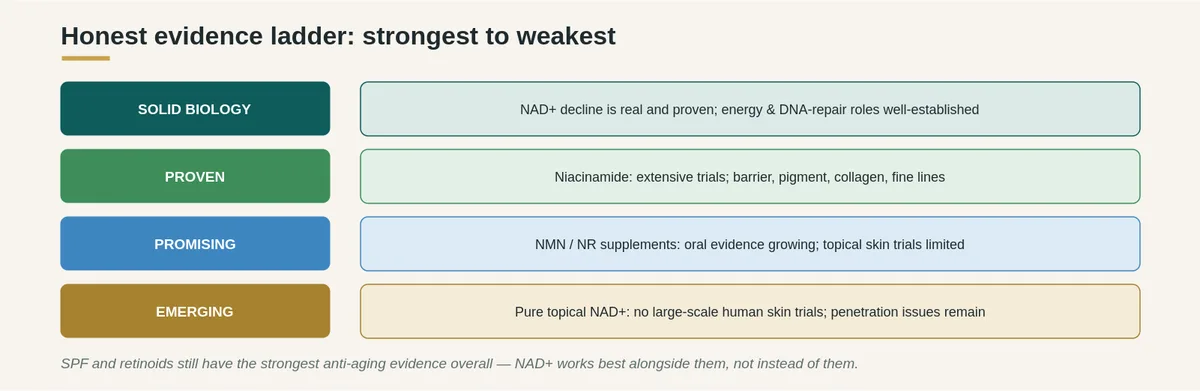
Being accurate about this is what makes the whole NAD⁺ story credible rather than hype. The biology is solid: NAD⁺ decline is real and its skin roles are well-established. Niacinamide as a precursor is proven, with decades of clinical evidence behind it. NMN and NR are promising at the supplement level, with growing but limited human skin data. Pure topical NAD⁺ is emerging: the mechanisms make sense, the direction of travel is right, but the large-scale skin-specific human trials have not yet caught up with the excitement.
It is also honest to say that for anti-aging results overall, sunscreen and retinoids still have a far deeper evidence base than any NAD⁺ formulation. NAD⁺ is most compelling as a cellular-support layer alongside those proven staples, not as a replacement for them. The brands that position it as a standalone miracle are getting ahead of the data; the ones that position it as part of a well-formulated stack are on firmer ground.
Why it is breaking out now
The 2026 NAD⁺ surge is being driven by a convergence of things. Longevity science has moved from academic journals into mainstream culture, and NAD⁺ sits at the centre of it because it connects directly to sirtuin biology, cellular energy, and the hallmarks of aging that researchers have popularised. Korean brands like Numbuzin have launched dedicated NAD⁺ essences that have gone viral on social media. And formulation technology has quietly improved: better stabilisation, lipid-based delivery systems, and increasingly, the combination of NAD⁺ precursors with delivery-enhancing companions like PDRN and exosomes that genuinely help the active get where it needs to go.
The Korean approach: combine and deliver
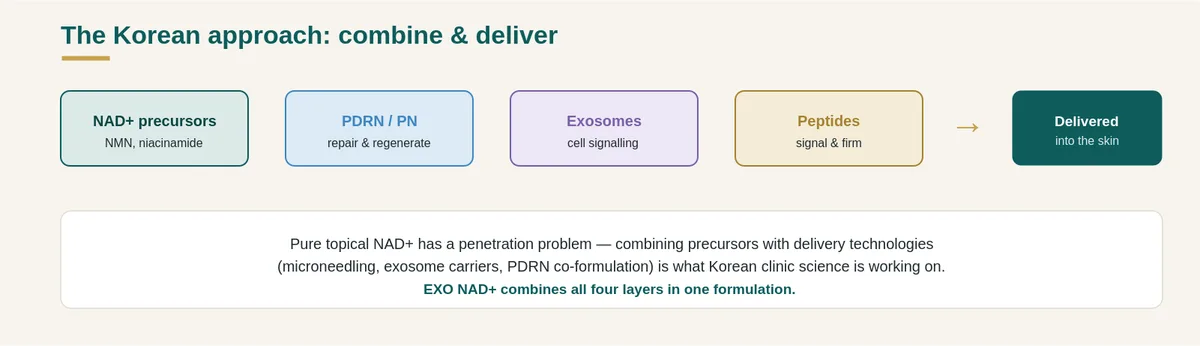
Korean skincare and clinic science has approached the NAD⁺ challenge differently from Western brands, and the approach is instructive. Knowing that pure topical NAD⁺ faces a penetration and stability problem, the most sophisticated Korean formulations combine NAD⁺ precursors with complementary regenerative ingredients, PDRN and polynucleotides for repair, plant exosomes as delivery and signalling vehicles, and multi-action peptides, and use them together to work across different cellular pathways at once.
This is exactly the design logic behind EXO NAD+, a professional clinic formulation that layers NAD⁺ alongside PDRN, PN, plant exosomes, and peptides in a single application. The thinking is that NAD⁺ precursors supply the energy and DNA-repair support, PDRN and PN accelerate tissue regeneration, and the exosome vehicle helps carry and signal at the cellular level, addressing the penetration limitation through companion delivery. This kind of multi-ingredient, clinic-strength approach is where the most interesting NAD⁺ work is happening right now, and it is a long way from the single-ingredient serums that make up most of the consumer market.
What to look for in products
On a label, the NAD⁺ family appears under several INCI names: nicotinamide adenine dinucleotide for pure NAD⁺, nicotinamide mononucleotide for NMN, nicotinamide riboside for NR, and niacinamide or nicotinamide for the vitamin B3 form. A product that lists niacinamide as its main NAD⁺ claim is well-evidenced but familiar; one that leads with NMN or stabilised NAD⁺ is more frontier territory but directionally sound. In both cases, what matters as much as the NAD⁺ ingredient itself is what it is paired with: actives that support collagen, barrier, and cellular repair, and a formulation designed to deliver it past the skin surface rather than just sitting on top.
How to use it and what to expect
For an at-home routine, the most reliable NAD⁺ entry point is still a well-formulated niacinamide serum, which is proven, affordable, and pairs cleanly with vitamin C (applied at separate times), retinol, and SPF. If you want to go further with NMN or a dedicated NAD⁺ complex, look for encapsulated or stabilised formulations from brands that name the form and the concentration. Expect benefits that build gradually, particularly in barrier function, skin tone evenness, and that overall sense of skin resilience, rather than overnight transformation. NAD⁺ is a long-game ingredient, not a quick-fix one.
In the clinic context, the most advanced NAD⁺ work is done via microneedling infusion or mesotherapy, where the penetration barrier is bypassed entirely and the ingredient is delivered directly where it needs to be. This is where [exosome and PDRN treatments]https://myguidekorea.com/trends/skincare/rejuran-vs-exosomes-vs-skin-boosters-korea-2026) overlap with the NAD⁺ story, and why combination treatments are increasingly the standard at the premium end of Seoul's clinic menu.
The takeaway
NAD⁺ deserves its 2026 moment because the underlying biology is real and important. Its decline with age is well-established, its cellular roles in energy, DNA repair, and longevity are proven, and the direction of travel in both research and formulation is genuinely exciting. But the evidence still runs on a gradient: niacinamide is solid, NMN and NR are promising, and pure topical NAD⁺ is still catching up with the science needed to confirm it works as well through the skin as it does in cell biology. The most honest approach is to treat it as a cellular-support layer alongside your proven staples, SPF, retinoids, antioxidants, rather than a replacement for them. And if you want NAD⁺ where the science currently gets the furthest, the Korean clinic formulations that pair it with exosomes, PDRN, and peptides are the most coherent application of where the research is heading.