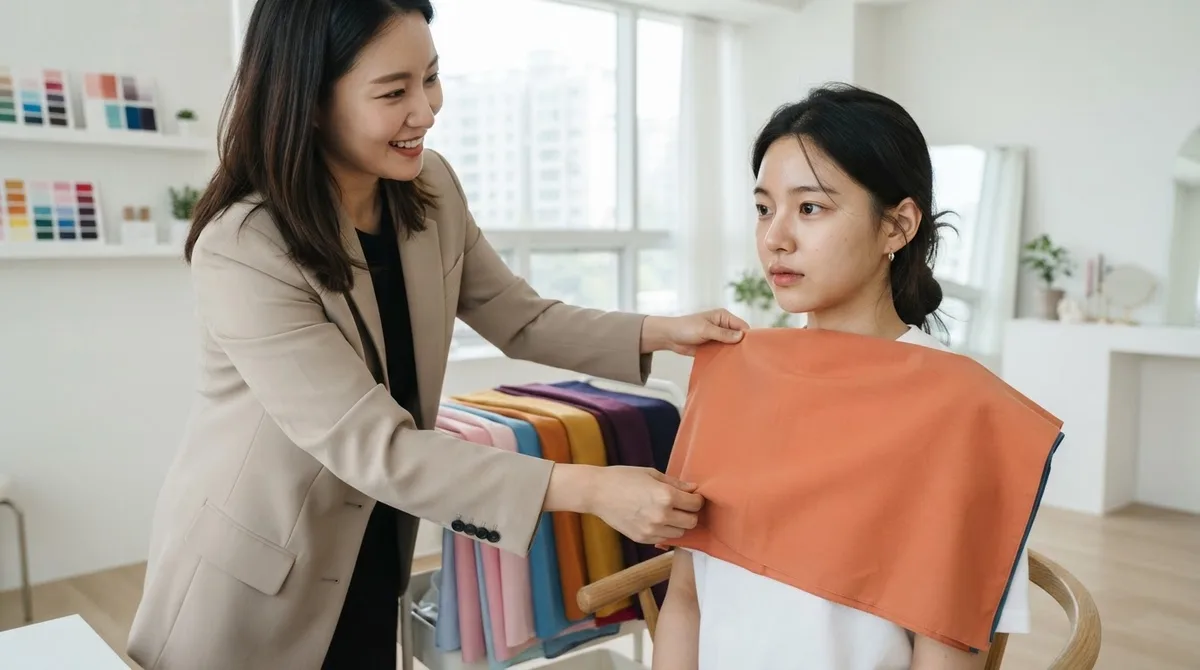
Personal color analysis -- 퍼스널컬러 진단 in Korean -- has been a fixture of Seoul beauty culture since the 2010s. Politicians have had it done. K-pop idols have had their results shared online. When Jisoo of BLACKPINK's personal color analysis went viral on YouTube with 2.6 million views, it triggered a wave of international interest that has not subsided. The topic now sits at 375 million TikTok views. The Korea Tourism Organization created a pop-up studio at New York's Rockefeller Center to capitalise on the demand. Studio slots in Gangnam, Hongdae, and Seongsu book out one to two months in advance.
The appeal is specific. The service does something concrete: a trained consultant drapes hundreds of calibrated fabric swatches at your neckline under standardised lighting and reads how each shade affects your complexion. Some colours make your skin look clearer, your eyes brighter, the shadows under your eyes lighter. Others do the opposite. The analysis identifies which is which, assigns you to a seasonal colour category, and gives you a product-specific shopping guide that transfers directly to Olive Young, any Korean makeup counter, and your wardrobe. It is not a personality assessment. It is a colour matching tool with measurable outputs.
How the system works: three axes
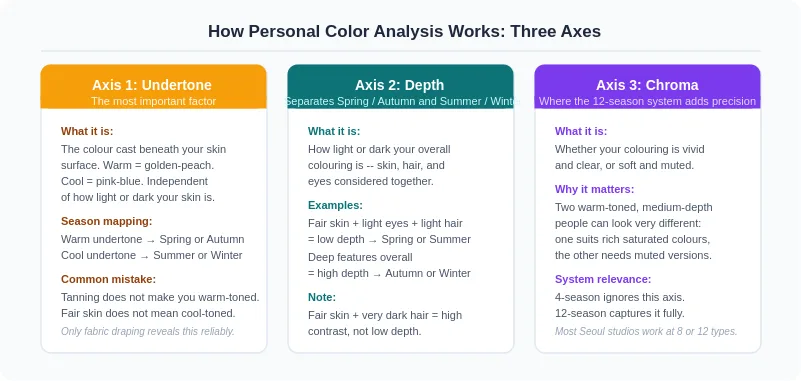
The Korean personal colour system organises human colouring along three measurements. Every Seoul studio session, regardless of the number of seasons it outputs, is reading the same three things.
Undertone is the colour cast beneath your skin's surface. Warm undertones have a golden or peachy quality. Cool undertones have a pink or blue quality. This is the most important axis and the one most commonly misread by self-assessment. Tanning does not make you warm-toned. Fair skin does not mean cool-toned. A person with very deep skin can have a cool undertone. A person with very fair skin can have a warm undertone. The undertone is determined by the ratio of melanin types beneath the skin surface, which is why it holds across all ethnicities and complexion depths and cannot be read reliably from a photograph or vein colour question. Undertone determines whether you land in the warm seasons (Spring or Autumn) or the cool seasons (Summer or Winter).
Depth is how light or dark your overall colouring is when skin, hair, and eyes are considered together. Low depth -- fair skin, light eyes, light hair -- points toward Spring or Summer. High depth points toward Autumn or Winter. Someone with fair skin and very dark hair can have high depth, because it is the gap between features that matters, not skin tone in isolation.
Chroma measures whether your colouring is vivid and clear or soft and muted. This is the axis the four-season system ignores and the 12-season system captures. Two people can have identical warm undertones and similar depth but need completely different colour intensities -- one suits rich, saturated shades, the other looks overwhelmed by them and needs softer, more grayed versions. This is where the practical wardrobe guidance becomes specific rather than generic.
The four seasons and what each means
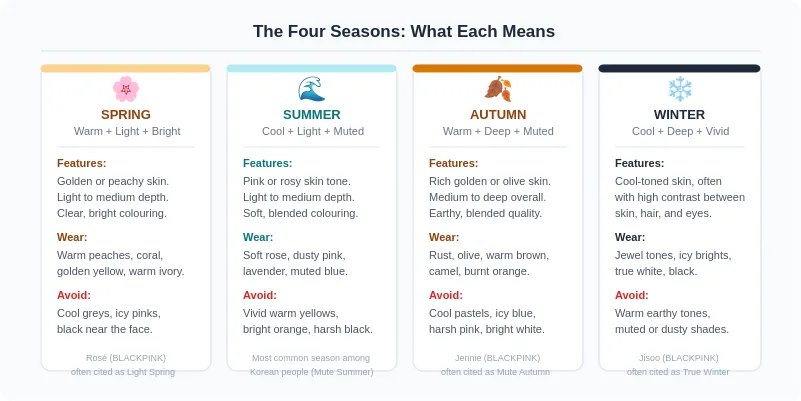
Spring types have warm undertones, light to medium depth, and a clear, bright quality to their colouring. The palette is warm peaches, coral, golden yellow, warm ivory. Cool greys, icy pinks, and black near the face tend to drain Spring colouring. BLACKPINK's Rosé is often cited by Korean colour analysts as a textbook Light Spring -- her styling consistently reaches for soft peaches, warm pinks, and light golden tones.
Summer types have cool undertones, light to medium depth, and a soft, blended quality. The palette is soft rose, dusty pink, lavender, muted blue, and cool soft neutrals. Vivid warm colours tend to overwhelm Summer colouring. Korean colour researchers have consistently identified Mute Summer as the most common season among Korean people, which explains why the muted, dusty pastel aesthetic dominates Korean product ranges.
Autumn types have warm undertones and medium to deep depth, with an earthy, blended quality. The palette is rust, olive, warm brown, camel, burnt orange. Cool pastels, icy blue, and bright white fight against Autumn colouring. Jennie of BLACKPINK is frequently cited by Korean styling analysts as a Mute Autumn -- her consistent use of camel coats, warm neutrals, and earthy tones is deliberate colour season application.
Winter types have cool undertones and typically higher depth or contrast, suited to jewel tones, icy brights, true white, and black. Winter is the season that wears colours that overwhelm other types. Jisoo of BLACKPINK is consistently cited as a True Winter -- her styling team reaches for jewel tones, icy brights, and high-contrast combinations that would look harsh on her groupmates but sit precisely in her palette.
Four seasons vs 12 seasons: which Seoul studios use
The basic four-season system tells you whether you are warm or cool and lighter or deeper. Most budget sessions work at this level. The 12-season system adds the chroma axis, splitting each of the four seasons into three sub-types. This is where the guidance becomes specific enough to identify exact lipstick shades rather than just colour families.
The practical difference: a four-season result tells you "you are warm-toned, wear warm colours." A 12-season result tells you which intensity of warm colours works. A True Autumn can handle rich, saturated warm shades. A Mute Autumn needs the same colour family at significantly lower saturation. A Deep Autumn can go darker and richer than either. Three people who all test as Autumn in a four-season reading wear three genuinely different wardrobes.
Most mid-range Seoul studios work at eight or twelve types. The jump from four to twelve makes meaningful practical difference. The jump from twelve to sixteen is fine-tuning primarily useful for professional styling.
What happens in the room
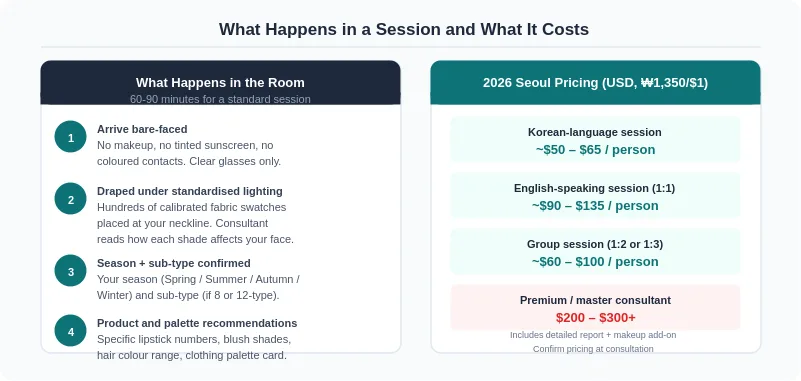
A standard session runs sixty to ninety minutes. You arrive with no makeup, no tinted products of any kind, and no coloured contact lenses. The requirement for a completely bare face is not optional -- a foundation running one shade warm or cool can push the reading in the wrong direction.
The consultant seats you facing a mirror under standardised neutral lighting. Fabric swatches are draped one at a time at your neckline, and the consultant reads your face: how the shadow under your eyes reads, whether your skin looks clearer or more uneven, whether the colour of your lips and cheeks looks natural or washed out. Some studios use two hundred or more swatches in the initial pass before doing precise comparisons. Premium studios add digital imaging tools or spectrophotometers for undertone reading.
The session ends with a confirmed season and sub-type, a set of specific colour recommendations, and typically a physical palette card. Many studios give product-level recommendations: specific lipstick numbers from ROM&ND or AMUSE, specific blush shades from WAKEMAKE, hair colour range guidance. This turns the abstract season label into a functional shopping tool.
One honest caveat: colour analysis is a specialist skill and assessments are not perfectly consistent between consultants. The same person can test as a different sub-season with two different analysts, particularly at the boundary between seasons. A single session with a certified consultant is still significantly more accurate than self-testing, and the guidance holds reliably at the season level even when the sub-season is a close call.
Booking logistics
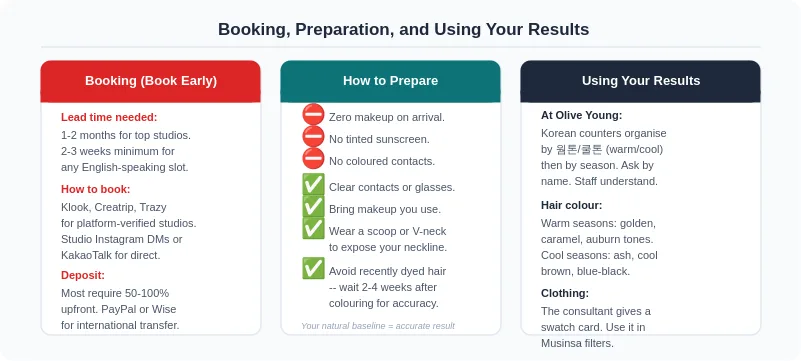
Booking is the most genuinely difficult part for international visitors. The best-reviewed English-language studios in Gangnam, Hongdae, and Seongsu book out one to two months in advance, particularly during spring (March to May) and autumn (September to November). Do not arrive in Seoul expecting to book a session on the day or even the same week.
The most reliable booking routes for international visitors are Klook, Creatrip, and Trazy -- all list verified studios with English-language support, confirmed pricing, and infrastructure that accepts international payment. For premium or master-consultant sessions, booking directly through the studio's official Instagram or KakaoTalk channel is recommended, as some high-end consultants do not list through platforms.
Pricing in 2026 runs from around fifty to sixty-five US dollars for a Korean-language session through ninety to one hundred and thirty-five dollars for an English-speaking standard session, to two hundred dollars and above for premium or master-consultant sessions with detailed reports. Group discounts of ten to twenty percent apply at most studios for two or three-person sessions.
Most studios require a deposit of fifty to one hundred percent of the session cost upfront. PayPal and Wise are the standard international transfer methods. Cancellation policies are strict -- most studios forfeit the full deposit for cancellations less than two to three days before the session.
What to do with the result
At Olive Young, Korean beauty counters organise products by 웜톤 (warm tone) and 쿨톤 (cool tone) and then by season sub-type. If you know you are a Mute Summer, a Warm Spring, or a Deep Autumn, ask at the counter by that name. The staff understand this vocabulary and it is one of the clearest demonstrations of how embedded the colour season system is in Korean consumer beauty culture.
Hair colour guidance is one of the most commonly acted-on recommendations immediately after a Seoul session. Warm seasons are steered toward golden, caramel, and auburn tones. Cool seasons toward ash brown, cool brown, and blue-black. Korean hair salons are familiar with the season colour vocabulary and will understand a brief like "I am a cool summer, ash brown family" without further explanation.
The physical palette card or digital swatch list becomes the shopping filter for both the Seoul portion of the trip and subsequently. For clothing at Musinsa, the palette translates directly into filter criteria. For makeup anywhere internationally, the specific product numbers the consultant recommends are available via global shipping from Korean platforms at prices well below Western retail equivalents.
- Book as soon as you have your Seoul travel dates confirmed. Do not wait until you arrive.
- Go bare-faced. No makeup, no tinted sunscreen, no coloured contacts. This is the preparation step most likely to affect your result.
- Group sessions (1:2 or 1:3) are cheaper per person and considerably more entertaining.
- Avoid recently dyed hair -- most consultants recommend waiting two to four weeks after colouring.
- Bring the makeup you currently own. A good consultant will tell you which of your existing products work and which you can stop buying.
Related: The K-Pop Idol Makeup Look: Lingerie Skin, Gradient Lips, Glass Eyes | How K-Pop Idols Actually Take Care of Their Skin | Korean Acne Treatment in Seoul: Clinics vs Products