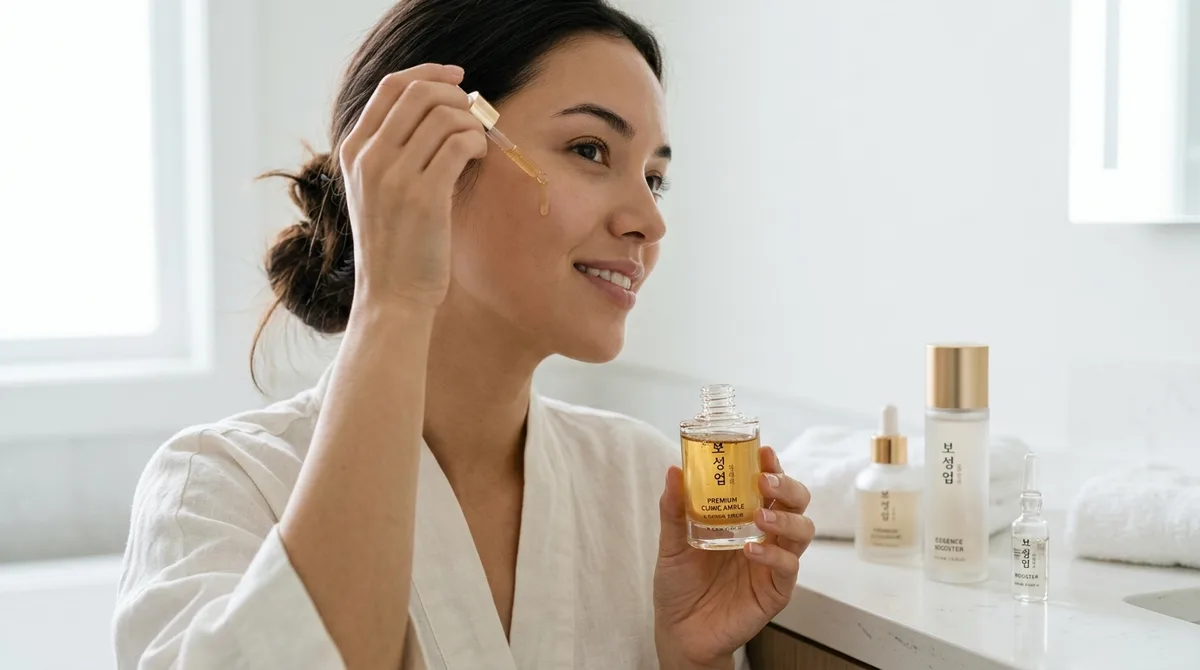
Korean skincare has always had one foot in the clinic. The philosophy, the ingredients, the protocols — all of it traces back to what dermatologists in Gangnam were doing and what the retail market then made accessible at a fraction of the price. In 2026, that pipeline is faster than it has ever been. Ingredients that required a needle in 2020 are on Olive Young shelves in 2026. Technologies that required a clinical device in 2022 have home versions available in 2024. The compression between clinic and consumer is accelerating, and the result is a genuinely useful at-home ecosystem for anyone who wants to maintain clinic results between visits or approximate clinic-level care from home.
The honest version of this story has a gap. At-home versions of clinic treatments are real, useful, and increasingly sophisticated. They are not equivalent to clinic sessions. Understanding exactly where the gap sits, and what transfers well versus what does not, is what determines whether you are spending money on something genuinely useful or paying for impressive marketing on a serum that cannot do what it implies.
Four categories of at-home clinic alternatives
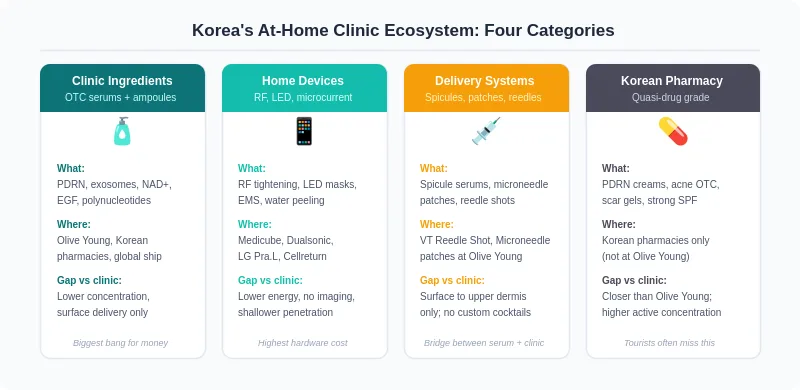
The at-home clinic ecosystem breaks into four categories, each with a different relationship to the clinic treatment it approximates.
Clinic ingredients in OTC formats are the largest and fastest-growing category. PDRN, exosomes, EGF (epidermal growth factor), polynucleotides, and NAD+ formulations — all developed for and first used in Korean aesthetic clinics — are now available at Olive Young in serums and ampoules. Between October 2025 and March 2026, PDRN appeared in 33 of Olive Young's top 50 skin longevity products, second only to hyaluronic acid. These products contain the same ingredient class as their clinical counterparts at lower concentrations, delivered topically rather than by injection or device. The gap is real but the ingredients are genuine.
Home devices represent the hardware category. RF (radiofrequency), LED masks, EMS microcurrent, and water peeling devices have all matured significantly. Medicube's AGE-R Booster Pro remains the best-selling Korean all-rounder for international buyers. Dualsonic produces genuine home HIFU devices that reach deeper than most consumer alternatives. LED masks now feature over a thousand chips on flexible silicone frames. None of them replicate clinic-grade energy levels or imaging-guided precision, but they are no longer cosmetic-only placebo devices.
Delivery systems are the middle ground. Spicule serums and reedle shots create micro-channels in the upper layers of skin that improve ingredient absorption and provide mild cell turnover stimulation. Microneedle patches loaded with hyaluronic acid or PDRN target specific areas. These work above the level of a standard serum and below the level of clinic microneedling. Understanding them as a delivery mechanism rather than a standalone treatment sets appropriate expectations.
Korean pharmacy products are the category most tourists miss entirely. The Korean pharmacy stocks a different class of product from Olive Young — quasi-drug grade, with higher active concentrations than cosmetic formulations. A PDRN cream at a Korean pharmacy costs roughly 15,000 to 25,000 won. A clinic PDRN injection session starts at around 100,000 won. Foreign visitor pharmacy spending in Korea jumped 142 percent to 141.4 billion won in 2025.
What actually transfers from clinic to home
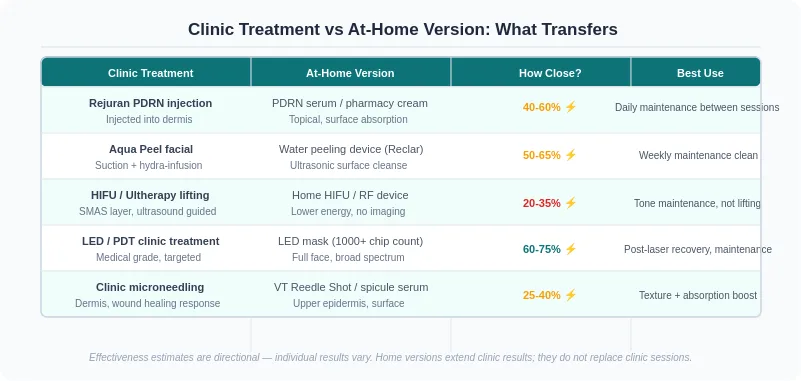
LED therapy transfers most cleanly of all the clinic-to-home comparisons. Home LED masks in 2026 feature over a thousand chips, cover the full face, and include near-infrared wavelengths that penetrate deeper than standard red LEDs. At roughly 60 to 75 percent of clinical effectiveness, a quality home LED mask is genuinely useful for post-laser recovery, collagen maintenance, and acne reduction. It is the most cost-effective home device relative to what clinic sessions charge.
Water peeling handles a meaningful portion of what regular Aqua Peel clinic visits deliver. The clinic version adds a hydra-infusion step that home devices cannot fully replicate, but the ultrasonic exfoliation and surface debris removal that home water peelers deliver is genuinely analogous to a significant portion of the clinic treatment. Weekly use maintains the cleansed-pore baseline that the clinic session establishes.
PDRN serums transfer the ingredient but not the delivery depth. Injected PDRN through Rejuran sessions reaches the dermis, where fibroblast activation and structural repair happen most meaningfully. Topical PDRN works at the epidermis and upper skin layers. The same DNA fragments are present; the mechanism is real; the surface-level outcomes are genuine. The quantitative gap between clinic injection and topical application is meaningful. Used daily, PDRN serums build on the foundation a Rejuran session establishes and extend the maintenance window between clinic visits. Some marketing materials for PDRN serums imply equivalence that the delivery mechanism does not support — that is the part worth knowing before you buy.
Home HIFU devices are the most hyped and most honestly gapped category. Clinical HIFU using Ultherapy or Shurink reaches the SMAS layer using real-time ultrasound imaging to confirm energy placement. Home devices, including the Dualsonic Maximum which is among the most advanced consumer options available, deliver energy at meaningful depths but shallower and less precisely than clinic HIFU with imaging guidance. The gap is approximately 20 to 35 percent of clinic effectiveness. If HIFU lifting is your goal, book the clinic session. Use the home device for maintenance between sessions.
RF and microcurrent devices occupy a useful maintenance role. The microcurrent component addresses facial muscle tone, which clinic HIFU and laser treatments do not regularly target. For daily skin toning and serum absorption enhancement, the home RF/microcurrent category delivers something clinic visits do not always provide — the comparison is not entirely apples-to-apples.
Olive Young vs Korean pharmacy: two different ecosystems
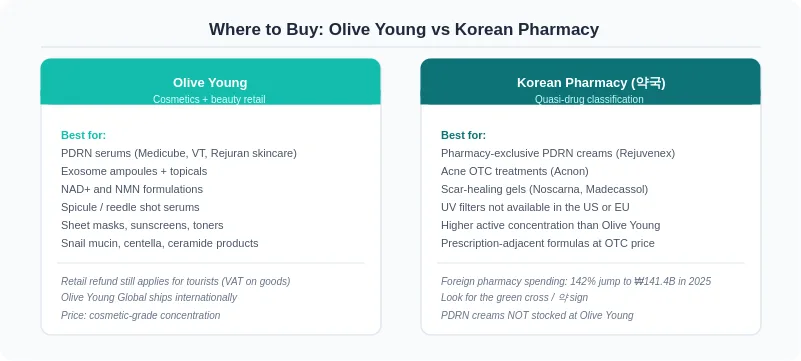
Olive Young stocks cosmetic-grade products — beautifully formulated, ingredient-led, and legitimately effective at what they do. The PDRN serums, exosome ampoules, and spicule reedle shots at Olive Young are real products with real ingredients.
The Korean pharmacy stocks a different category entirely. Under Korean law, quasi-drug classification applies to products containing active ingredients at concentrations above cosmetic thresholds. These products are pharmacy-exclusive — Olive Young does not stock them. The price gap is significant: a pharmacy PDRN regeneration cream runs 15,000 to 25,000 won where a clinic PDRN session starts at 100,000 won. Pharmacy-only acne treatments, scar-healing gels, and sunscreens with UV filter combinations not approved in the US or EU are available at the green-cross pharmacy sign.
The practical approach in Seoul: buy serums and spicule products at Olive Young, then walk to the nearest pharmacy for the PDRN cream, scar gel, and pharmacy-exclusive sunscreen. Budget around 80,000 to 120,000 won for a solid pharmacy haul. Save the Korean product names on your phone before entering: 리쥬비넥스 for Rejuvenex PDRN cream, 애크논 for Acnon acne cream, 노스카나 for Noscarna scar gel.
Which home device for which clinic goal
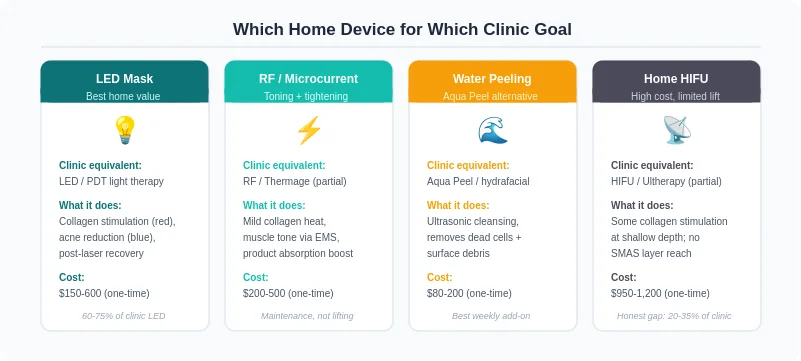
If collagen maintenance and post-treatment recovery are the goal, the LED mask is the highest-value device purchase. Look for 2026-model flexible silicone masks with near-infrared in addition to red and blue wavelengths, and a chip count above a thousand. LG Pra.L and Cellreturn are the established Korean premium brands; both offer dual-voltage for international use.
If pore cleansing and surface texture maintenance are the goal, a water peeling device handles a meaningful portion of what regular Aqua Peel clinic visits deliver. The Reclar water peeler is the consistent bestseller in this category. Weekly use keeps the baseline from reverting between clinic visits.
If tone, firmness, and serum penetration are the goal, the RF/microcurrent category delivers maintenance without the investment of home HIFU. The Medicube AGE-R Booster Pro remains the most recommended all-in-one Korean device for international buyers, combining electroporation for ingredient delivery with multiple modes. The dual-voltage design handles international travel without a converter.
Home HIFU is worth the investment only if you understand what it actually does. It is not a replacement for clinic HIFU. It is a complementary maintenance tool that extends the results of a clinic session. The Dualsonic Maximum at around $950 to $1,200 makes economic sense if you are committing to a long-term maintenance protocol between annual or biannual clinic sessions.
Building the stack
The most effective at-home approach treats home products and devices as a maintenance layer on top of clinic sessions, not an alternative to them. The stack Korean dermatologists recommend to patients who cannot visit frequently: daily SPF50+ and barrier care as the non-negotiable foundation; a PDRN or polynucleotide serum in the evening routine; a reedle shot two to three times per week for texture and absorption; LED mask three to four times per week for collagen maintenance and recovery; and a clinic session every three to six months to reset the structural foundation that home care cannot reach.
EXO NAD+ represents the direction Korean clinic products are heading for the home-use channel: combining plant-derived exosomes with PDRN, polynucleotides, and NAD+ in a single formulation designed to approximate the multi-ingredient clinic protocol in a topical. The honest caveat applies: surface delivery limits how deep these ingredients work. The biology is genuine; the clinical trial depth at topical application is still building. Use these as the most advanced layer of the home stack, with appropriate expectations.
For the full picture of what clinic treatments do that home care cannot replicate, see our Korea skin treatment cost guide and the Rejuran vs Exosomes vs Skin Boosters comparison. For which clinic treatments to prioritise when visiting Seoul, see the medical tourism first-timer guide.
Related: K-Beauty Treatments Going Viral in 2026 | "Slow Aging": The Korean Philosophy Replacing Anti-Aging | Korean Scalp Care: What Tourists Are Adding to Their Trips