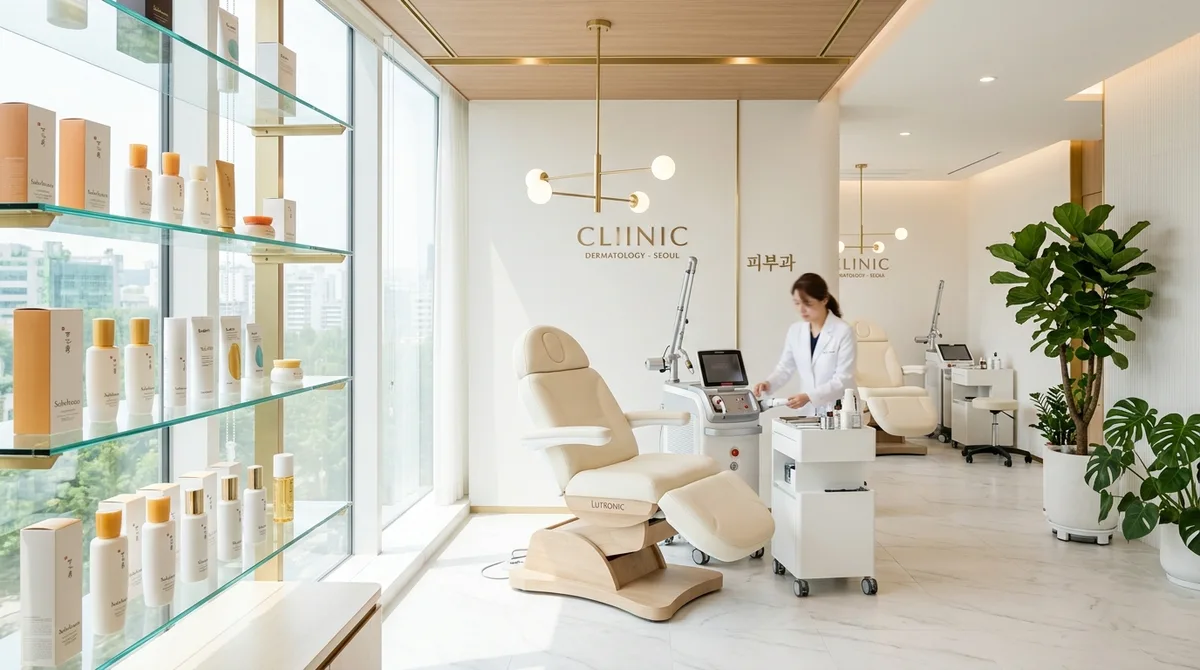
Three countries now dominate the conversation about medical beauty tourism, and they appeal to very different patients. Turkey took the price-leadership position years ago and holds it for hair, rhinoplasty, and bundled multi-procedure packages. Thailand built a reputation on JCI-accredited hospitals, comprehensive recovery packages, and body surgeries at prices well below Western equivalents. Korea carved out something different: a global reputation specifically for dermatology, skin technology, and facial precision that the other two countries cannot match on the same terms.
The right destination depends on what you are booking, where you are traveling from, and what matters more to you — lowest price, best technology, or recovery environment. This comparison gives you the honest version of each.
The three countries at a glance
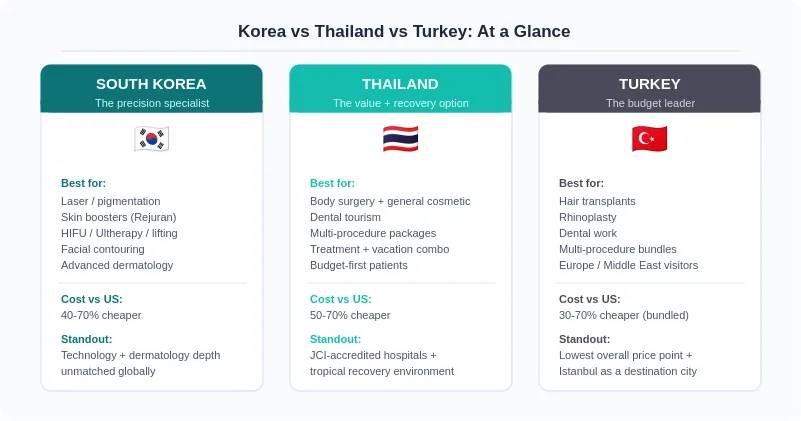
Korea is the specialist's choice for skin. Almost two-thirds of its medical tourists choose dermatology or skin treatments, drawn by technology that reaches Seoul before anywhere else, dermatologists who treat high volumes of diverse skin types, and a depth of procedural protocol that comes from operating in the world's most competitive aesthetic market. It is not the cheapest option on this list, but it costs forty to seventy percent less than equivalent care in the US or UK, and for skin and facial procedures specifically, no destination competes on quality.
Thailand draws patients who want lower prices on body procedures, a genuinely pleasant recovery environment, and the option to combine treatment with time in Bangkok or Phuket. Its hospitals include some of the most JCI-accredited institutions in Asia. For body surgery, dental tourism, and package deals that cover accommodation and transfers, Thailand consistently delivers strong value. Its dermatology offering has improved, but it does not match Korea's depth on skin technology or pigmentation expertise.
Turkey is the price leader for specific procedures. Hair transplants at $1,500 to $2,500, rhinoplasty at $1,500 to $4,500, and dental implants at $500 to $800 make it the obvious first call for patients traveling from Europe or the Middle East whose priority is the lowest total spend. Turkish clinics have invested heavily in international patient infrastructure, bundle accommodation and aftercare into packages, and benefit from Istanbul's position as a world city worth visiting regardless of medical purpose. The trade-off is that advanced dermatology technology — particularly the skin booster treatments and laser protocols that define Korean clinics — is less developed.
Price comparison
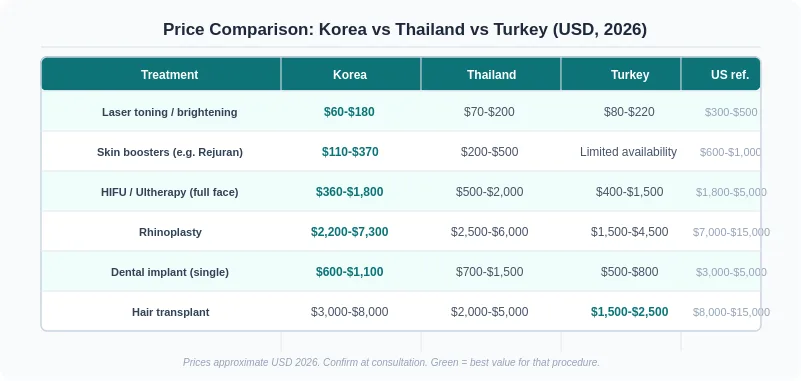
On raw price, Turkey wins for hair and rhinoplasty. Thailand wins for body surgery. Korea wins for skin-specific treatments when you factor in both price and outcome quality — particularly for laser, pigmentation, and skin booster protocols.
For Rejuran and other polynucleotide skin boosters, Korea is effectively the only real option. These products originated in Korea, are manufactured here, and are administered in far higher volumes than anywhere else. Clinics in Thailand offer some equivalents, but the protocol depth and product authenticity are not comparable. Turkish clinics offer limited access.
For HIFU and lifting devices, all three countries offer broadly similar price access, but Korea's clinics operate the highest device volumes — and for a procedure where energy delivery settings determine the outcome, that practitioner experience matters.
One cost factor that rarely appears in comparisons: flight distance. Turkey is two to four hours from most of Europe. Thailand and Korea are eight to fourteen hours from European markets. For a one-session non-invasive treatment, the flight cost can shift the economics significantly. For a multi-session or multi-procedure trip, it flattens out.
What Korea does that the others don't
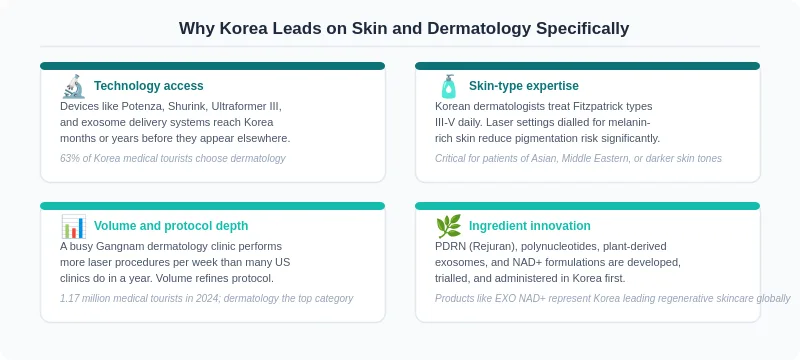
The gap between Korea and its competitors on dermatology is specific and meaningful. Four factors drive it.
Technology access. Devices reach Korean clinics ahead of anywhere else — Potenza radiofrequency microneedling, Shurink HIFU, Ultraformer III, and exosome delivery systems are standard clinic equipment in Gangnam and Myeongdong years before they appear as premium offerings elsewhere. If a treatment is being discussed as emerging in Western markets, Korean clinics are likely already running established protocols on it.
Skin-type expertise. Korean dermatologists treat Fitzpatrick skin types III through V at scale every day. Laser settings for melanin-rich skin, where the margin between effective treatment and post-inflammatory hyperpigmentation is narrow, are dialled with a precision that comes from volume and consequence. Patients with East Asian, Middle Eastern, South Asian, or mixed skin tones get meaningfully better outcomes from practitioners who have run these protocols thousands of times rather than hundreds.
Ingredient innovation. Rejuran (PDRN polynucleotide), Juvelook, plant-derived exosomes, and NAD+ formulations for skin are developed, clinically used, and refined in Korea first. Products like EXO NAD+, combining plant exosomes with PDRN and polynucleotides, represent the current frontier of regenerative skin treatment — administered in Korean clinics as established offerings rather than experimental add-ons.
Protocol depth from volume. A well-run Gangnam dermatology clinic handles more laser sessions per week than many Western clinics do in a year. That volume builds practitioner expertise, refines treatment protocols, and produces the kind of outcome consistency that high-volume practice delivers over low-volume practice.
What Thailand does better
Thailand's strongest case is body surgery at lower cost combined with recovery comfort. Breast augmentation starting around $3,300 to $4,000 versus Korea's $6,500-plus starting point is a meaningful gap for patients where the procedure, not the destination, is the priority. Tummy tucks, liposuction, and general reconstructive work are available at comparable quality standards through JCI-accredited Bangkok hospitals at prices well below Seoul's.
The recovery environment is a genuine differentiator for longer procedures. Recovering from a two-week surgery in Bangkok or Phuket — with access to good food, warm weather, and accommodation designed for post-operative patients — is a different experience from recovering in Seoul in February. For patients who need genuine downtime, Thailand's package-based model removes planning friction that can be stressful when you are recovering.
Thailand's dental tourism ecosystem is also strong, with pricing and quality that rival Korea's for implants and restorative work. For patients combining dental and cosmetic procedures in a single trip, Thailand's package infrastructure handles this more smoothly than Seoul's largely independent clinic model.
What Turkey does better
Turkey owns the hair transplant market. The combination of FUE and DHI techniques at $1,500 to $2,500 per procedure, clinic infrastructure built entirely around international patients, and Istanbul's accessibility from Europe and the Middle East has made it the global default for this procedure. Patient forums consistently report strong outcomes at Turkish specialist clinics.
For rhinoplasty on a budget, Turkey competes effectively. The $1,500 to $4,500 range covers standard to complex cases, and several Turkish surgeons have developed internationally recognised technique innovations, particularly for revision work. The caveat that applies everywhere applies here: surgeon credentials and clinic accreditation must be verified before booking.
For European patients specifically, Turkey's logistics work in its favour. An Istanbul trip for a treatment session has a different friction level than flying to Seoul. For non-invasive procedures where destination proximity matters, that geographic advantage is real.
Who should go where
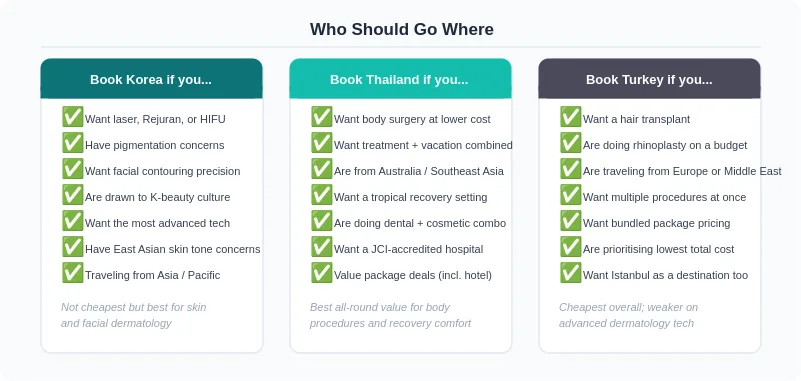
Go to Korea if your primary interest is skin — laser, pigmentation, skin boosters, HIFU, or any treatment where dermatology technology and practitioner expertise on diverse skin types matters. Also go to Korea for facial contouring precision, scalp care, or anything driven by K-beauty culture. Accept that it is not the cheapest option. The forty to seventy percent saving over US prices still represents strong value.
Go to Thailand if you are having body surgery and recovery comfort matters alongside price. Thailand also makes strong sense for patients combining dental and cosmetic work, for those traveling from Australia or Southeast Asia, and for anyone who wants a package deal that handles accommodation and coordination.
Go to Turkey if hair transplant or rhinoplasty are your procedures, if you are traveling from Europe or the Middle East, or if the lowest total cost is the primary filter. Turkey is also the obvious first call for multi-procedure bundles where volume discounting makes a meaningful difference.
None of these choices excludes the others. Patients who book Korea for skin treatments and are considering rhinoplasty sometimes do the two trips sequentially rather than combining.
The one thing to verify regardless of destination
Clinic accreditation and surgeon credentials matter more than the destination. A JCI-accredited hospital in Bangkok offers stronger safety guarantees than an unverified clinic in Seoul, and vice versa. The Ministry of Health and Welfare registry in Korea, the Medical Council of Thailand, and Turkey's Ministry of Health all maintain public records of licensed practitioners. Check before booking, get treatment plans in writing, and confirm that the doctor you consult with is the one performing the procedure.
For Korea-specific clinic verification, the medicalkorea.or.kr portal is the official government resource. For a full guide to planning a Korea medical trip from scratch, see our medical tourism first-timer guide.
Related: Medical Tourism in Korea: The Complete First-Timer's Guide | Best Time to Visit Korea for Skin Treatments | How Much Do Skin Treatments Cost in Korea? 2026 Price Guide