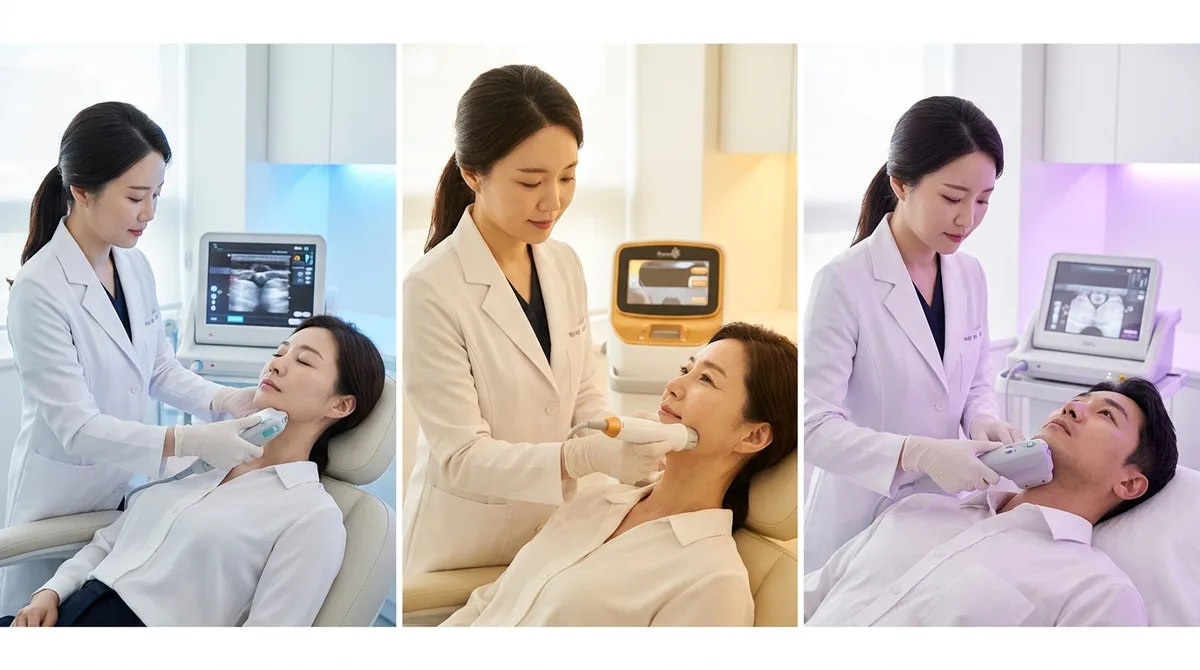
Walk into a Seoul clinic asking about non-surgical lifting and three names come up almost immediately: Ultherapy, Thermage, and HIFU. They get pitched side by side, bundled into packages, and described in nearly identical language, firming, lifting, tightening, no surgery, no downtime, which makes them maddeningly hard to tell apart. Yet they are not the same treatment, and choosing the wrong one for your concern is the easiest way to be disappointed.
The good news is that the difference comes down to one simple distinction, and once you understand it the whole menu makes sense. Here is what each one actually does, which suits which concern, and why a clinic might recommend more than one.
The one distinction that explains everything
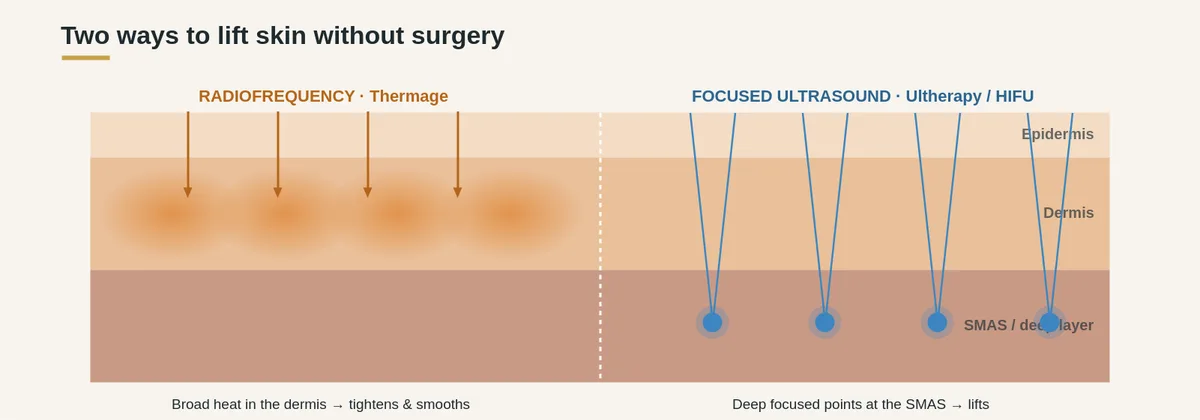
Every one of these treatments works by heating the deeper layers of skin to trigger new collagen, but they split into two camps by the type of energy and the depth it reaches. Ultrasound treatments, which include Ultherapy and HIFU, deliver focused energy to precise points deep down, reaching the SMAS, the supportive layer surgeons tighten in a facelift. That depth is what produces genuine lifting. Radiofrequency, which is Thermage, spreads heat more broadly through the dermis closer to the surface, which is what tightens and smooths skin quality rather than lifting structure.
So the mental model is simple: ultrasound goes deep and lifts; radiofrequency works broader and tightens. Almost everything else is detail. Hold onto that and the three treatments stop blurring together.
Ultherapy: the premium lift
Ultherapy is a specific, branded micro-focused ultrasound device, and its defining feature is imaging. It uses real-time ultrasound visualisation, so the practitioner can actually see the layers of your skin and target the SMAS precisely rather than working blind. It is the only such device FDA-cleared to lift the brow, chin, and neck, and it has the deepest research base of the three. The result, for the right candidate, is the closest a machine gets to a mild, non-surgical facelift effect, real lifting of a sagging brow, jowls, and jawline.
The trade-offs are price and comfort. Ultherapy is typically the most expensive of the three and the most intense to sit through, so clinics apply numbing cream and sometimes offer pain relief. Most people need only one session, with results building over two to three months and lasting around a year to eighteen months.
HIFU: the value lift
HIFU, short for high-intensity focused ultrasound, is the broader category that Ultherapy technically belongs to, but in everyday clinic language it usually refers to the other ultrasound devices, especially the excellent Korean-made machines like Shurink and Ultraformer. These deliver the same kind of deep, focused ultrasound lifting, often across multiple cartridge depths, at a noticeably lower price, which is exactly why they are so popular in Seoul.
The practical differences from Ultherapy are that many HIFU devices do not include real-time imaging, so the practitioner works to anatomical landmarks rather than a live picture, and results may not last quite as long. For most people with mild to moderate laxity who want effective lifting and good value, a quality HIFU treatment by a skilled hand is a smart, comfortable choice, and many Gangnam dermatologists genuinely prefer devices like Shurink for their precision and patient comfort.
Thermage: the tightener
Thermage is the odd one out, because it is not ultrasound at all, it is monopolar radiofrequency. Instead of focusing energy on deep points, it heats the dermis broadly to contract existing collagen and stimulate new growth, producing an all-over tightening and smoothing rather than a lift. Think of it as shrink-wrapping and refining the skin's surface quality. That makes it the best of the three for crepey or loose-textured skin, enlarged pores, fine lines, and general firmness, particularly across the cheeks and forehead.
The current generation, Thermage FLX, has added cooling and vibration for comfort, so it is generally well tolerated. Like the others it usually needs just one session, and its results tend to last the longest, often well over a year. What it will not do is lift a genuinely sagging jawline, that is ultrasound's job.
Side by side
| Ultherapy | HIFU (Shurink etc.) | Thermage FLX | |
|---|---|---|---|
| Technology | Micro-focused ultrasound + imaging | Focused ultrasound (often no imaging) | Monopolar radiofrequency |
| Mainly does | Lifts the deep SMAS layer | Lifts; multiple depths | Tightens & smooths the dermis |
| Best for | Sagging brow, jowls, neck | Lifting on a budget | Crepey texture, pores, firmness |
| Comfort | More intense; numbing used | Generally comfortable | Comfortable (FLX cooling) |
| Sessions | Usually one | One; series for maintenance | Usually one |
| Results last | ~12–18 months | ~6–12 months | ~12–24 months |
So which is right for you?
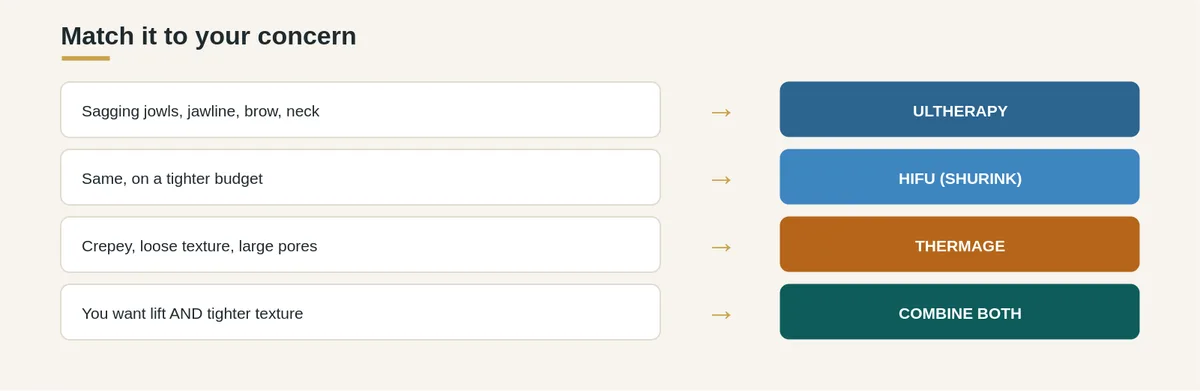
Start from your main concern rather than the brand name. If your issue is sagging, a drooping brow, jowls, a softening jawline, or a loose neck, you want an ultrasound lift: Ultherapy for the premium, imaging-guided version, or HIFU like Shurink for the same lifting effect at a friendlier price. If your concern is skin quality rather than sag, crepey texture, enlarged pores, fine lines, or a general loss of firmness without much drooping, Thermage is the better fit. And if you genuinely have both, real laxity and tired skin texture, the honest answer is that one device will not optimally do both jobs.
Age and elasticity matter too. These treatments suit mild to moderate laxity, broadly the thirties through fifties, and they work best while the skin still has some elasticity to respond. For severe sagging, no energy device matches what surgery achieves, and a good clinic will tell you so rather than sell you three sessions that cannot deliver.
Why clinics often combine them
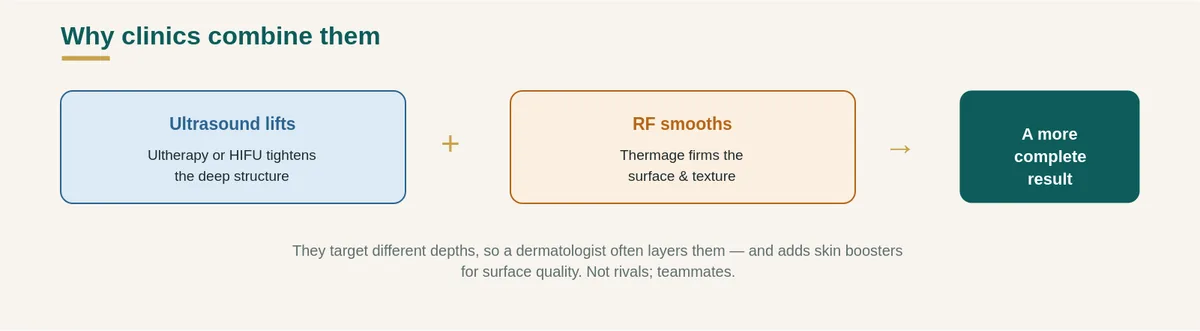
Because ultrasound and radiofrequency do different jobs at different depths, the most effective plan for many people is not one or the other but both. A very common Gangnam combination is an ultrasound lift, Ultherapy or HIFU, to tighten the deep structure, paired with Thermage to firm and smooth the surface, sometimes in the same visit. Clinics frequently discount these combination packages. Many also layer in skin boosters like Rejuran or exosomes afterward, since energy devices tighten structure while boosters improve the surface quality and glow, a different layer of the same goal. This is also why you should be sceptical of any clinic insisting a single device is the answer to everything.
Costs and what to expect in Korea
Korea is one of the most affordable places in the world for all three. As a rough guide, a full-face HIFU runs around three hundred to fifteen hundred US dollars, Ultherapy roughly six hundred to eighteen hundred, and Thermage FLX from about two thousand upward depending on the shot count, all well below US and UK pricing. Shot count is the figure that really matters: a suspiciously cheap session is often a low-shot one that underdelivers. For the full breakdown of how these compare internationally, see our Korea skin-treatment cost guide. Downtime across all three is minimal, with some redness or mild swelling, and results build gradually over weeks rather than appearing overnight.
Choosing safely
Two checks protect your result. First, insist on a genuine device: authentic Ultherapy machines carry a Merz certificate of authenticity and an orange genuine-machine sticker, and you can ask to see the live ultrasound image on screen, which confirms it is the real, imaging-guided system. Second, ask the shot count and make sure a board-certified doctor, not a sales consultant, plans and performs the treatment. Because shot count drives both price and effectiveness, comparing clinics only on headline price is misleading; compare on shots and on who is holding the handpiece.
The takeaway
Ultherapy, Thermage, and HIFU are not interchangeable, they are tools for different jobs. Ultrasound treatments, Ultherapy and HIFU, go deep and lift, with Ultherapy the premium imaging-guided option and HIFU the great-value one. Thermage uses radiofrequency to tighten and refine the surface rather than lift it. Match the technology to whether your concern is sagging or texture, expect natural, gradual results rather than a surgical change, combine them when you have both concerns, and verify the device and the doctor before the price. Do that, and Seoul offers world-class lifting at a fraction of what it costs almost anywhere else.