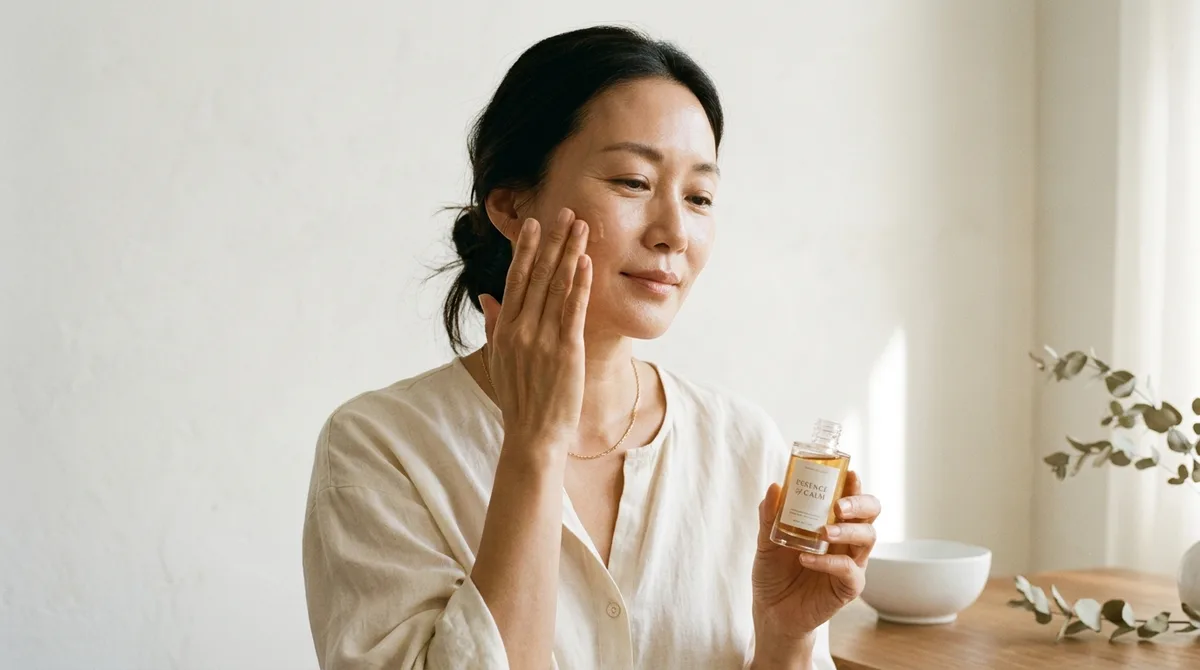
Olive Young, South Korea's largest beauty retailer, named slow aging its top trend for 2026. That is not a marketing call made lightly. Olive Young tracks purchase data across millions of Korean consumers, and the shift it is describing is real: a broad move away from aggressive wrinkle-correction and toward long-term skin maintenance, prevention, and what Korean dermatologists call skin longevity.
The term sounds gentle. The philosophy behind it is rigorous. Slow aging is not passive acceptance of getting older. It is the recognition that skin damage is cumulative, that the majority of visible facial aging is preventable, and that the time to act on that is not when wrinkles appear but years before. Korean women in their twenties are buying collagen-support serums. Korean dermatologists are running HIFU maintenance sessions on patients who do not yet need them, precisely so they never will. That is slow aging in practice.
What slow aging actually means
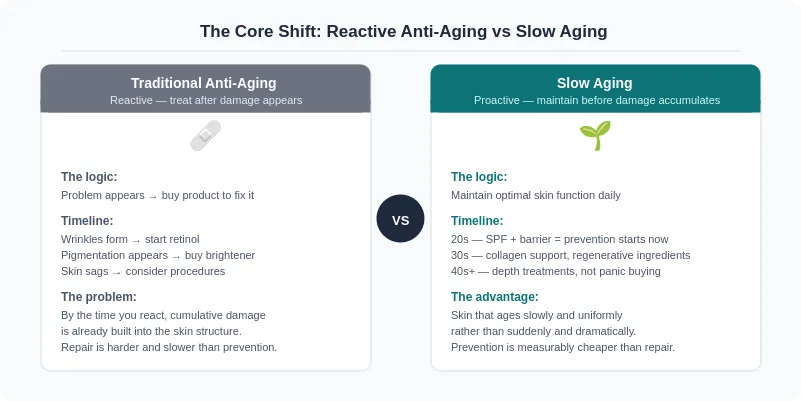
Traditional anti-aging is reactive. A wrinkle forms, you reach for retinol. Pigmentation appears, you buy a brightening serum. Skin starts to sag, you consider procedures. By the time you react, the underlying damage is already built into the skin's structure. Collagen that took decades to degrade does not rebuild quickly. Melanin that has settled into the dermis layer does not shift with a few weeks of product use.
Slow aging runs the other direction. The question is not how to fix visible damage but how to slow the rate at which damage accumulates in the first place. Barrier integrity maintained daily reduces the trans-epidermal water loss that makes skin look dull and lines look deeper. Sunscreen worn consistently from your twenties prevents the UV-driven degradation that accounts for the majority of visible facial aging by the time you reach your fifties. Collagen-stimulating treatments done preventively preserve structure rather than attempting to restore structure that is already gone.
The cultural shift here is worth naming. Korean beauty brands, led by Sulwhasoo and followed by most of the major players, have moved their marketing squarely at consumers in their twenties and thirties, not at the fifty-plus demographic that anti-aging products traditionally targeted. Slow aging works over decades. Starting at forty-five is better than not starting at all. Starting at twenty-five is measurably better than starting at forty-five.
The five pillars
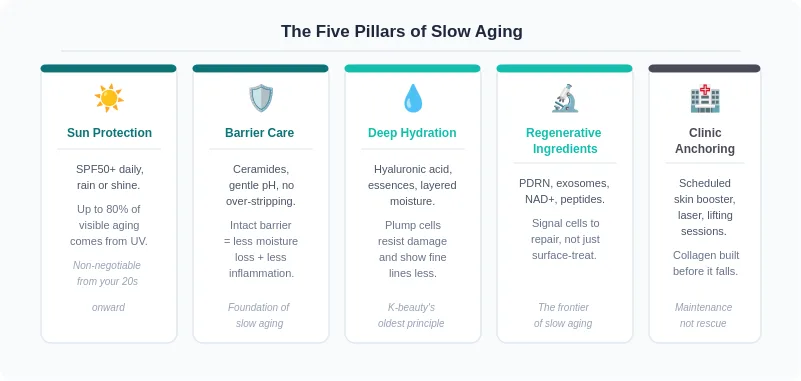
Sun protection is the non-negotiable first pillar and the most impactful single action in slow aging. Studies consistently estimate that UV exposure causes between seventy and eighty percent of visible facial aging — wrinkles, pigmentation, laxity, and uneven texture. Korean dermatologists prescribe SPF50+ daily regardless of weather, season, or whether the patient plans to be outdoors. UVA penetrates cloud cover, penetrates window glass, and penetrates the haze of a yellow dust day. Wearing sunscreen only when the sky is clear catches less than half the relevant exposure.
Barrier care is the second pillar and the structural foundation of slow aging. An intact skin barrier keeps moisture in, irritants out, and maintains the microbiome balance that healthy skin depends on. Korean skincare philosophy has emphasised barrier function for longer than Western skincare, and the slow aging framework makes this explicit. Products with harsh surfactants, high-concentration acids used too frequently, or physical scrubs used too aggressively all compromise barrier function over time. The slow aging approach replaces stripping with supporting: ceramides, low-pH cleansers, and moisturisers that reinforce rather than disrupt the barrier layer.
Hydration is the third pillar, and the oldest principle in K-beauty. Plump, well-hydrated skin cells show fine lines less, resist environmental damage better, and recover from stress faster than dehydrated ones. The layered hydration approach — essence, serum, moisturiser, each adding a different molecular weight of water-binding ingredient — is distinctly Korean and effective at maintaining the skin's water content across seasons and skin types.
Regenerative ingredients are the fourth pillar and the one that defines 2026's version of slow aging. PDRN, polynucleotides, exosomes, NAD+ formulations, and advanced peptides are classed as regenerative because they work at the cellular signalling level rather than the surface level. They tell skin cells to repair, rebuild, and function more youthfully rather than simply layering moisture or pigment correction on top. This category has moved from clinic-only to home routine in the last two years, driven by brands like Medicube and VT making PDRN and reedle-shot delivery accessible at Olive Young price points.
Clinic anchoring is the fifth pillar. Slow aging at home gets you most of the way. Clinic treatments extend and deepen what home care cannot reach. The slow aging approach to clinic visits is preventive scheduling rather than emergency booking: HIFU or Ultherapy sessions before laxity develops; Rejuran or Juvelook skin booster sessions on a maintenance schedule; laser toning to manage pigmentation before it deepens; exosome therapy to deliver regenerative signals deeper than topical products can reach.
Slow aging by decade
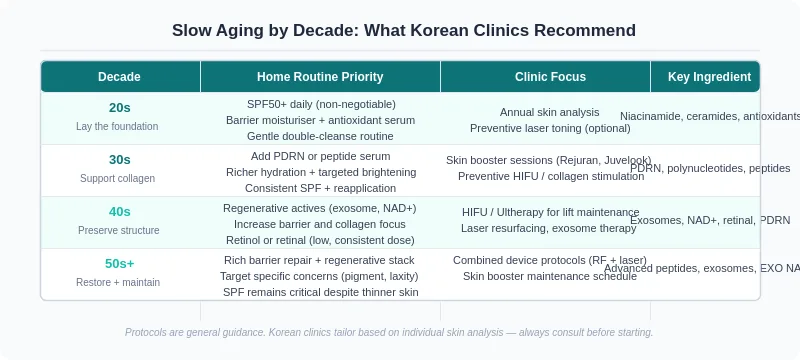
In your twenties, slow aging means two things: SPF every day without exception, and a barrier moisturiser that keeps your skin functioning well. Adding an antioxidant serum — niacinamide, vitamin C, or a centella-based formula — gives you protection from oxidative stress that accumulates from pollution and lifestyle. Clinic involvement at this stage is optional; an annual skin analysis is useful for knowing your baseline.
In your thirties, the approach adds a PDRN or peptide serum to support collagen that is beginning its natural decline from the mid-twenties onward. This is the decade where Korean dermatologists recommend the first skin booster sessions — Rejuran or Juvelook — on a maintenance schedule of two to three times per year. The goal is not to correct anything visible yet but to keep the dermis structurally dense so less correction is needed later. Preventive HIFU is worth considering by the mid-thirties for the same reason.
In your forties, the regenerative ingredient stack becomes more important. Exosome therapy, NAD+ formulations, and clinical PDRN sessions add depth that surface products cannot provide. HIFU or Ultherapy as a lifting maintenance tool keeps collagen stimulation active. Patients who have been following the slow aging framework from their twenties typically need lighter interventions in their forties than patients who are starting here.
From the fifties onward, the framework shifts slightly toward restoration alongside maintenance. Combined device protocols, more frequent skin booster sessions, and targeted treatments for specific concerns — pigmentation, laxity, texture — become more central. But the foundation does not change: daily SPF, barrier care, regenerative ingredients, consistent hydration. Skin that has been maintained well responds better to treatment at every age.
The ingredients that make it work
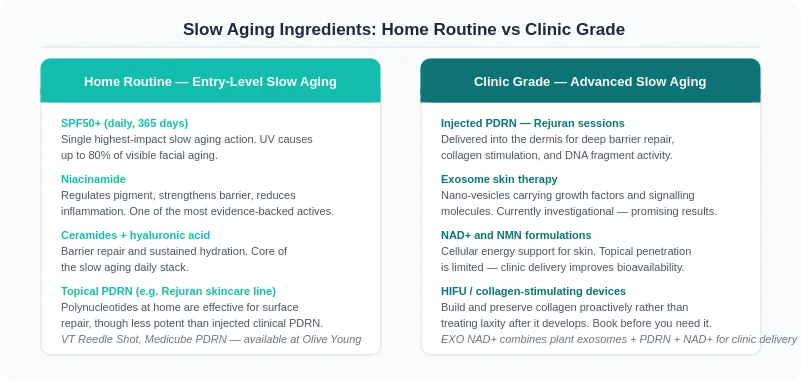
At home, the slow aging ingredient stack starts with niacinamide — one of the most evidence-backed actives in skincare, with documented effects on pigmentation, barrier function, and inflammation. Ceramides and hyaluronic acid at multiple molecular weights form the hydration and barrier foundation. Topical PDRN, now widely available through the Rejuran skincare line, VT Reedle Shot, and Medicube's PDRN range, brings polynucleotide activity to daily use at Olive Young price points — effective at the surface level, though not equivalent to injected clinical PDRN.
At the clinic level, injected PDRN through Rejuran sessions delivers polynucleotides directly into the dermis where they stimulate fibroblast activity, support the skin's DNA repair processes, and rebuild the structural layer that surface products cannot reach. Exosome skin therapy, delivered via microneedling or injection, introduces nano-vesicles carrying growth factors and cell-signalling molecules that promote repair and reduce inflammation at the follicular and dermal level. This category is investigational by international standards — results in published case series are promising — and Korean clinics are currently running the highest volumes of exosome treatment globally.
NAD+ and NMN formulations represent the current frontier. NAD+ is a coenzyme central to cellular energy production and DNA repair. Its concentration in skin cells declines with age, and restoring it is theoretically one of the most upstream slow aging interventions available. Topical delivery is limited by the molecule's size and stability. Products like EXO NAD+, which combine plant-derived exosomes with PDRN and polynucleotides, are designed to address this by pairing NAD+ with delivery mechanisms that improve skin penetration. Large-scale human trials are still limited; the biology is sound and Korean clinic adoption is real, but outcomes should be understood as promising rather than definitively proven.
The common thread through all of these ingredients is the direction of action. They do not mask aging. They signal the skin to maintain and repair itself. That is slow aging at the biological level: working with the skin's own mechanisms rather than overlaying correction on top of damage.
How Korean clinics apply slow aging
The clinic expression of slow aging is a scheduled maintenance model rather than a crisis-response model. Patients come in for Rejuran sessions twice or three times a year from their thirties. They book HIFU annually, or every eighteen months, as a collagen preservation measure. They run quarterly laser toning sessions to manage pigmentation before it deepens. Each visit is a routine maintenance check rather than an intervention for a visible problem.
For medical tourists visiting Seoul, this creates a useful framing. A single treatment trip is not a slow aging programme — it is the beginning of one, or a single maintenance session within one. The most direct value a tourist can extract from a Seoul clinic visit is a thorough skin analysis, an understanding of their current baseline, a first session of Rejuran or exosome therapy, and a protocol to continue at home with a recommendation for what to book on the next visit. Slow aging is designed for exactly that kind of consistent, structured relationship with your skin.
For more on which treatments make sense at which stage of this framework, see our Ultherapy vs Thermage vs HIFU guide for lifting and collagen stimulation, and our Rejuran vs Exosomes vs Skin Boosters guide for the injectable side of the stack.
The takeaway
Slow aging is not a trend in the sense of being temporary. It is the logical end point of what Korean skincare has always believed: that skin health built over time outperforms correction applied after damage. The specific ingredients and clinic technologies change as the science develops. The underlying principle does not: start early, stay consistent, work with your skin rather than against it.
Olive Young naming it the top beauty trend of 2026 is the retail confirmation of something Korean dermatologists have been practising for years. If you are in Seoul and asking a clinic what to do with your skin, the honest answer will almost certainly be some version of slow aging. SPF without exception. Barrier care daily. A skin booster schedule that starts before you think you need it. And patience, because the best results in skin show up a decade from now.
Related: Rejuran vs Exosomes vs Skin Boosters | NAD+ in Skincare: The 2026 Anti-Aging Ingredient Explained | Best Time to Visit Korea for Skin Treatments